This week, we remember the one and only Dolly Parton. Dolly used her musical success to help others. She started the Imagination Library, a free book program for children that included some of her favorites, like the "Little Engine that Could." And, Dolly’s kindness touched people from all walks of life.
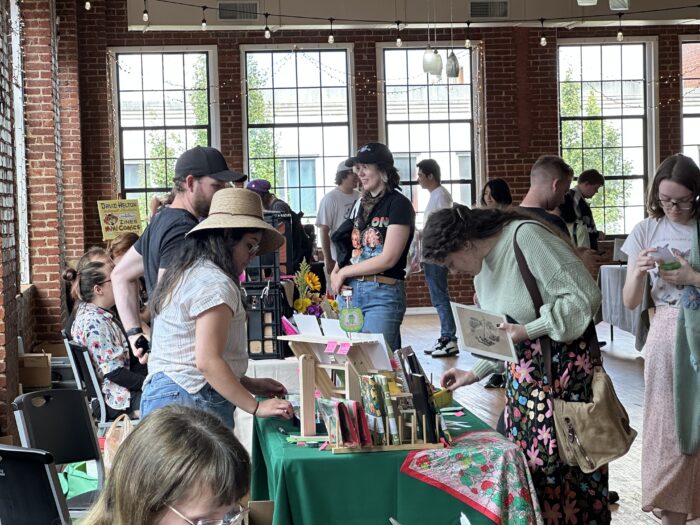
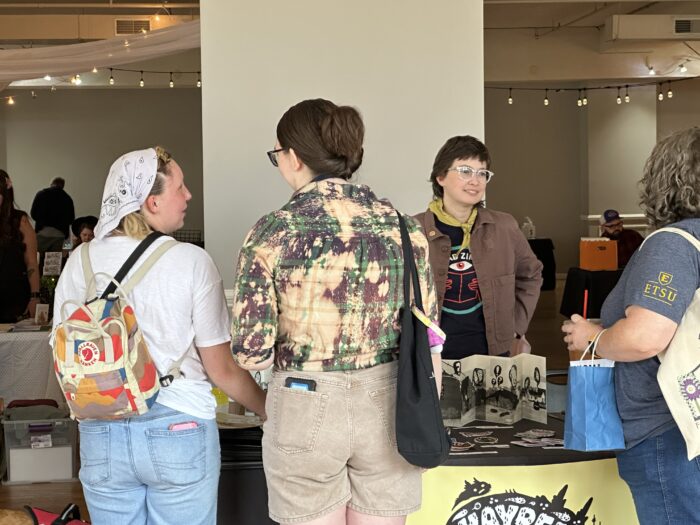
Attendees browse at the Johnson City Zine Fest.Courtesy of Suzie Kelly
Listen
Share this Article
This story originally aired in the Nov. 26, 2023 episode of Inside Appalachia.
The Johnson City Zine Fest has become a gathering point for southern Appalachia’s arts community.
If you’ve been involved in the punk or art scenes, you might be familiar with zines. A zine, as in magazine, is a self-published pamphlet or brochure, or even a booklet. Some are very low-tech and rudimentary, and others are elaborately designed works of art. They’re all unique, and reflect the people who make them.
But in 2022, the Johnson City Zine Fest returned. In its second year back since the pandemic, the 2023 Johnson City Zine Fest brought together people from Asheville, North Carolina; Lexington, Kentucky; Abingdon, Virginia; Chattanooga, Knoxville and Johnson City, Tennessee; and beyond.
Adams attended the 2023 fest to talk with makers and learn more about zinemaking.
Adams: How’d you get into making zines?
David Wischer: Oh man, I made my first zines in high school in the ’90s. So I think my friend Craig heard about zines somewhere — I’m not sure how — so we just started making them with collage and writing in his dad’s office. We made Xerox copies and passed them around.
Cait Maltbie: I started making zines in undergrad. I like them because they’re more accessible. So you can make them. They’re very easy, usually a sheet of paper and not a lot of supplies.
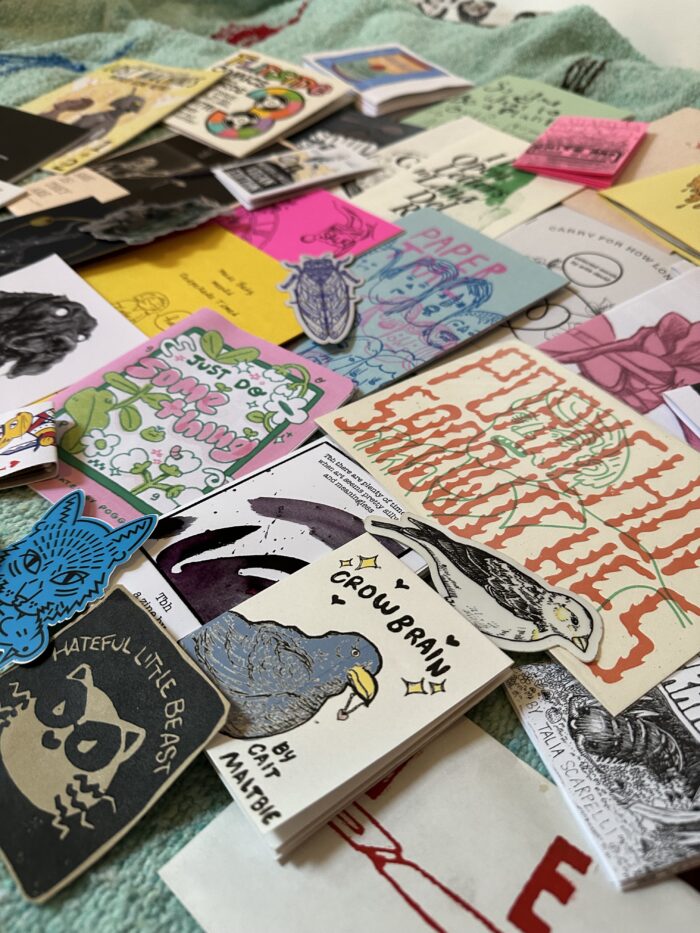
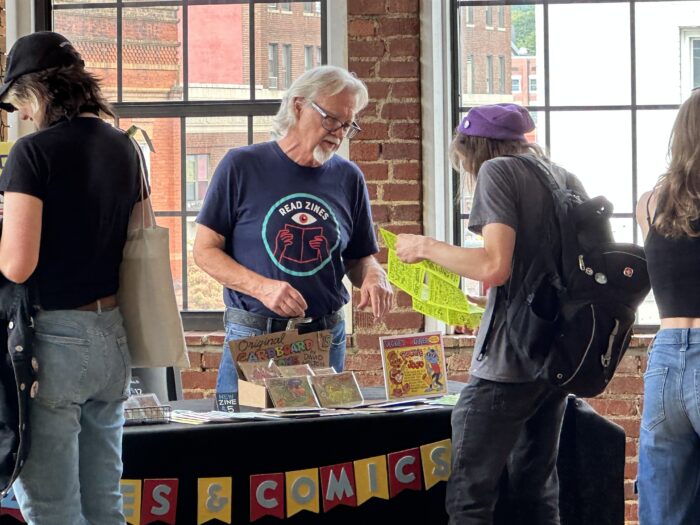
A selection of Cait Malbie’s zines at the Johnson City Zine Fest.
Credit: Suzie Kelly
Patrick Thomas: Honestly, my whole life, I’ve loved comic books and horror movies and drawing monsters and stuff. So in my adult life, it just made sense to keep on doing that stuff, but to actually share it with people, instead of just having little notebooks folded up for myself, you know.
Elizabeth Kidder: I got into zines through collecting. Whenever I go to a convention or an event, if I see a little booklet I like, I have to get that for the collection. I’ve never actually made any zines until this month, when I reached out to Johnson City. And they said, “Oh, you’re interested in coming as a vendor?” I’m like, uh, uh. I panicked and said, “Sure.” And then I had a month to make some zines. And now I don’t just collect them, now I make them.
Richard Graves: I’m an Appalachian artist and a local artist here. And it seems like zines and the DIY self-publishing very much has, like, a grassroots feel to it. And I see that it’s very Appalachian. And something that I wanted to try my hand at.
Adams: So would you pick one and tell me about it?
Kidder: Yeah. So this zine is called Unknown Cryptids. It is a collection of ten different cryptids that you do not know, because I made them up. After coming up with that idea. I went through and I just said, if I wanted to see something walking through the woods, what would it be? So each page is kind of set up like a nature doc, where you have the name, a descriptor, a picture, when it’s active and the size ratio in comparison to a human being, so you can tell how much you should run if this thing comes after you.
Johnson City Zine Fest co-organizer Sage Perrott chats with attendees.
Credit: Suzie Kelly
Claire Thompson: Jayne Mansfield’s Head is my favorite zine I’ve ever made. She’s on the cover with her head severed. It’s about the sort of urban legend, pop culture myth that Jayne Mansfield who did die in a car accident, but it’s about the myth that she was completely decapitated.
Amanda Simons: It’s called Is This a Couch and Will I Ever Be Comfortable Again? So the zine’s about these Instagram advertisements and, over time, me trying to figure out what actually is a couch. Because I was getting advertised things like beanbags and dog beds and, like, floor pillows and all these things, because that’s what I was also searching. But I thought I was looking for a couch. But the internet thought it differently.
Maltbie: I have a variety of zines right now. The ones I have out, I have some about my childhood toys. I have some about my job, in which I had to do a lot of phone calls, cold calling. And then I have some about, like, loving trinkets. So a variety of things.
Brett Marcus Cook: I decided to make a zine about bodily autonomy, body liberation, body neutrality. Just Western society is so filled with weird ideas that are contradictory about the body. Like there are things that we need to be ashamed of about our functions or certain parts and things.
Carrie Kindle: It’s the soup season zine and it has 15 different soup recipes in it. So it’s kind of like a recipe anthology. A lot of these are my parents’ recipes. So I grew up eating a lot of these soups.
A zinemaker at the Johnson City Zine Fest.
Credit: Suzie Kelly
Jaclyn Lewis: So I have one called Ayako and Xochitl, and it’s a glimpse into the world of female wrestling. And it sort of tells the story of these two female wrestlers who are sisters, and one match that was very epic, they had to wrestle each other and it was very emotional.
Artie David: It’s called Peach Baby. And it’s a couple of different poems. But the last poem, the titular poem, is called “Peach Baby,” and it’s about my experiences, like, struggling with my mental health and emotional, physical health. And kind of looking at that through the lens of some chickens that I rescued, who were named Peach and Baby.
Kindle: If you’ve never made a zine before, definitely try it. You can literally print it on a piece of copy paper, and make a zine!
------
This story is part of the Inside Appalachia Folkways Reporting Project, a partnership with West Virginia Public Broadcasting’s Inside Appalachia and the Folklife Program of the West Virginia Humanities Council.
The Folkways Reporting Project is made possible in part with support from Margaret A. Cargill Philanthropies to the West Virginia Public Broadcasting Foundation. Subscribe to the podcast to hear more stories of Appalachian folklife, arts and culture.
Add WVPB as a preferred source on Google to see more from our team
On this West Virginia Week, a second data center is coming to Mason County, the Rural Health Transformation Program Funds are beginning to be distributed in the state, and remembering Dolly Parton.
This week, we remember the one and only Dolly Parton. Dolly used her musical success to help others. She started the Imagination Library, a free book program for children that included some of her favorites, like the "Little Engine that Could." And, Dolly’s kindness touched people from all walks of life.
Taylor Hankins of the West Virginia Mine Wars Museum said the Battle of Blair Mountain remains an important story of solidarity that exemplifies the Appalachian spirit.