In the North Carolina foothills, a common dessert in the fall is a sonker. Folkways Reporter Amanda Goins first heard that name when she moved to Surry County, North Carolina. She got curious and shares what she learned about this local dessert whose history goes back centuries.
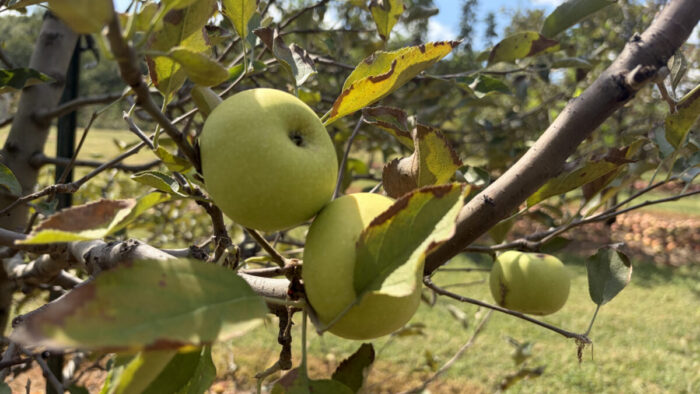
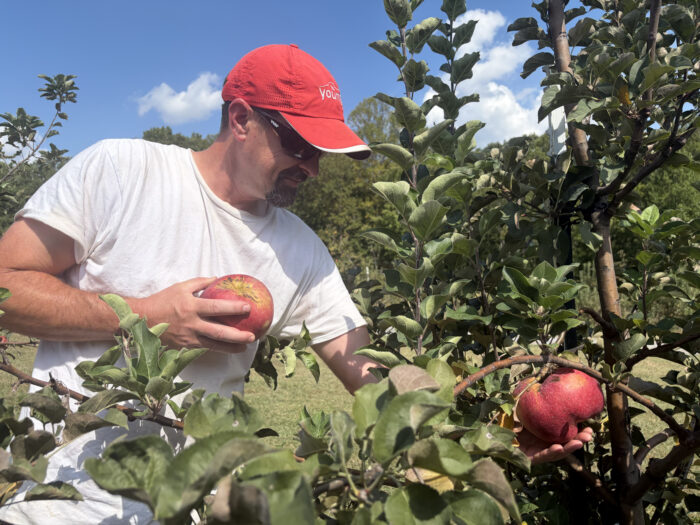
The Southern Heritage Orchard at Horne Creek Farm preserves more than 400 varieties of apples.Andrea "river" Peterson/West Virginia Public Broadcasting
Listen
Share this Article
This story originally aired in the Nov. 22, 2026, episode of Inside Appalachia.
Every apple is a choice – and a story.
Keeping an apple variety around takes work, determination and sometimes, luck, according to Jason Bowen, the horticulturist at Southern Heritage Orchard at Horne Creek Farm, a history museum run by the state government in Surry County, North Carolina.
The museum shows what life was like on a typical Appalachian farmstead in the early 1900s – and preserves hundreds of rare apple varieties.
“Probably one of my favorites would be Hunge, which is a North Carolina variety,” said Bowen.
He’s able to enjoy Hunge apples because of a lady named Gertrude Morris, who grew up eating them.
“Her daddy had a whole orchard of them,” he explained, but the fruit wasn’t widespread, and almost everyone forgot about them.
Everyone, but his daughter Gertrude, that is. And in 1986, Gertrude got lucky.
“She found one tree remaining that was about dead,” but she had seen her dad graft years before – so she took a cutting, and hoped for the best.
“So said she wrapped it with a dirty dish towel and the graft took. And if that graft wouldn’t have taken, we wouldn’t be eating Hunge apples today,” Bowen said.
Now, Gertrude Morris is part of the Hunge apple story. But she’s not alone, according to apple Historian and Virginia-based orchardist Diane Flynt.
“Every apple carries a story because every graft tree was chosen by a person,” said Flynt.
That means every named apple variety you eat today is here for a reason, even if it was first a happy accident.
Humans started cultivating apples thousands of years ago in what is now Kazakhstan. The fruit arrived in America with Spanish colonizers in the 1500s, then traveled inwards towards Appalachia – at first, organically.
“Feral hogs and, you know, deer and elk and bear eat and eat an apple and poop out the seeds,” explained Flynt. Then seedling apples followed the animals’ migratory paths, so seed grown apples spread quickly inwards towards Appalachia.
Those seed-grown apples were all different varieties, because apple trees generally need to be cross-pollinated to produce fruit. It’s sort of like you need a mom and a dad tree to create a baby apple, which then produces seeds, and if planted, one of those seeds could become a tree with its own unique apple variety.
“So you might have a seedling tree growing on your farm or in your backyard and you might notice that it had an especially tasty apple or one that ripened in June or one that ripened in late October and kept all winter,” explained Flynt. “You would want to replicate that tree,” she added.
But planting a seed from the tree wouldn’t get you the same apple.
Enter the art and science of grafting that helped Gertrude Morris save Hunge apples. It’s a workaround to the whole mom and dad tree thing.
Instead of planting apple seeds and hoping for the best, you can take part of a living tree and plant it into the ground hoping it will root or you can graft it to another tree.
Grafting works by forcing two separate living plants, typically a hearty root and a piece of the plant you’re trying to copy called a scion, to grow together at a wound until they fuse into one plant.
That fusion essentially creates a biological clone of the scion.
The resulting tree also carries on the legacy of the people who worked to keep it alive, including generations of Appalachians.
Native Americans in the South, especially the Cherokee people based in what is now North Carolina, became skilled apple orchardists. When the English colonized these lands, they planted orchards with apple varieties grafted in England.
This all fused together into a thriving Appalachian home orchard culture that lasted until grocery stores became a staple of modern life. Because of the decline in home orchards and rise of industrial farming, many apple varieties that once flourished here are now on the verge of extinction.
Horticulturist Jason Bowen helped graft apples at this orchard from trees collected by Lee and Edith Calhoun.
Photo Credit: Andrea “river” Peterson/West Virginia Public Broadcasting
The endangered apple varieties at Horne Creek are the legacy of one married couple, Lee and Edith Calhoun, and their love for apples.
Horne Creek site manager Lisa Tuttle said it all started when the pair retired to nearby Pittsboro, North Carolina. The Calhouns wanted a backyard orchard and got recommendations from a neighbor in his 80s.
“The man said, ‘You need Magnabonum, you need Winesap, you need Nickajack.’ And he started going down this list of apples that Lee had never heard of,” said Tuttle.
This was startling for Lee, because in college, he had studied agriculture and botany.
That’s when Lee Calhoun became obsessed with hunting down nearly gone varieties, according to Flynt.
“Lee, I think, really was the kind of the quintessential apple explorer,” she said.
Apple explorers, also known as apple hunters, are people who track down forgotten varieties of the fruit, usually by visiting abandoned orchards and talking with folks about local food lore.
The Calhouns would go on road trips hunting for new varieties, knocking on strangers’ doors when they saw an apple tree in the yard.
And when they found some fruit, the real fun started.
“When someone brought him an apple, he really investigated it. He wanted to know everything he could find about it,” explained Flynt. And then he would graft a copy at his own orchard.
Tuttle said the Calhouns also started advertising in local agricultural magazines and almanacs across the south, asking people to tell him about their local apples.
“People started sending him the stories of apples that had originated on their grandparents and great-grandparents family farms. Then they started sending him cuttings from their trees,” she said.
The Calhouns ended up with more than 400 varieties. Many were the only known trees left alive. With the research support of his wife, a retired librarian, Lee Calhoun catalogued more than 1,600 varieties once grown in the region in the book Old Southern Apples.
And when Horne Creek wanted to add an orchard, they turned to the Calhouns. With Bowen’s help, they grafted copies of their collection and planted them at Horne Creek – tree by tree.
At the orchard, Bowen and Tuttle now keep two trees growing for each apple variety.
“If we lose one, we’ll have a copy so that we can get it back and keep everything here at the farm,” Bowen explained.
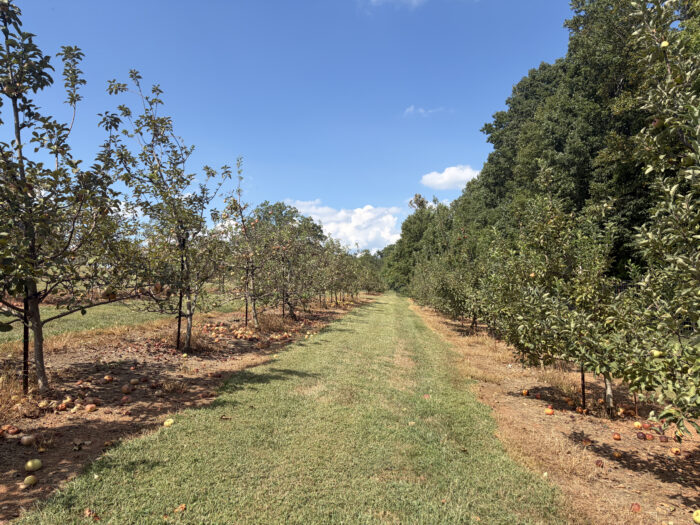
The Southern Heritage Orchard at Horne Creek Farm maintains two copies of trees to preserve rare apple genetics.
Photo Credit: Andrea “river” Peterson/West Virginia Public Broadcasting
And there are some varieties that Bowen does not want to lose. Take Limbertwigs, for example, a popular family of Appalachian heritage apples that includes dozens of sub-varieties.
Bowen said Black Limbertwigs are tart, spicy fruit and make great apple sauce. The orchard also carries Grimes Golden, a West Virginia apple related to a fruit you might recognize from the grocery store: one of the parents of Golden Delicious.
And they have trees of the ultimate supermarket apple: Red delicious, which Bowen said was originally called Hawkeye.
Hawkeye comes from Iowa.
“The guy had grew the tree it just chance seedling came up in his field and he cut it down the first time and then it came back and it got big enough to where it set a fruit and he’s like, ‘Man, that’s the best apple I’ve ever had,’” he explained.
That man entered his prize apple in a 1893 fruit competition where it was a winner. Stark Brothers – a popular mail order nursery still operating today – bought the rights.
Hawkeye was later renamed Red Delicious. The apple also was tough, so it shipped well, and came about at just the right time.
“The railroads coming through the south was another big advantage for the Red Delicious, so people quit having to grow apples at their house,” explained Bowen
With the rise of grocery stores, home orchards lost favor and apple varieties dwindled because commercial farming is all about growing what’s most profitable.
“The need to have bigger farms that grew one thing very profitably meant that [the] apples’ home turf shrunk to the places in the south where it wasn’t profitable to grow anything else, which was the mountain south,” said Flynt.
Here in the mountain south, apple hunters are still seeking to reclaim the fruit’s turf.
Although Lee and Edith are now gone, Flynt says there’s another generation that’s taking Lee’s scientific approach even further thanks to genetic testing – and have easier ways of researching old varieties than placing magazine ads.
The North American Fruit Explorers has more than 3,000 official members and many more people in their official Facebook group where folks share their discoveries.
And at Horne Creek, they share the Calhoun’s legacy – one tree at time.
“We’re trying to sell trees so that we get the apples out there because unless you’re getting them out there being planted, they’re still endangered, explained Bowen. “So, that’s the only way to save them – to plant more trees.
Twice per year, the orchard hosts a tree sale where it offers up as many saplings as Bowen can graft.
Add WVPB as a preferred source on Google to see more from our team
In the North Carolina foothills, a common dessert in the fall is a sonker. Folkways Reporter Amanda Goins first heard that name when she moved to Surry County, North Carolina. She got curious and shares what she learned about this local dessert whose history goes back centuries.
Former governor and U.S. senator Jay Rockefeller's funeral service was announced, the state auditor's legal troubles grew, and StoryCorps is asking you to record conversations during Thanksgiving.
This week, local fruit gets made into all kinds of desserts, but have you ever heard of a sonker? Also, there are thousands of apple varieties, and each one means something to somebody. And, a beloved West Virginia hotdog restaurant closed in 2018. An annual tribute sale gives people a chance to relive its glory days.
Young students at Floyd County, Virginia’s Handmade Music School are compiling a songbook of tunes that have become standards in their community. One of those songs came from influential Virginia bluegrass band The Lost & Found. This summer, Handmade Music School student Rylah Grim spoke with the band’s longtime banjo player Gene Parker, about a song he helped write, called “Brown Hill.”