This story originally aired in the Aug. 23, 2026, episode of Inside Appalachia.
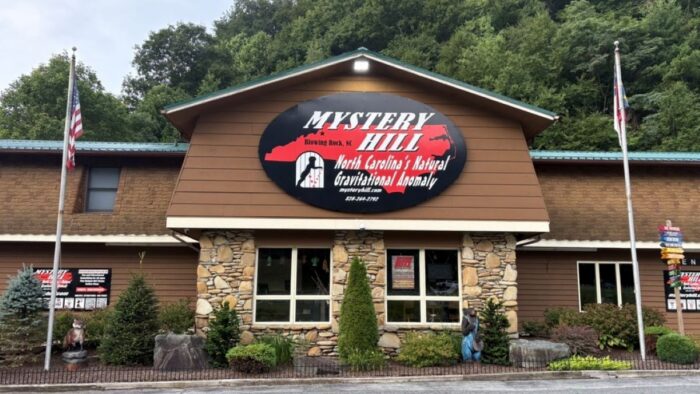
Mystery Hill is a sprawling tourism complex in Blowing Rock, North Carolina, with gem-mining, an old-timey photobooth, an arcade and a history museum inside the Dougherty House – a home built by the brothers who founded nearby Appalachian State University.
But it all started with a “mystery spot” or “gravity house” – style attraction opened back in 1948, according to operations and guest services manager Jim Justice.
Justice has worked at Mystery Hill for a decade and started out giving tours of the attraction.
The site where Mystery Hill is located used to be an apple orchard owned by a family called the Hudsons, he said. Like many Appalachians, they made moonshine with their crop.
“But there was one particular spot where they felt a little dizzy, a little off,” Justice said. ”And, it was just in that one area of the orchard … there was a tire swing that wouldn’t swing all the way forward. It would stop halfway and then go back.”
And it was on that orchard where Mystery Hill was developed.
“Mystery spot” or “gravity house” attractions use illusions to trick your brain into thinking gravity is broken. They often combine supernatural origin stories and window-less basements with fun-house elements like a ball that appears to roll uphill.
One of the earliest ventures to commercialize this type of anomaly in the United States is called the Oregon Vortex. The Santa Cruz Mystery Spot, now a California State Historical Landmark is another early example that opened in 1941. Justice says photos of that California attraction helped inspire Mystery Hill.
Mystery spots took off in Appalachia around the same time that Americans began being able to afford cars and fell in love with road trips, according to Willard Watson III, the programs and outreach director at the Blowing Rock Art & History Museum.
“As the agricultural economy here was starting to decline, you had the establishment of the interstate highways,” Watson said.
Recreational infrastructure, like the Blue Ridge Parkway and other New Deal developments also took off, according to Watson. Construction on the parkway began in the 1930s and the road is now traveled by millions of visitors each year.
The rise of Appalachian tourism came with tension over how the region is represented, including attractions that may play on stereotypes of the area, according to Watson. Plenty of locals tried to cash in on the traffic with authentic wares, too.
“There is a long history of entrepreneurs in the area, like people that are making value-added goods coming to Blowing Rock, coming to the parkway to get some of that tourist industry,” he said. “Locals often brought homemade goods like jams or honey and crafts like quilts or toys to sell along tourist routes.”
Today, many aspects of Mystery Hill may strike visitors as kitschy or charming, but some elements – particularly a display of Native American artifacts that’s been largely unchanged for decades – may even be considered problematic by visitors, according to Watson.
That collection is on display by an agreement with the heirs of the original collectors, Irene and Moon Mullins, who sought to preserve it after a highway development project displaced its previous home, Justice said.
“We tried to keep the collection as similar to their museum as possible,” he said.
The golden era of road trips is now in the rearview mirror thanks to cheaper air travel and the expansion of multi-lane highways that bypass the two-lane roads where many attractions once flourished.
Remaining mystery spots, including Mystery Hill and another, similar attraction called Mystery Hole, in Ansted, West Virginia, offer a glimpse into roadside culture of the past – letting younger visitors feel a sort of nostalgia for an era they didn’t experience firsthand.
Those that still thrive often have their own niches.
Justice says Mystery Hill leans into being part of “weird Appalachia”.
Watson agrees, saying that embracing the odd helped Mystery Hill grow into an anchor of the tourism industry in a place where subsistence farming used to rein.
Many Mystery Hill guests are now nostalgic legacy patrons, bringing in the next generation of visitors.
“We have grandparents coming in with their grandchildren and even parents that say, ‘I was here with my grandparents or my parents and now I’m bringing my children,’” Justice said.
--
This story is part of the Inside Appalachia Folkways Reporting Project, a partnership with West Virginia Public Broadcasting’s Inside Appalachia. Subscribe to the podcast to hear more stories of Appalachian folklife, arts and culture.