Alert (09/29/2026): Our Parkersburg TV transmitter is still undergoing maintenance and remains temporarily inoperative. We apologize for the inconvenience.
All our programming is available via our TV livestreams on our website and WVPB Passport. Thank you for your patience!
For LGBTQ youth in Appalachia, estrangement from their families of origin can be a common and heartbreaking experience. So, some LGBTQ people rely on “chosen family." In Roanoke, Virginia, the culture of ballroom offers the safety and stability of family, along with traditions that are handed down — traditions like vogueing. Mason Adams reported this Folkways story, in collaboration with Brad Kutner and Kelley Libby.
John Brown’s Abolitionist Raid On Harpers Ferry, 165 Years Later
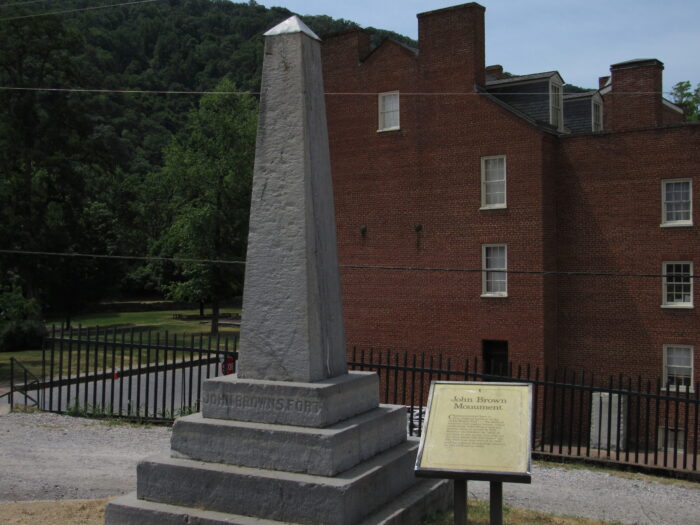
In Harpers Ferry, a stone monument commemorates the life of abolitionist John Brown.Jack Walker/West Virginia Public Broadcasting
Listen
Share this Article
Today, Harpers Ferry, West Virginia is a hotspot for American history buffs. But 165 years before any tourists came to town, fighters here clashed in a prelude to the United States Civil War.
Wednesday, Oct. 16 marked the 165th anniversary of abolitionist John Brown’s raid on Harpers Ferry, then a part of Virginia. In 1859, Brown — and at least 21 other men including Shields Green and John Henry Kagi — spent months planning an armed rebellion, with the goal of initiating a revolt that would free people enslaved across the South.
Brown and his colleagues descended upon a federal armory and arsenal in Harpers Ferry with the goal of distributing weapons to people who were enslaved in Virginia. That night, they overtook bridges to town, occupied weapons facilities and took hostage local slaveholders.
Brown and his colleagues had hoped their raid would serve as a catalyst for a wider rebellion, with more people joining their ranks.
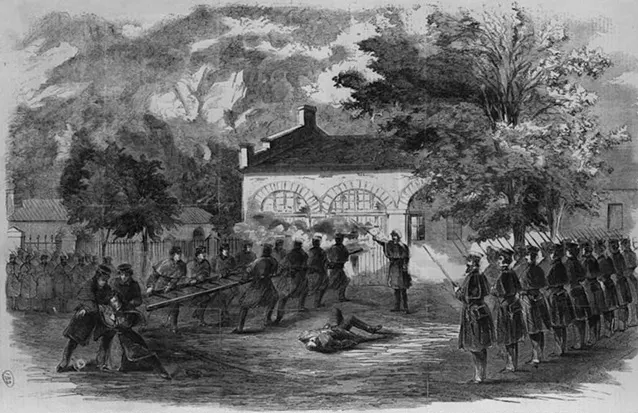
But his plan never came to fruition, as two days later dozens of U.S. marines quashed the revolt. Brown was executed just months later, and the majority of his colleagues were killed in action or also executed.
United States Marines storm an armory fire engine house taken over by John Brown and his team in this illustration from the 1800s.
Illustration from Frank Leslie’s Illustrated Newspaper/United States Library of Congress via National Park Service
The abolitionist raid received national press coverage as contentions over slavery and wider conflict mounted. Today, it is remembered as a precursor to a national war, and one of the first acts of coordinated armed resistance against chattel slavery in the United States.
From this, Harpers Ferry has long held a place in the public consciousness as a site of revolutionary potential, especially for Black Americans.
In 1906, African American civil rights leaders visited the town for the second meeting of the Niagara Movement, an early civil rights group described as a precursor to the National Association for the Advancement of Colored People (NAACP).
Harpers Ferry’s abolitionist history, combined with its presence of a higher education institution serving Black Americans, Storer College, led leaders to select the town as the site for their conference.
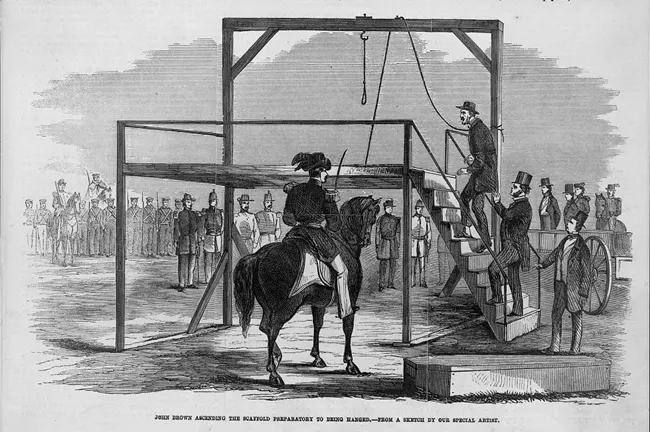
An illustration from the 1800s depicts John Brown’s execution in present-day Charles Town, West Virginia.
Illustration from Frank Leslie’s Illustrated Newspaper/United States Library of Congress via National Park Service
Today, the legacy of Brown’s raid and the abolitionist movement in Harpers Ferry is remembered through historical events hosted by the National Park Service (NPS) at Harpers Ferry National Historical Park.
In the afternoon of Saturday, Oct. 19 and Sunday, Oct. 20, the United States Marine Corps Historical Company will partner with NPS to host “living-history” exhibits, talks and demonstrations regarding Marine involvement in the conflict.
The park will also host a tour called “Clearing the Sky” on Oct. 18, Oct. 25 and Dec. 2.
The program will visit sites of importance to Brown’s raid and trial, including the Jefferson County Courthouse in Charles Town and the Jefferson County Museum, where artifacts from Brown’s life are held. The tour lasts roughly two-and-a-half hours.
For more details on NPS programming to commemorate the 165th anniversary of John Brown’s raid on Harpers Ferry, visit the organization’s website.
Add WVPB as a preferred source on Google to see more from our team
For LGBTQ youth in Appalachia, estrangement from their families of origin can be a common and heartbreaking experience. So, some LGBTQ people rely on “chosen family." In Roanoke, Virginia, the culture of ballroom offers the safety and stability of family, along with traditions that are handed down — traditions like vogueing. Mason Adams reported this Folkways story, in collaboration with Brad Kutner and Kelley Libby.
Mountain Stage is changing locations for its final two live events of 2026. The Sunday, Nov. 15 show will now take place at the Charleston Theater at the Convention Center, and the Sunday, Dec. 6 show will be held at the Capitol Theater in Downtown Charleston.
During spooky season, popular attention turns toward ghosts and goblins – or if you live in Appalachia – cryptids. For the Appalachia + Mid-South Newsroom, Bill Lynch, producer of Inside Appalachia, brings us the story of the Flatwoods Monster.
This week, ballroom culture offers LBGTQ folks a chance to be as fabulous as they want to be. Also, national media reports on the deaths of notable people, but small, hometown papers add a more personal touch. And, alpha-gal syndrome takes red meat off the menu, but what about ostrich?