


Harrison County Voters To Consider New, Unique Levy Aimed At Historical Preservation
The levy would provide at least $100,000 for the next four years to 13 historic preservation organizations across the county.
Continue Reading Take Me to More News


To Educate, Inform, and Inspire by Telling West Virginia's Story

Mountain Readers 2026 has concluded! Please fill out our volunteer post-survey.
Nominate an exceptional West Virginia K-12 teacher today!

On Demand

On Demand

Stream original productions from WVPB

Watch locally produced documentaries & more.

On Demand

On Demand






West Virginia Morning

Inside Appalachia

West Virginia Week

Mountain Stage

Us & Them

The Legislature Today

The Legislature This Week

Send us your comments and questions.

Stream our board meetings.

Check out the latest WVPB news.

Sign up for our newsletter and get weekly updates.

Meet the WVPB staff.

WV Educational Broadcasting Commission, the WVPB Foundation, and the Friends of WVPB.

Come work with us!

Read our annual report and learn how we educate, inform and inspire with your support.

Sponsor impactful and engaging media and entertainment.

Use your IRA to make a gift to WVPB.

Become a member with your gift of $1,000 or more.

Make WVPB part of your legacy.

Manage your membership account.

Learn how you can Protect and Sustain West Virginia Public Broadcasting.
This story originally aired in the Aug. 30, 2026, episode of Inside Appalachia.
This October, the Adaptive Climbers Festival (ACF) will gather in Kentucky’s Red River Gorge for the fifth year. Hundreds of rock climbers with disabilities will camp, hike, climb and share meals for three days at the mom-and-pop campground, Lago Linda’s Hideaway. The event is for and organized by folks with disabilities.
Inside Appalachia covered the Adaptive Climbers Festival in 2023. Now, three years later, the organizers say they’re almost at max capacity with 300 climbers, caregivers and volunteers. The campground has made accessibility improvements over the years, and folks are now chipping in to spruce up the trails, too.
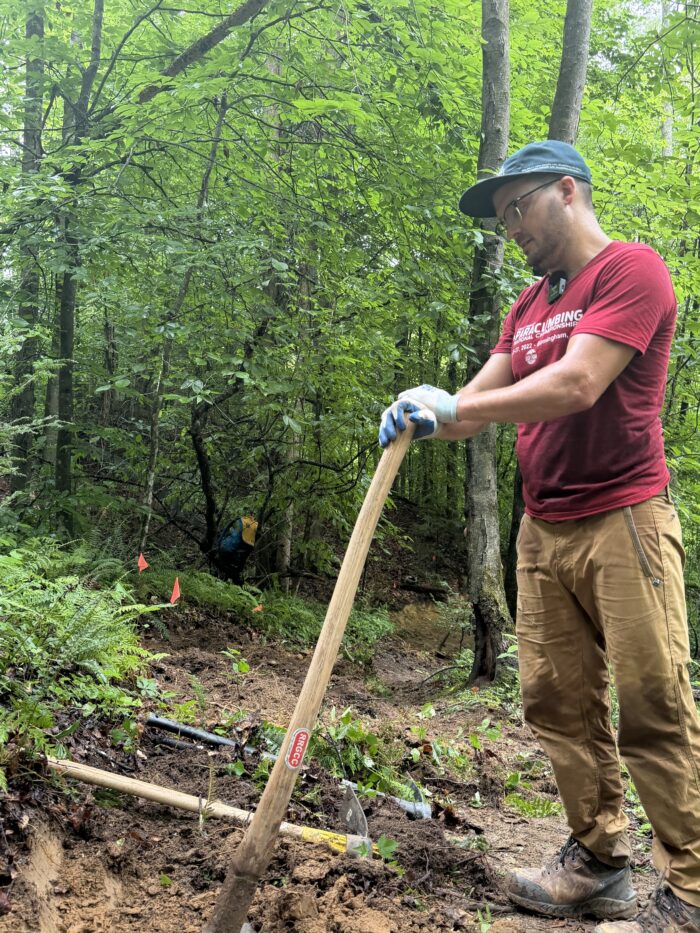
Catalyst Sports is the main nonprofit partner of ACF, and the group hosted the trail day where adaptive climber Alex Dornbusch volunteered this summer to widen the trail.
“We’re widening the trail out right now so that wheelchairs can get through,” Dornbusch said. “I think they’re wanting 36 inches … hopefully all the way up to the crag.”
Dornbusch found climbing after a brain injury. He was originally drawn to the sport for the indoor competitions and now climbs outside with ACF. The trail he worked on is one of the most used trails at ACF, because the path is not too long and fairly wide. So, with some basic modifications, the volunteers hope that adaptive climbers at the festival (and year-round) can hike the trail to the climbs themselves with little assistance.
Part of the reason ACF has settled in Kentucky is the trails are generally more accessible; they’re often old logging roads. This is actually seen throughout Appalachia, because many of the climbing areas are reclaimed coal mining or logging sites – so the access roads are wider to accommodate the equipment. They’re also wide enough for people to hike up with mobility aids or to use an ATV.
Some areas are still used for natural gas drilling. In fact, if the wind blows just right, you can smell gas, like where Dornbusch was working. Dornbusch is from Kentucky, but he says climbers come to the festival from all over the world.
“Australia, Canada, Europe, you know, they come here to Central Kentucky, which no one usually knows about, aside from Kentucky Fried Chicken; we get them out to, it’s a little part of Appalachia,” Dornbusch said.
Anna Parsons, a New Zealand climber who comes to the festival by way of Canada, says she’s climbed all over the world, and there’s nothing quite like the Red.
“I think the Red River Gorge is perfect for something like ACF,” Parsons said. “It’s easy to get around, and there’s a bus that takes everybody to the crag. And once you’re there, you’ve got the whole day to play around on this massive crag. And it’s quite easy to get access.”
The bus she mentioned isn’t public transit. It’s an old school bus that a local converted into gorge-transportation, complete with Braille signs for ACF.
Once a climber is on the wall, it’s up to them to haul themselves up, but getting to and from the cliff is often where adaptive climbers, especially those with neurological or vision impairments, need help. And that’s where the Red really shines. There are some places in the country with great climbing, but the access is more complicated, like in Colorado, for example.
The ACF crew recently traveled to Colorado and found themselves having to navigate slippery rock and narrow trails.
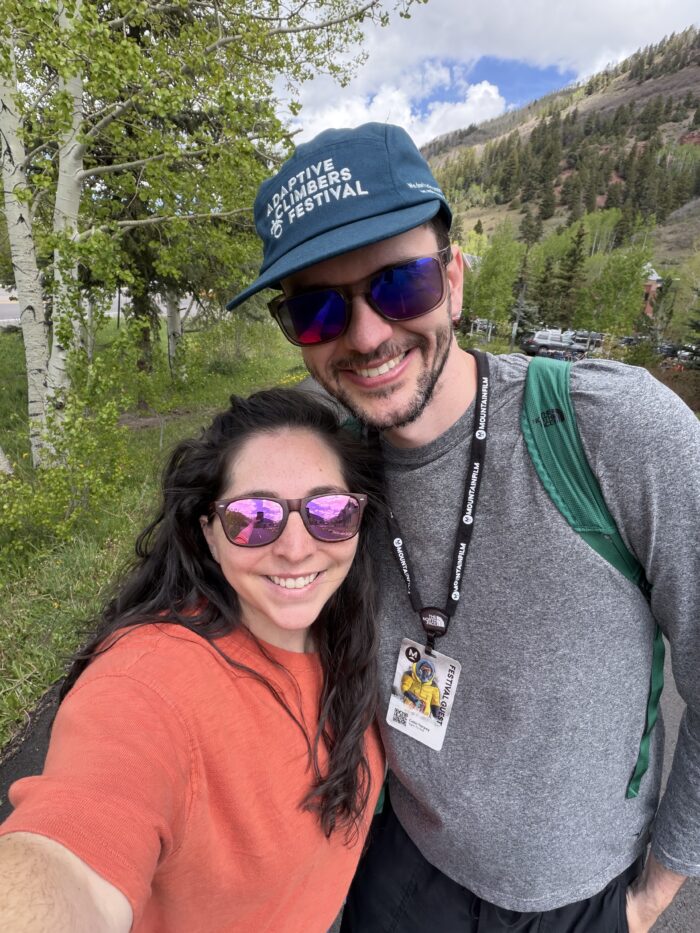
A handful of ACF climbers and organizers were on the Colorado trip, including adaptive climber Colin Torpey. Torpey explains that it’s not just the Kentucky landscape that makes the Red a logical home for ACF, it’s also the local support.
“[It would be] very hard to have ACF in this iteration of 300-plus participants, volunteers and caregivers in somewhere outside of The Red,” Torpey said. “I mean, like, the support from the community, the support from the different climbing coalitions, and property owners. It would require starting over.”
Hands-on teaching has long been a mainstay of ACF – passing down rope skills and climbing techniques that just can’t be learned online.
Torpey’s wife, Abby Lefkove, points out there’s a checks-and-balances that happens in person.
“Am I doing this right? You’re watching me do it, I’m showing it back to you,” Lefkove said. “And finding out other ways to do things too that are not necessarily on the YouTube video, because this whole community does have to do things a little bit differently.”
“Yeah, every amputee does climb a little bit different,” adds Torpey. “Some with the leg, some without their prosthetic. And so, it’s a little bit different when you’re wanting to learn with a new foot or a new style, for example.”
For others though, what they get from ACF is less tangible. Parsons explains the mental benefits, “I’m physically really strong, but I find the mental side of it is definitely where I lack. And then, seeing so many other people that are just like me and they’re trusting their feet, and they’re climbing really hard with a prosthetic, is so good to increase your skills in climbing and to feel the movement on rock now with your new body now.”
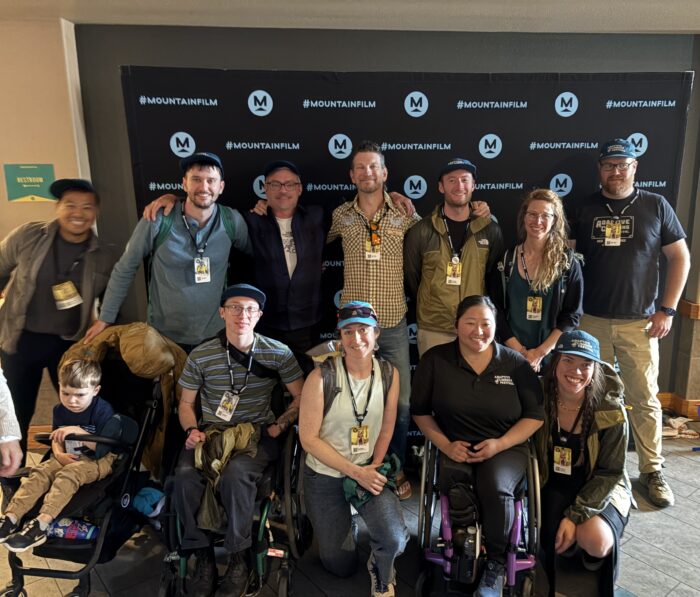
Parsons and Torpey are both lower limb amputees who climb and hike with prosthetics. They are also two of three climbers featured in a short documentary film about ACF that showed this past summer in Telluride, Colorado. The ACF crew didn’t travel to Colorado just to climb; they were there to premiere their documentary and be honored at the acclaimed event, Mountainfilm.
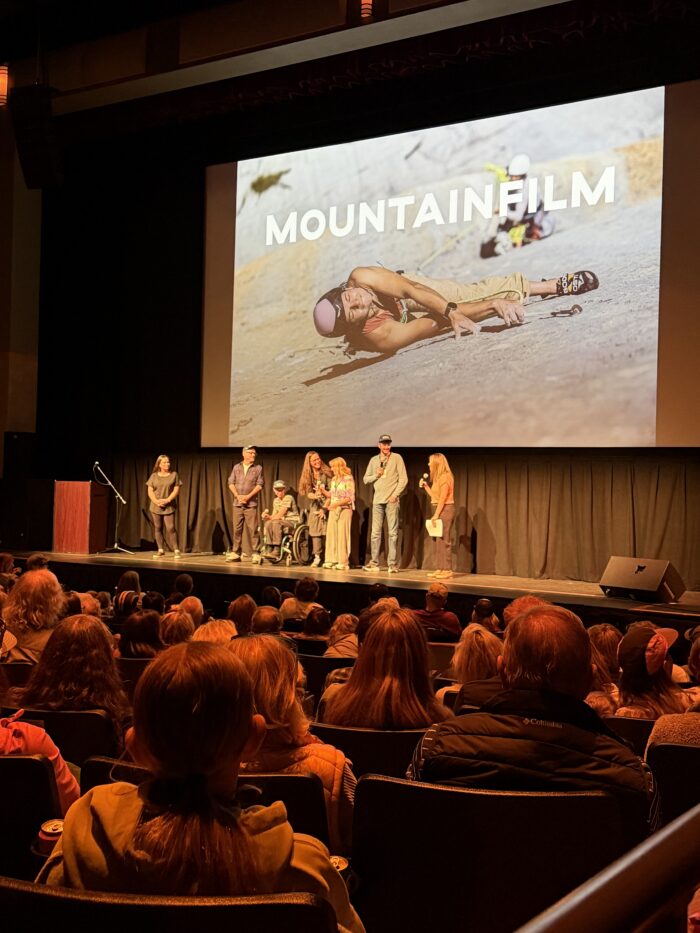
After the premiere, Wade Balmer, the film’s producer, and the development director of the Adaptive Climbers Festival, said having ACF included feels like a milestone. The film festival is one of the longest-running in the country and is well known for expedition and adventure films.
“To be part of that storytelling platform is just sick, right? Because we’re athletes like everyone else,” Balmer said. “So, it’s a massive moment for ACF because it’s the culmination of all that, right? We got to make the film last year at ACF. We got to tell the stories of these three climbers, ya know, that come at it from different experiences, and different takes on what they get from ACF and what they give to ACF themselves.”
Torpey echoes that making it to Mountainfilm is no small feat. “You have to know what you’re doing to be here, and to make it, and to be accepted as a major film here.”
Lefkove, Torpey’s wife, later says that while Torpey has climbed as ACF since the very beginning, he’s now taking on a more official leadership role.
Balmer says this is exactly what they need right now: long-time ACF climbers carrying on the tradition.
“There comes a point when you’re holding onto knowledge,” Balmer said. “And you’re holding onto processes, and you’re not passing them down. So we need to start bringing in people and showing them what it takes. And also, like for me, I need to find a new Development Director, right? I can start to shadow and mentor. But, I also need to recognize like he can’t be ‘mini Wade.’ He or she needs to bring their own ideas; they need to make it their own. Because that’s success, that’s adaptation, that’s ACF.”
While reporting on this group of ACF climbers who traveled to Colorado, it was clear that presenting their documentary at Mountainfilm represented a turning point of being accepted as part of the larger climbing community. And back in Kentucky, during that day of trail work with Alex Dornbusch, he shared something similar about his own experience.
“I’ve become more comfortable talking to members of the community, right? Not just para climbers, but rock climbers,” Dornbusch said.
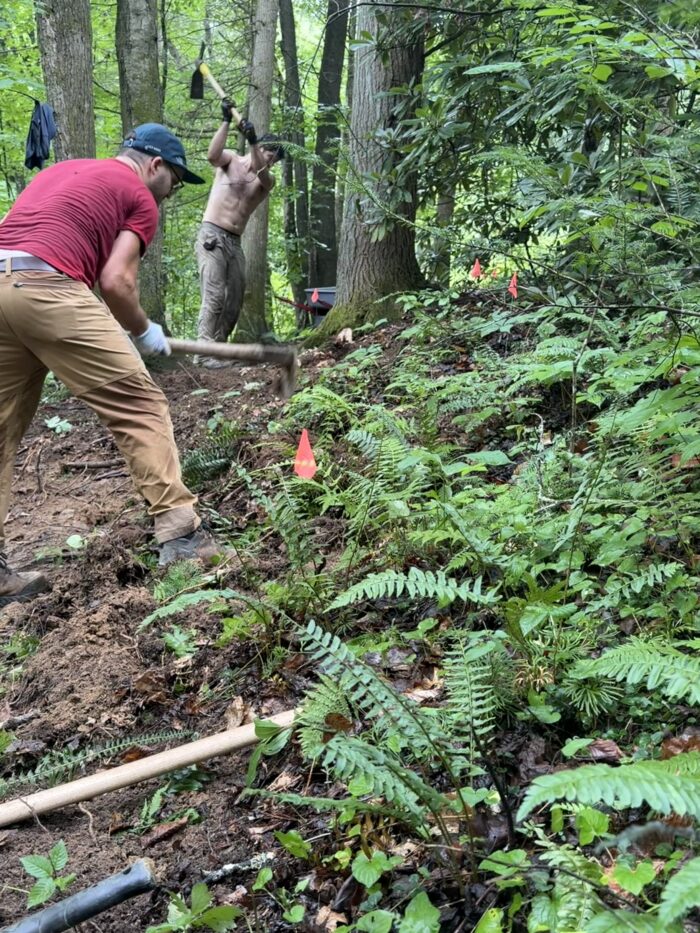
Climbing outdoors – in his home state – has given him reference points and a shared language with others who come here from all over the world to test themselves in Kentucky’s famously difficult areas like “the Motherload.”
Dornbusch describes a typical climber conversation: “Oh, you know, Motherload, yeah, I know Motherload. I went there one time. Really cool place to get to. Climbs are way too hard for me, but it’s really cool. And, you know, I know where they’re talking about now if they should say something.”
There’s a tradition of trail work in the climbing community, of donating your time to maintain the trails you use. Dornbusch says he knows it means something to other climbers to see him – a climber with a disability, a paraclimber – out on the trails, doing his part, just like everyone else.
“They see me in the community working on these trails, and It’s not just, oh, he’s just a guy who trains in the gym all the time now,” he said.
Dornbusch and the others hope to have the trail work done by the fall for this year’s ACF. The Red will be in the height of its busy season, with leaf peepers and pro climbers from around the world – and hundreds of adaptive climbers, their mobility aids, guide dogs and volunteers. Along with the falling leaves and misty mornings, the festival is now part of the annual October landscape of the Red River Gorge.
Add WVPB as a preferred source on Google to see more from our team

The levy would provide at least $100,000 for the next four years to 13 historic preservation organizations across the county.
Continue Reading Take Me to More NewsGenerations ago, kudzu was introduced to Appalachia to help control erosion and provide forage for cattle. But then, it kind of just took over. Kudzu is an invasive plant that chokes out native greenery. Some people are fighting back. Folkways Reporter Eliza Benbow spent time with the kudzu warriors in western North Carolina.
Continue Reading Take Me to More NewsInside Appalachia Host Mason Adams met with author Barbara Kingsolver at her home outside Abingdon, Virginia, a couple weeks before her new novel "Partita" was set to publish.
Continue Reading Take Me to More NewsOn this West Virginia Week, a mine operation in Kanawha County gets a WARN Notice, three Wyoming County Schools will remain closed until next week, and we learn the origins of the Flatwoods Monster.
Continue Reading Take Me to More News