Alert (09/10/2026): Our Parkersburg TV transmitter is undergoing maintenance for a few days and will not be operational. We apologize for any inconvenience.
All our programming is available via our TV livestreams on our website and WVPB Passport. Thank you for your patience!
This October, the Adaptive Climbers Festival will gather in Kentucky’s Red River Gorge for the fifth year. In 2023, Folkways Reporter Emily Chen-Newton covered the event for Inside Appalachia. Since then, the Adaptive Climbers Festival has grown. Organizers say they’re nearly at capacity, with 300 climbers, caregivers and volunteers. Ahead of the festival, the campground has made accessibility improvements. Volunteers with the ACF have also been sprucing up the trails.
The House of Delegates has passed a bill that would effectively put an end to greyhound racing in the state, according to its opponents. Senate Bill 437 discontinues the Greyhound Breeding and Development Fund, putting about $14 million back into excess lottery revenue accounts for lawmakers to appropriate in the upcoming fiscal year. The bill was approved last week in the Senate on a 19 to 15 vote.
The fund was created by the state Legislature in 1994 and helps support greyhound racing at the state’s two racetrack casinos in Wheeling and Nitro. It’s made up of a small percentage of the money bet at table and video lottery games at those locations and helps pay breeders as well as the winnings on races.
Greyhound officials have said eliminating the fund would cut 1700 jobs in the industry.
Several delegates – mostly Democrats – spoke against the bill during a Saturday floor session, like Joe Canestraro, of Marshall County.
“All this body has done has voted to cut low hanging fruit,” Canestraro said, “Low hanging fruit under the illusion that we’re right sizing government. No, what we’re doing is we’re taking jobs and revenue from each of our districts is what we’ve done.”
Delegate Erikka Storch, of Ohio County, was the only Republican member of the body to speak in opposition to the bill. She says the entire state reaps the benefits of greyhound racing.
“All of your districts get money from the racing casinos and the Greenbrier,” Storch said, “I would imagine if you speak to your mayors and commissioners, they will tell you about their uses for this money. Based on a study in Iowa, a year after they eliminated greyhound racing, their figures dropped 20 percent. Every district in the state will feel this.”
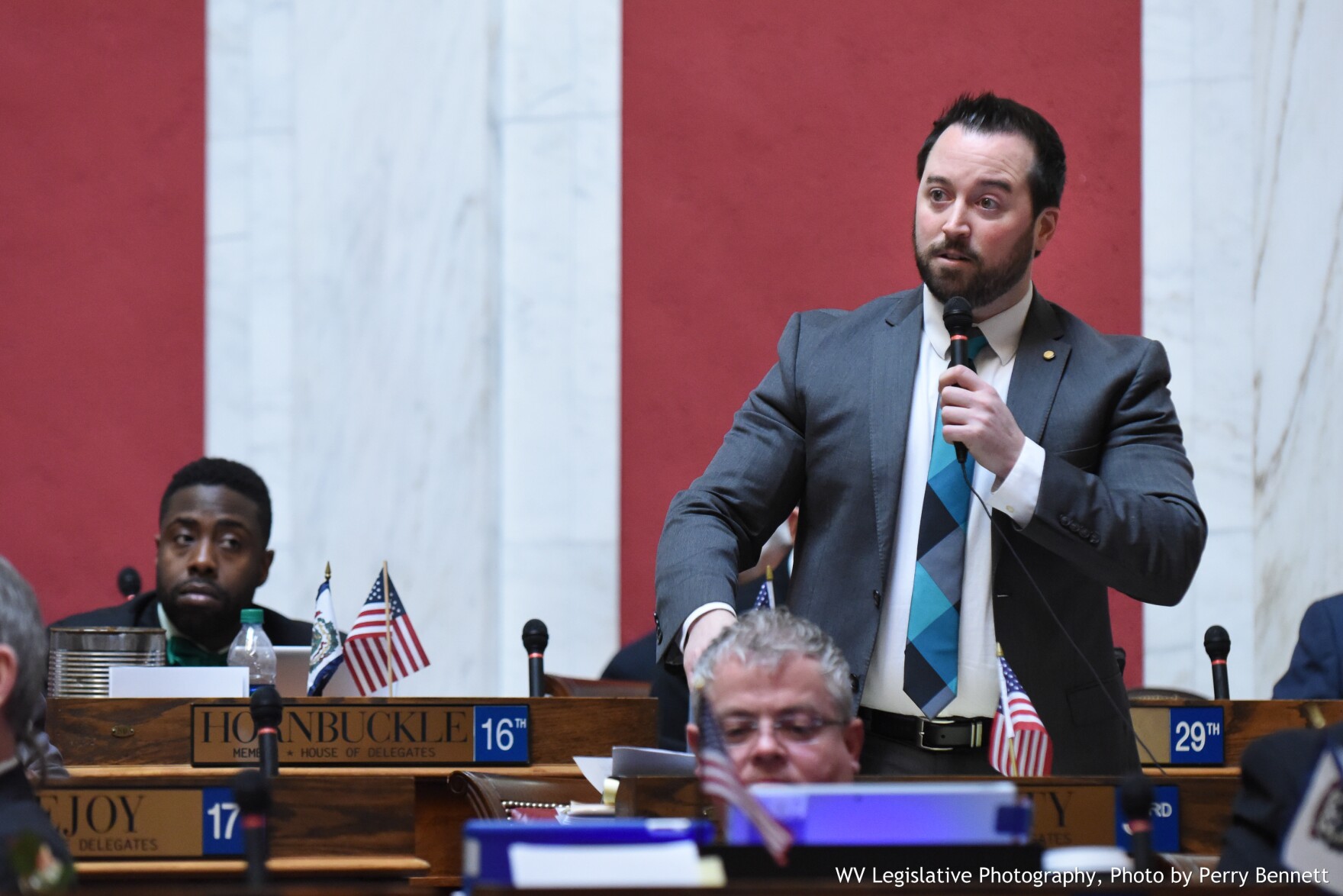
Delegate Shawn Fluharty, a Democrat from Ohio County, pointed out the secondary jobs that cutting the greyhound fund could impact.
Credit Perry Bennett / West Virginia Legislative Photography
/
West Virginia Legislative Photography
Del. Eric Nelson, R-Kanawha, House Finance Chair.
“Sarah’s Kennel’s in Wheeling; they spend $5,000 a week on food and vitamins for the greyhounds,” Fluharty noted, “Now, where do they purchase that? Tristate Kennel Supply in Brooke County. They purchase vehicles; a typical kennel truck costs $60,000. Sarah’s Kennel’s owns ten of them. Where do they purchase them? Robinson Chevrolet in Wheeling, and then driving those kennel trucks, who drives them? Employees. Up and down Route 2. How much do they pay a week in just fuel? They average around $300 a week in just fuel. How many small businesses will be impacted?”
Only four delegates spoke in support of the bill, including House Finance Chair Eric Nelson who says the industry is dying in the state and it’s time for lawmakers to make tough budgetary decisions.
“At the end of the day, we’ve got to have; we ask the question of priority, and this happens to be a priority where we use a certain amount of state dollars to support a purse fund,” Nelson explained, “so the priority is, do we use this amount of money to support purses? Or do we look at our higher education and have an effect on that? Do we look at some of our health programs? The alternatives are some serious cuts to other areas that will also have serious effects on many, many citizens of West Virginia. Mr. Speaker, there’s no easy decisions with this budget.”
Senate Bill 437 passed 56 to 44 and now heads back to the Senate before moving on to Governor Jim Justice for a signature.
Add WVPB as a preferred source on Google to see more from our team
At the core of the case is who in government has final authority over policy and rulemaking for the state's public schools: the Board of Education or the Legislature.
The state argued that the judiciary cannot and should not intervene in what they see as regular legislative proceedings when removing one of their own members.
Sharp federal limits on radio frequency interference have made it very challenging for emergency crews in two counties to communicate effectively in a crisis.