We explore the history of a song that’s become a universal anthem of hope and forgiveness. “Amazing Grace” was first written as a Christian hymn, and its beginnings in America come in the early 1800s. That’s when people traveled to revivals to worship with preachers from various denominations.
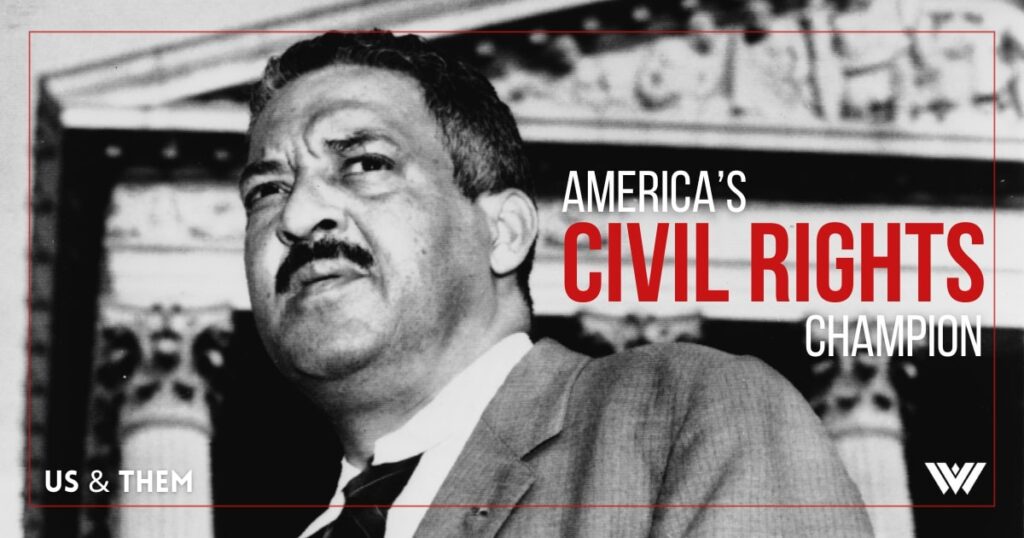
Many people know Thurgood Marshall as the first African American U.S. Supreme Court justice, however, first he had a long and distinguished career with the American Civil Liberties Union and the NAACP Legal Defense Fund.
On this episode of Us & Them, Trey Kay hosts a community conversation highlighting Thurgood Marshall’s legacy and sharing excerpts from a new Maryland Public Television documentary “Becoming Thurgood: America’s Social Architect.”
Marshall was the lead attorney for the plaintiffs in the 1954 Brown vs. Board of Education case which declared racial segregation in public schools unconstitutional. His work used the law as a tool for social change while dismantling institutional racism and inspiring social reforms.
This episode of Us & Them is presented with support from Maryland Public Television, the Greater Kanawha Valley Foundation and the CRC Foundation.
Subscribe to Us & Them on Apple Podcasts, NPR One, RadioPublic, Spotify, Stitcher or wherever you get your podcasts.
Courtesy Maryland Public Television
West Virginia Public Broadcasting recently hosted a community conversation highlighting a new documentary “Becoming Thurgood: America’s Social Architect” on the life and legacy of Thurgood Marshall, produced by Maryland Public Television (MPT). The film, directed by Alexis Aggrey, examines Marshall’s journey from Baltimore to the U.S. Supreme Court, tracing his legal strategy, moral vision, and enduring impact on American constitutional law and civil rights. The documentary is airing on PBS member stations across the country.
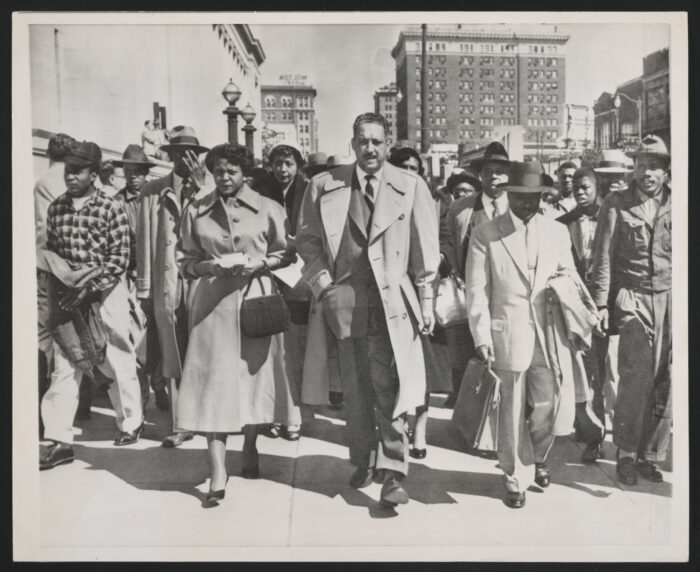
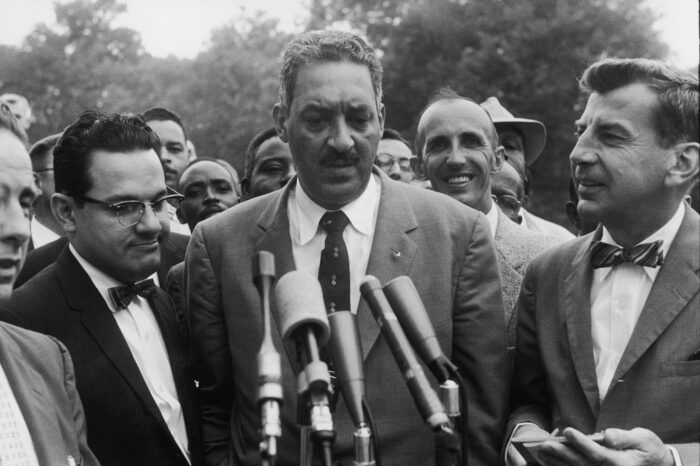
Thurgood Marshall walks near federal court during proceedings tied to the University of Alabama desegregation case involving Autherine Lucy in February 1956. The legal battle marked a pivotal moment in the fight to dismantle segregation in higher education.
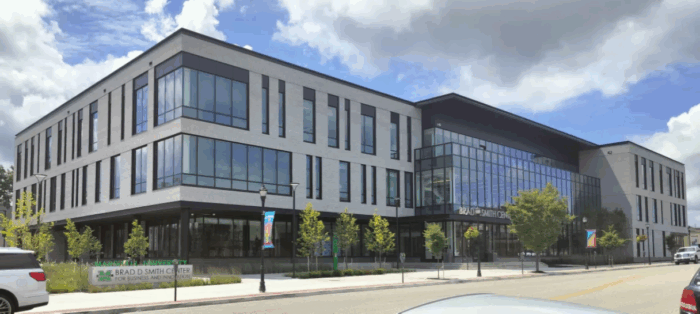
Photo courtesy of the New York World-Telegram & Sun Collection, Library of CongressWest Virginia Public Broadcasting hosted a community screening and discussion of “Becoming Thurgood” on Nov. 18, 2025, at the Brad D. Smith Center for Business and Innovation at Marshall University in Huntington, West Virginia.
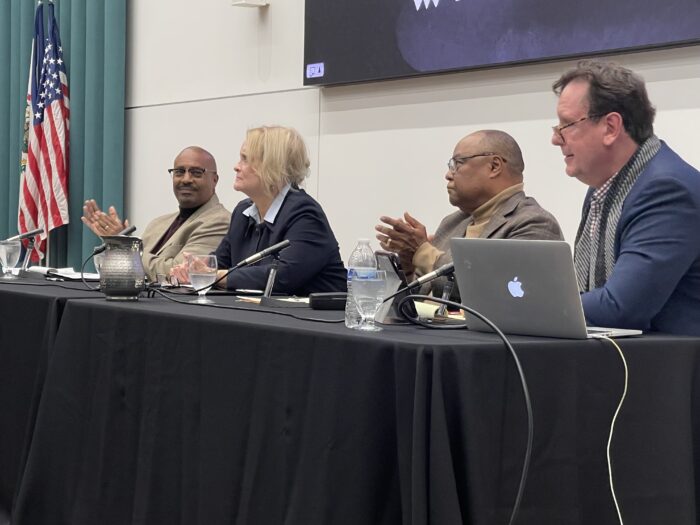
Members of a three-person panel prepare for a community discussion as attendees gather in the Encova Auditorium at Marshall University’s Brad D. Smith Center for Business and Innovation in Huntington, West Virginia, ahead of a screening of “Becoming Thurgood.”
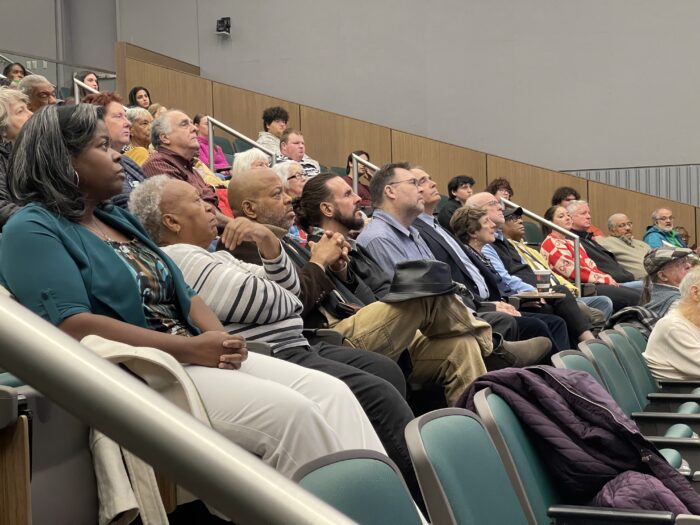
Photo Credit: Julie BlackwoodAudience members gather at Marshall University to watch selections from the Maryland Public Television documentary “Becoming Thurgood.”
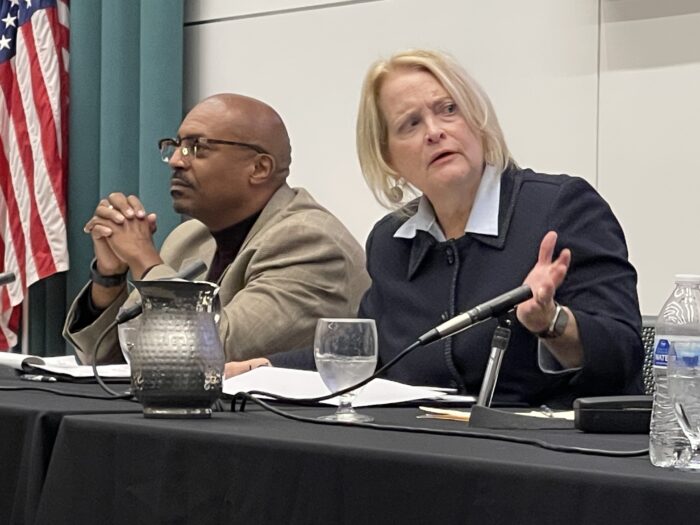
Photo Credit: Julie BlackwoodPanelists for the evening’s discussion about the legacy of Thurgood Marshall include (left to right) Clinton Arnold of West Virginia State University, Patricia Proctor, J.D., of Marshall University, and Cicero Fain of Marshall University. The conversation was moderated by Us & Them host Trey Kay.
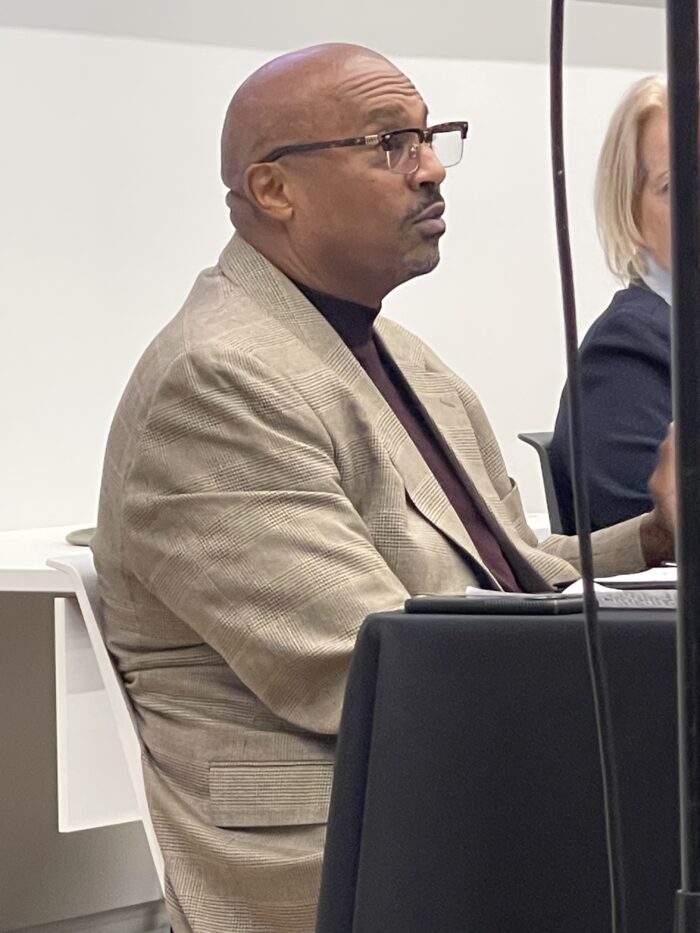
Photo Credit: Julie BlackwoodClinton Arnold, a professor at West Virginia State University, is the CEO of the Kanawha Institute for Social Research & Action, a nonprofit focused on workforce development, reentry support and strengthening families. Prior to holding these positions, Arnold spent 25 years with Verizon Communications Inc.
Photo Credit: Julie Blackwood
“If you go back to my humble beginnings in Dayton, Ohio, where I grew up, my sister and I integrated the Catholic schools in Dayton in 1972, which was after the brutal civil rights activities of the ’50s and ’60s.
I can’t tell you how many names I was called those early years until we got through the first few years. My parents said, ‘We’re not leaving.’ That wouldn’t have happened if it weren’t for some of the victories we’re talking about with Thurgood Marshall. That prepared me to go on to high school … and then on to the University of Kentucky.
If it weren’t for some of these laws and the fights done back in the ’40s, ’50s, ’60s and ’70s, I may not have had the opportunity to compete, and that’s what propelled me into my corporate career.
Once you were able to prove yourself, there’s still a fight. There’s still a fight to keep proving yourself over and over again. That’s part of his legacy … the persistence, the strategy, the tactics, the support, because nobody does anything on their own.
I don’t care how many people say, ‘I did it all by myself.’ Nobody does anything by themselves.”
— Clinton Arnold, professor at West Virginia State University (one of West Virginia’s two HBCUs). Arnold is also CEO of KISRA — the Kanawha Institute for Social Research & Action — a nonprofit focused on workforce development, reentry support and strengthening families.
Patricia Proctor, J.D. is the founding director of Marshall University’s Simon Perry Center for Constitutional Democracy and the university’s pre-law advisor. Prior to joining Marshall, Proctor was a litigator and partner at Drinker Biddle & Reath and a member at Steptoe & Johnson.
Photo Credit: Julie Blackwood
“I think [Thurgood] Marshall did more through his achievements to change American society. The change was lasting. The change, I think, is forever. We live in a different world in 2025 than the world that existed in 1950, and it is because of Marshall.
We believe we have rights in America, and someone may threaten those rights, but I believe that society at large will be determined that those rights must be preserved and respected. I don’t know what the end looks like, but just like Marshall, we have to play a long game in this world.
We have to say this is the goal, and there may be steps to getting there. We may not get everything we want all at one time, but that doesn’t mean that you don’t continue to go to that goal, and I think that is the legacy.”
— Patricia Proctor, J.D. is the founding director of Marshall University’s Simon Perry Center for Constitutional Democracy.
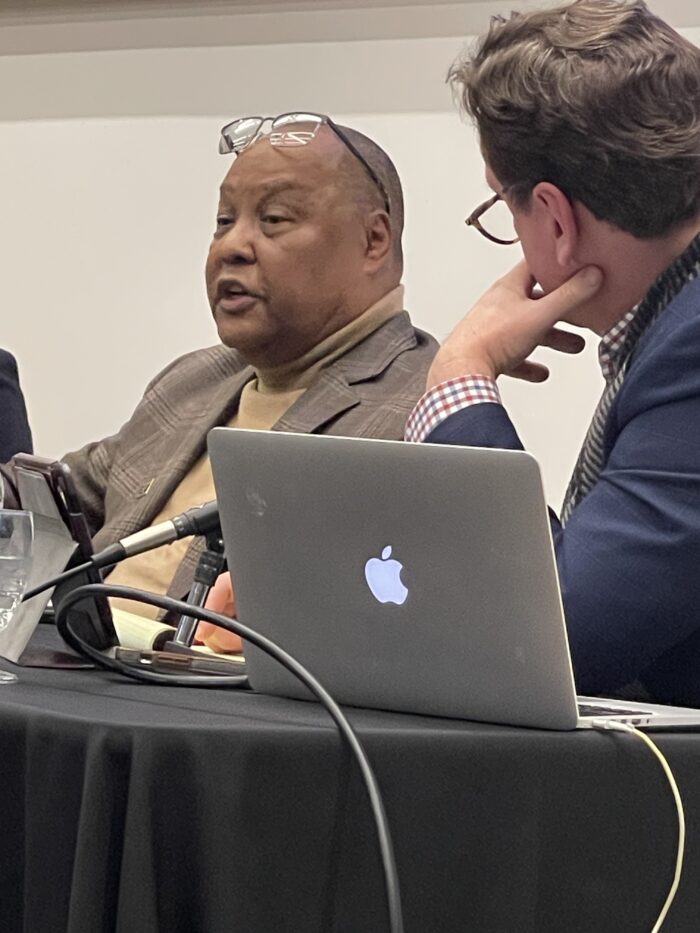
Cicero M. Fain III, assistant provost for Inclusive Excellence at Marshall University and a historian of Black life in central Appalachia, is the author of Black Huntington: An Appalachian Story. He also helps lead the Appalachian Freedom Heritage Initiative, which documents Underground Railroad sites in the region.
Photo Credit: Julie Blackwood
“In terms of West Virginia, we have a rich history of scholars and lawyers who attacked the racialized status quo. We can start with J.R. Clifford, the first African American lawyer in the state. Here’s a man of great intelligence, great passion, civil rights presence and identity.
He sees a state that is not adhering to its constitution and is segregating and treating Black people with inferiority. What he does, then, is utilize the law, like Thurgood Marshall, to attack and ameliorate the obstacles of Jim Crowism that exist in the state.
It’s paradoxical when we talk about West Virginia because certainly … there were challenges, there were Jim Crow prescriptions, but there was also progressiveness that existed here. It was compelled by Black agency that many times forced white legislators and the courts to adjust accordingly.”
— Cicero M. Fain III, historian and assistant provost for Inclusive Excellence at Marshall University
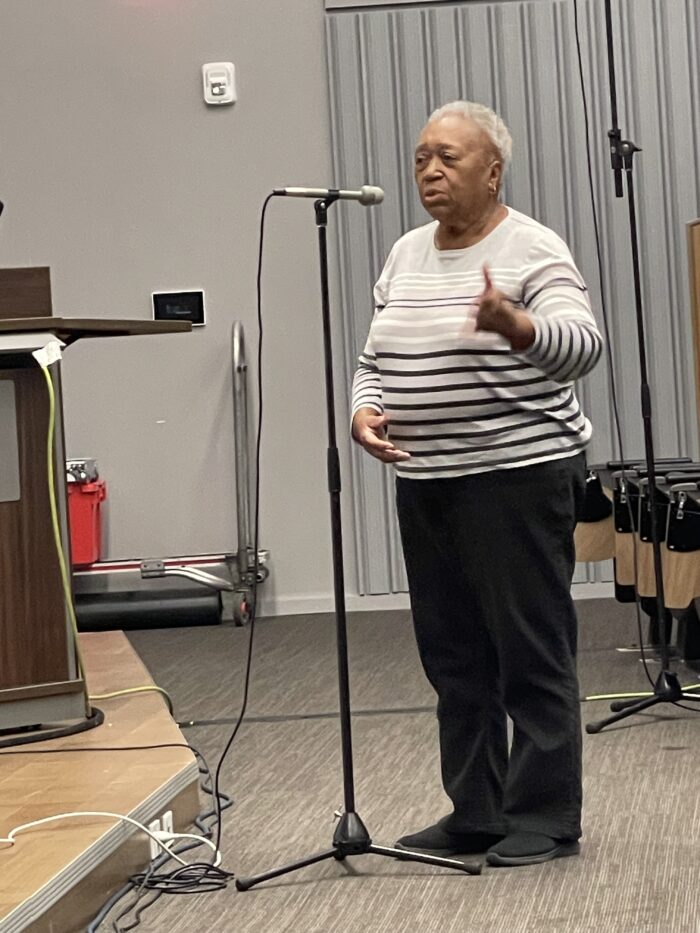
Sandra Clements, a lifelong resident of Huntington, poses a question during a community discussion about Thurgood Marshall and his legacy at Marshall University’s Brad D. Smith Center for Business and Innovation.
Photo Credit: Julie Blackwood
“I attended Catholic school where most of the students were Black, then went on to St. Joe where most of the students were white. From the time I was four or five years old, my father embedded in me that I was representing his family, his race, his people.
No matter where I was or what I was doing, I was representing my father — and I was never to disappoint him or be told I didn’t do what I was supposed to do as a Black woman.
I can’t imagine how Thurgood Marshall felt when he was threatened, but I know how it feels. Every Black person has been in that situation. Who in this room hasn’t been threatened or harassed?
I don’t want that for my children — but I know it will happen. My job is to fortify them to handle it. That is my responsibility. We cannot stop this fight. We cannot stop the progress that’s been made. We are not going back.”
— Sandra Clements
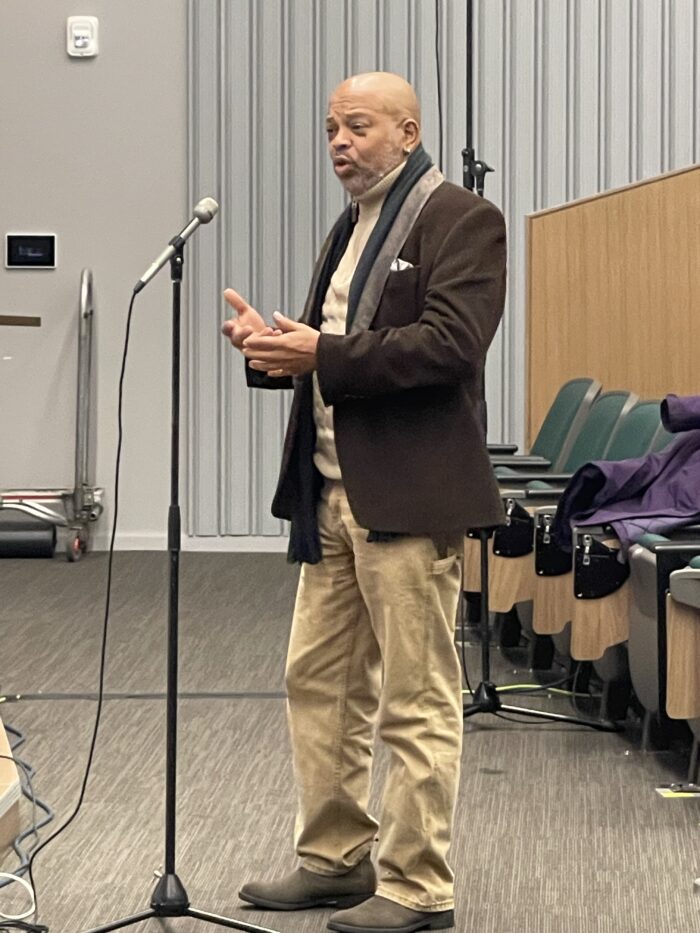
Alan Letton, director of the Center for Economic & Community Development in Black Appalachia and Isolated Communities at Marshall University, speaks during a community discussion about Thurgood Marshall and his legacy at Marshall University. Letton also serves as a visiting scholar in Marshall’s College of Business graduate programs.
Photo Credit: Julie Blackwood
“One of the things you don’t know if you haven’t been in an HBCU — a predominantly Black HBCU — is that the community is built around supporting you … in ways you don’t see if you don’t go to those institutions. When you think about fraternities and sororities, and the level of Black excellence they demand, there’s a social structure created around that.
In our aerospace engineering programs, all of our lab experiments and case studies were done around Black excellence — something you don’t get in predominantly non-Black universities. Black excellence means you’re always given examples and opportunities to show where you’re the best in a particular field — not just equivalent.
So when you’re studying civil rights, or the transition from slavery to freedom, you look at the Booker T. Washington and Frederick Douglass letters … you analyze the writing styles, the research, the excellence in communication. You look at Lincoln, Langston Hughes, music, the arts — always through that lens.
You never see an example that’s any less than that. What HBCUs do is create a culture that is always showing excellence — and demanding that you come in with that excellence.”
— Alan Letton, reflecting on the culture of historically Black colleges and universities and their importance in the education of Thurgood Marshall.
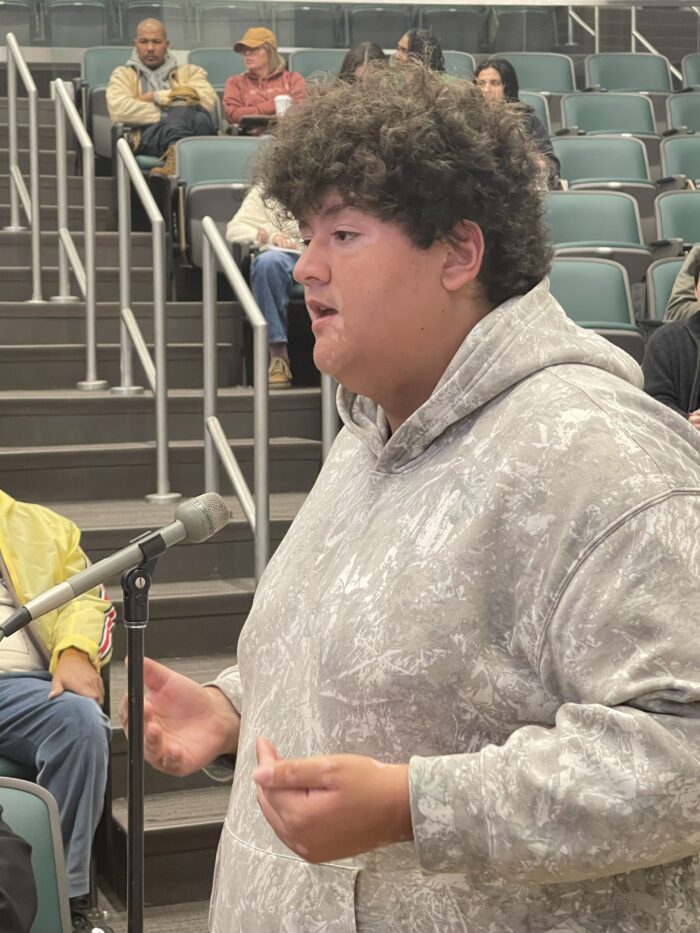
Jayden Sullivan, a political science major at Marshall University and a member of the Thundering Word Speech & Debate Team, asks the panel how young people can continue to fight for civil rights in a political climate he describes as increasingly hostile, during a community discussion about Thurgood Marshall.
Some county-level Republicans are calling for a reversal of the state party's decision to hold a closed election, only for registered Republicans this year.
The Supreme Court of the United States will hear oral arguments Tuesday in a case brought by the state involving a transgender teen from West Virginia.
Sen. Donna Boley, R-Pleasants, has decided to retire from public service after 41 years in the West Virginia Senate. Her resignation is effective immediately.