Alert (09/10/2026): Our Parkersburg TV transmitter is undergoing maintenance for a few days and will not be operational. We apologize for any inconvenience.
All our programming is available via our TV livestreams on our website and WVPB Passport. Thank you for your patience!
News Director Eric Douglas sat down in a classroom studio with Marshall's Chuck Bailey, the student news director Emma Johnson, and the Director of the Marshall School of Journalism and Mass Communications Rob Quicke, to learn more.
John Smith fretting a five-string bass at the West Virginia Music Hall of Fame.
Listen
Share this Article
Fifty years ago, a band of Black musicians stood up to racism and now they’ve been honored for that action.
Bass player John Smith is the surviving member of “The In Crowd,” a Charleston, West Virginia band that played popular tunes in the 1960s. One night at the Charleston Athletic Club, a multi-racial couple was refused service and the band took a stand.
Smith says, “If they couldn’t dance, we wouldn’t play.”
There were consequences for that action, but now, finally, Smith and his deceased colleagues have been honored for the role they played to push back against racial discrimination.
For this episode, host Trey Kay talks with John Smith at the West Virginia Music Hall of Fame. They sat in on a practice session of the Charleston-based band The Carpenter Ants. Practice gave way to conversation as musicians from different generations talked about their experiences past and present. They reflect on a golden era of the local music scene and the unity AND division they’ve all experienced.
This episode of Us & Them is presented with support from the West Virginia Humanities Council and the CRC Foundation.
Subscribe to Us & Them on Apple Podcasts, NPR One, RadioPublic, Spotify, Stitcher and beyond. You also can listen to Us & Them on WVPB Radio — tune in on the fourth Thursday of every month at 8 p.m., with an encore presentation on the following Saturday at 3 p.m.
Trey Kay
/
John Smith on his front porch swing at his home in Rand, WV.
John Smith
/
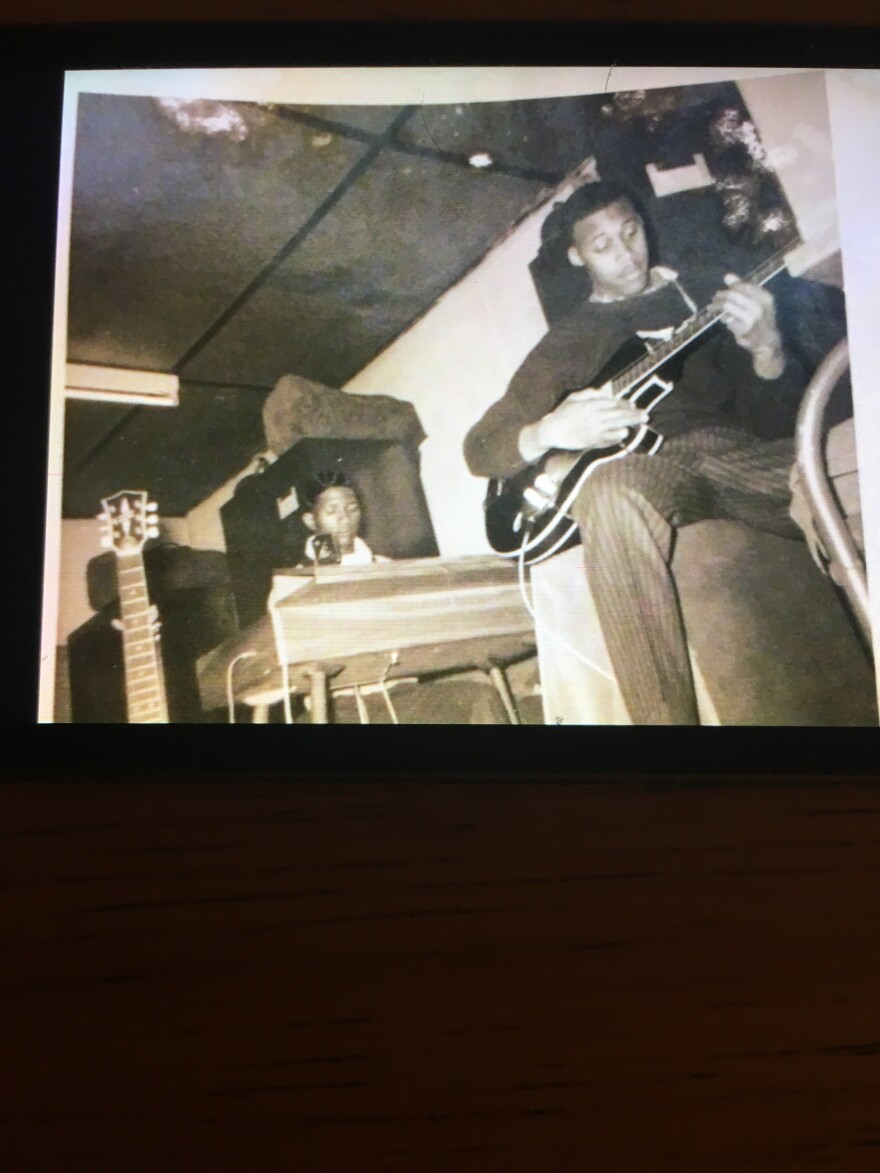
Young John Smith playing guitar while serving in the Army in Germany in 1959.
Trey Kay
/
Michael Pushkin, President of Local 136 of the American Federation of musicians, at the Levi Baptist Church in Rand, WV, apologizing to John Smith and the late members of “The In Crowd” for the actions the union took fifty years ago.
Trey Kay
/
The Carpenter Ants practicing at the West Virginia Music Hall of Fame in Charleston, WV. Charlie Tee (vocals), Michael Lipton (guitar), Ted Harrison (bass) and Jupie Little (drums).
Trey Kay
/
WVPB
Barbara and John Smith grooving to the Carpenter Ants at the West Virginia Music Hall of Fame.
Trey Kay
/
WVPB
Carpenter Ants bassist Ted Harrison showing John Smith his five-string bass at the West Virginia Music Hall of Fame.
Brian Smith
/
Trey Kay with Barbara and John Smith at the West Virginia Music Hall of Fame
Add WVPB as a preferred source on Google to see more from our team
The student-led team that produces the news for WMUL radio at Marshall University learned in August that they won a collegiate Edward R. Murrow award for Outstanding Newscast for the second year in a row.
News Director Eric Douglas sat down in a classroom studio with Marshall's Chuck Bailey, the student news director Emma Johnson, and the Director of the Marshall School of Journalism and Mass Communications Rob Quicke, to learn more.
A new book called "Appalachian Plants: In the Garden, In the Yard, and In the Wild" explores some of the history and lore of plants that have been used by many in the region. Inside Appalachia’s Mason Adams spoke with author Linda Hager Pack and illustrator Pat Banks about their book.