This week, Hurricane Helene devastated central Appalachia and disrupted the lives of people in recovery. Also, in West Virginia, fur trapping continues, even in the 21st century. And, baseball is America’s past-time. One league is making the game more inclusive.
Home » WVPB Podcasts » From Coal to Music: Appalachia's Connection to the United Kingdom
Published
From Coal to Music: Appalachia's Connection to the United Kingdom
Listen
Share this Article
Coal miners and their families in Appalachia take great pride in their work and the fellowship that surrounds coal mining. As Jeremy Brock, one former Kentucky coal miner, put it: “It’s a culture. It’s a brotherhood.”
“Once you get used to it, I wouldn’t do nothing else,” he told the documentary project, Humans of Central Appalachia, in 2016.
For many in Central Appalachia, coal mining doesn’t just mean jobs or the ability to earn a good living right out of high school. We’re also talking about identity and culture. On this week’s episode of Inside Appalachia, we’ll explore the Trump administration’s rollback of environmental regulations and learn about the decline of coal production in the United Kingdom. We’ll also revisit a 2014 conversation about the connections between Appalachian folk music and traditional ballads from Scotland and Ireland.
When President Trump wants to talk coal, he comes to West Virginia, so it wasn’t surprising that he visited Charleston in August, just hours after his administration unveiled a long-awaited overhaul of the Obama administration’s signature climate change regulation.
“Since Donald Trump was elected to president, coal mining has picked up, and he made his promise, and he’s keeping it and continue to make coal good and American great again,” said Jonathan Crum, a Kentucky coal miner who works for a mine repair and maintenance company in Logan County, W.Va.
While coal production is lagging nationwide, it is up in southern West Virginia, the Beckley Register-Herald reported. But an annual coal production report, released last month by West Virginia University’s Bureau of Business and Economic Research, shows the recent uptick in coal production is likely to be short-lived.
Credit AP Photo/Lefteris Pitarakis
/
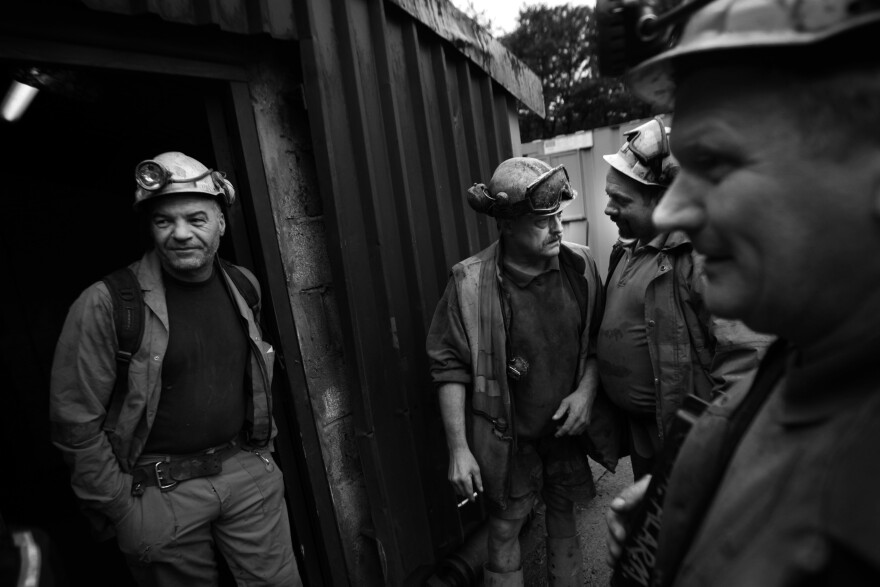
Miners share a moment as they change shifts at the Unity mine, near the south Wales village of Cwmgrach, Wednesday Aug. 27, 2008.
PRI’s The World recently released a two-part series about what happened in the UK when the government decided to shut down coal mines and coal-fired power plants as part of an effort to reduce greenhouse gas emissions. We’ll air those stories and listen as people from coal mining communities in Wales talk about mine closures from 30 years ago, part of the documentary project, After Coal.
Credit (AP Photo/Kirsty Wigglesworth)
/
Sheep graze near the closed Tower Colliery coal mine near the village of Hirwaun, in Glamorgan, South Wales, Wednesday, April 23, 2008.
And we’ll hear a 2014 interview with Fiona Ritchie, host of NPR’s Celtic music program The Thistle & Shamrock, about a book she co-wrote called Wayfaring Strangers: The Music Voyage from Scotland and Ulster to Appalachia. It tells the story of the music migration from Scotland and Ireland to Appalachia.
We had help producing Inside Appalachia this week from WMMT in Whitesburg, Ky., the Ohio Valley ReSource and PRI’s The World.
Music in today’s show was compiled by Fiona Richie from her book and CD. Music was also provided by Ben Townsend.
Roxy Todd is our producer. Our executive producer is Jesse Wright. He also edited our show this week. Our audio mixer is Patrick Stephens. Molly Born is our web editor. You can find us online on Twitter @InAppalachia.
Add WVPB as a preferred source on Google to see more from our team
At least one primary election race is headed for a recount. Also, an independent audit finds a critical deficit that could affect struggling families. And, the termination of a federal grant program for first time farmers is leaving some growers – and communities – in a bind.
This week, Hurricane Helene devastated central Appalachia and disrupted the lives of people in recovery. Also, in West Virginia, fur trapping continues, even in the 21st century. And, baseball is America’s past-time. One league is making the game more inclusive.
It’s been a year-and-a-half since Hurricane Helene ravaged central Appalachia. Communities are still recovering, including those who were already in recovery for addiction.
A small federal grant program aimed at increasing first-time farmer’s access to land, training and tools was finding fertile ground in West Virginia. But in March, the Trump administration suddenly terminated it, leaving local partners uncertain about their futures.