Alert (09/10/2026): Our Parkersburg TV transmitter is undergoing maintenance for a few days and will not be operational. We apologize for any inconvenience.
All our programming is available via our TV livestreams on our website and WVPB Passport. Thank you for your patience!
This week, in author Willie Carver, Jr.’s new book, he reconsiders a negative childhood experience with a neighborhood girl who might have just been looking for a friend. Also, a southwestern Virginia community rang the alarm after more and more of its children were diagnosed with cancer. A local journalist is trying to unravel the cause. And, the city of Asheville has a new crusading reporter. He’s a puppet.
Home » Stories » WVU Students Find Path to Auto Industry Through EcoCAR Competition
Published
WVU Students Find Path to Auto Industry Through EcoCAR Competition
Listen
Share this Article
Many college seniors have to worry about whether they’re going find a job after they turn their tassel. But some students in a car-building competition are being recruited by the auto industry even before they graduate.
EcoCAR 3 is the latest in a series of Advanced Vehicle Technology Competitions sponsored by the U.S. Department of Energy and General Motors. West Virginia University was one 16 schools in North America tasked with turning a 2016 Chevy Camaro into a hybrid-electric vehicle.
EcoCAR 3 is four-year competition and more than 40 WVU students work on it at any given time. Most are seniors who spend two semesters with the team and then are replaced by a new group. There are also six paid graduate assistants who help pass down knowledge from one group to the next.
As exciting as it may sound to produce a green version of one of America’s most recognizable muscle cars, the competition’s ultimate goal is to connect students with the auto industry.
Focus on Recruiting
“The real product is the students. And that’s why there’s such a heavy focus on recruiting among all the competition sponsors, and it’s a large group, is getting this next generation of engineers who are already on their feet in alternate and advanced transportation out into the industry,” said Mechanical and Aerospace Engineering professor Scott Wayne. He’s one of the WVU EcoCAR team’s advisors.
Professor Andrew Nix is another advisor in the same department. He said that since the Advanced Vehicle Technology competitions began in the late eighties, the majority of students involved have found jobs when they leave school.
Credit Jesse Wright / West Virginia Public Broadcasting
/
West Virginia Public Broadcasting
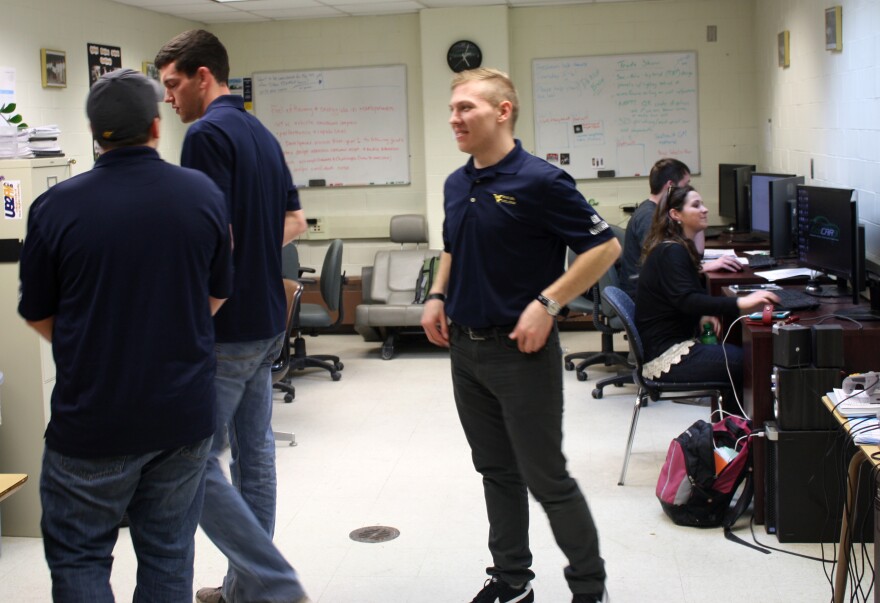
WVU EcoCAR 3 team members in their lab at the College of Engineering and Natural Resources.
“75 percent have been employed in the automotive or supporting industries.”
WVU senior Jessie Felde leads the project’s Mechanical Team. She said that while the competition is very time-consuming, the opportunity to work so closely with the industry she’s interested in makes it worth the sacrifice.
“I’ve actually been offered a job by GM and I’m going to be starting this summer. So it’s really helped me get a start in industry with a good job in something that I’m excited to work with.”
Multi-disciplinary Project
While the competition includes students from almost every department at WVU’s engineering school, business and public relations majors are also involved. Nix said those students are also finding work in the auto industry when they leave school.
“Some of the non-engineering majors also have taken positions with companies that either work very closely with or are part of the automotive industry,” Nix said.
An example of this multi-disciplinary aspect of the competition is the work Chelsea Betts is doing. She’s in the Reed College of Media’s graduate program and is heading up the EcoCAR team’s public relations effort. Betts is helping undergraduate PR students on a large Earth Day event at WVU’s Mountainlair that highlights the EcoCAR team’s work.
“So they’re helping me kinda put that together and it kinda gives them the experience of what it takes to actually organize, plan and execute an event of that size.”
Professor Nix says four of the team’s students were offered positions at GM in the competition’s first semester alone.
This week, in author Willie Carver, Jr.’s new book, he reconsiders a negative childhood experience with a neighborhood girl who might have just been looking for a friend. Also, a southwestern Virginia community rang the alarm after more and more of its children were diagnosed with cancer. A local journalist is trying to unravel the cause. And, the city of Asheville has a new crusading reporter. He’s a puppet.
Twenty-five years ago, on Sept. 11, 2001, at 8:46 a.m., a hijacked plane hit one of the twin towers at the World Trade Center in New York City, ending for this nation a certain innocence, and the belief that such an attack would never happen on American soil. Maria Young caught up an economics professor from WVU who was on site when the planes hit – and gave an exclusive interview to then-West Virginia Public Broadcasting News Director Beth Vorhees.
Schuyler Mitchell, assistant news director at nonprofit newsroom Mother Jones, found that at least $1 million in opioid settlement funds have been used to purchase ALPR surveillance systems across the country.