


'Haunted' Town Already Celebrating Spooky Season
Halloween is still several weeks away, but one West Virginia town is already celebrating the season.
Continue Reading Take Me to More NewsAlert (09/29/2026): Our Parkersburg TV transmitter is still undergoing maintenance and remains temporarily inoperative. We apologize for the inconvenience.
All our programming is available via our TV livestreams on our website and WVPB Passport. Thank you for your patience!




To Educate, Inform, and Inspire by Telling West Virginia's Story

Mountain Readers Week will be held Oct. 5-9, 2026! Celebrate and foster a love of reading in children across West Virginia.

Nominate an exceptional West Virginia K-12 teacher today!

On Demand

On Demand

Stream original productions from WVPB

Watch locally produced documentaries & more.

On Demand

On Demand





West Virginia Morning

Inside Appalachia
West Virginia Week
Mountain Stage
Us & Them
The Legislature Today
The Legislature This Week

Send us your comments and questions.

Stream our board meetings.

Check out the latest WVPB news.

Sign up for our newsletter and get weekly updates.

Meet the WVPB staff.

WV Educational Broadcasting Commission, the WVPB Foundation, and the Friends of WVPB.

Come work with us!

Read our annual report and learn how we educate, inform and inspire with your support.

Sponsor impactful and engaging media and entertainment.

Use your IRA to make a gift to WVPB.

Become a member with your gift of $1,000 or more.

Make WVPB part of your legacy.

Manage your membership account.

Learn how you can Protect and Sustain West Virginia Public Broadcasting.

Researchers at West Virginia University are looking for clues about West Virginia’s climate history -- by combing through old journals of naturalists who spent time in the state’s forests and hills.
Lori Petrauski is a WVU grad student from Minnesota who is starting this phenology project for West Virginians.
“I became interested in how to connect citizens and just normal people to nature,” Petrauski said.
Phenology, she says, is one easy way to do that.
Phenology: the study of cyclic and seasonal natural phenomena, especially in relation to climate and plant & animal life (e.g., noticing when the first migrating songbirds arrive in springtime)
Climate Clues
Today Petrauski is pouring through old journals of West Virginians as she compiles a baseline database of historical phenology in the state. It’s the start of a ten-year effort to create a resource for students and citizens. The goal is ultimately to allow West Virginians to better know the rhythms of the “wild and wonderful” part of West Virginia.
In cooperation with WVU’s Natural History Museum, the university’s Wildlife and Fisheries Department is putting out calls to citizens with any kind of historical records of timings of biological events.
“Especially helpful are journals from nature-minded citizens,” Petrauski said. “So people who would be out in the woods a lot and write down what they saw.”
George Breiding
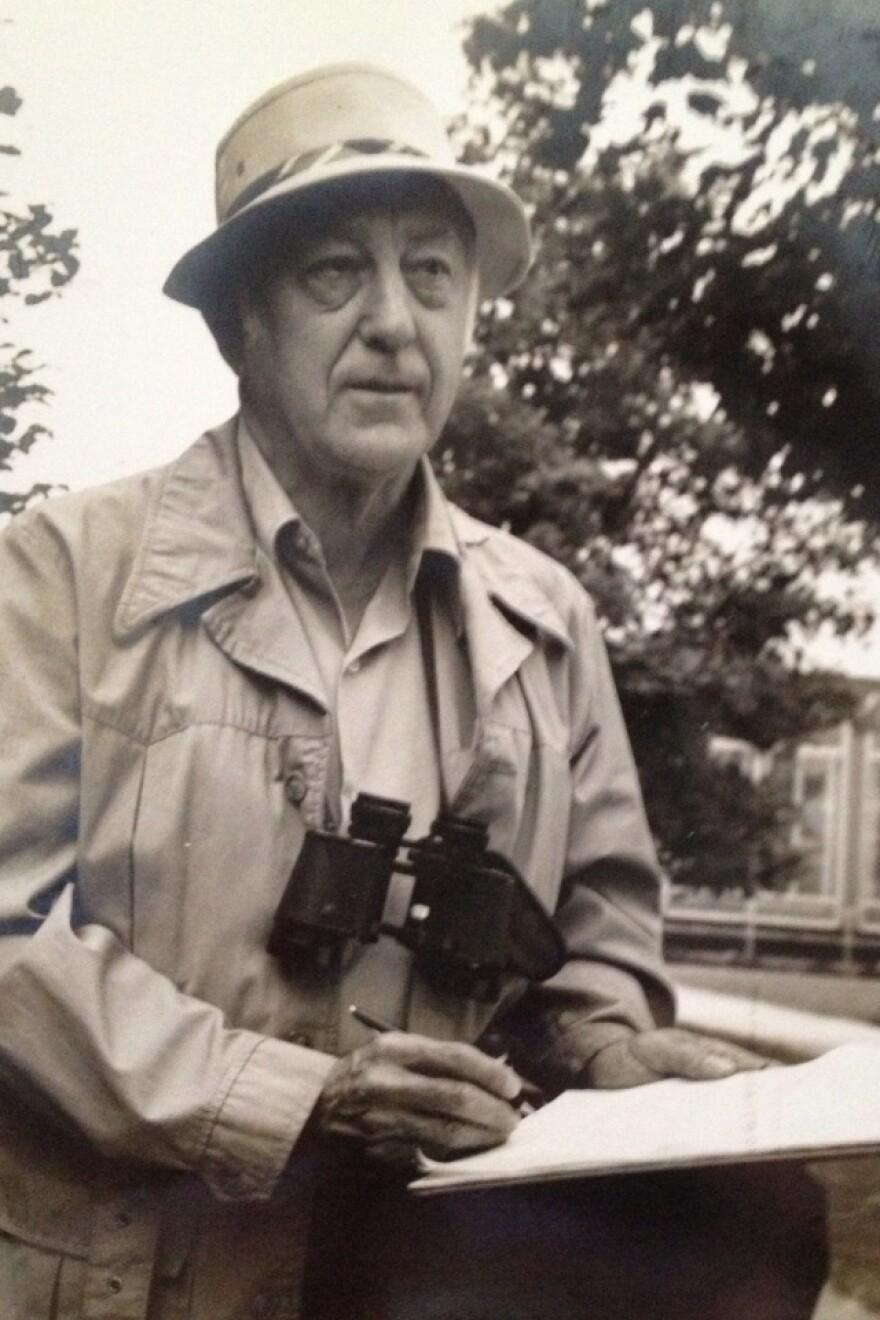
One such journaler who has provided a plethora of data for Lori and her team is George Breiding, of Wheeling. Born in 1917, Mr. Breiding was an avid birder and for years was the Director of Nature Education and the staff naturalist at Oglebay Park. He passed away several years ago but during his adult life he made lists of the birds he saw every day of his life right up until the day he died.
“It was like breathing to him. He never went out of the house without a notebook and pencil. And he rarely went out of the house without binoculars,” said Mr. Breiding’s son, Mike. “I’m sure he would have felt naked without them.”
“Prolific birders like that were really helpful for us because we could see the first day that he saw this bird must have been the first day that it migrated up to Oglebay Park because we know that he was out every day looking for birds,” Lori explained.
Data is gathered from:
The project as a whole will collect as much data as possible in the coming decade so that West Virginians have a solid base of knowledge to pull from, add to, and Lori hopes, an extra excuse to get outside and notice the world around them.
Add WVPB as a preferred source on Google to see more from our team

The $26.5 million grant from the U.S. Department of Agriculture will help construct the West Virginia State University Agriculture Complex that will house laboratory space for the university, as well as the state Department of Agriculture.
Continue Reading Take Me to More NewsThe Public Service Commission of West Virginia wants to ensure that if discontinuation of the current landline system is approved, an adequate service will be continue to be available to both new and existing customers.
Continue Reading Take Me to More NewsWest Virginia has seen the largest population decline in the nation - nearly 1.5% - and many of those leaving are young people. In an episode that aired last month, Us & Them host Trey Kay heard from some young people who think they may stay in the state to launch their futures. This month, Kay talks with those who say living their dreams may well require moving away from the Mountain State. We listen to an excerpt from the latest Us & Them.
Continue Reading Take Me to More NewsLesions, sores and an itchy, red rash have affected more than 50 Wyoming County public school students.
Continue Reading Take Me to More News