


'Haunted' Town Already Celebrating Spooky Season
Halloween is still several weeks away, but one West Virginia town is already celebrating the season.
Continue Reading Take Me to More NewsAlert (09/29/2026): Our Parkersburg TV transmitter is still undergoing maintenance and remains temporarily inoperative. We apologize for the inconvenience.
All our programming is available via our TV livestreams on our website and WVPB Passport. Thank you for your patience!




To Educate, Inform, and Inspire by Telling West Virginia's Story

Mountain Readers Week will be held Oct. 5-9, 2026! Celebrate and foster a love of reading in children across West Virginia.

Nominate an exceptional West Virginia K-12 teacher today!

On Demand

On Demand

Stream original productions from WVPB

Watch locally produced documentaries & more.

On Demand

On Demand






West Virginia Morning

Inside Appalachia

West Virginia Week

Mountain Stage

Us & Them

The Legislature Today

The Legislature This Week

Send us your comments and questions.

Stream our board meetings.

Check out the latest WVPB news.

Sign up for our newsletter and get weekly updates.

Meet the WVPB staff.

WV Educational Broadcasting Commission, the WVPB Foundation, and the Friends of WVPB.

Come work with us!

Read our annual report and learn how we educate, inform and inspire with your support.

Sponsor impactful and engaging media and entertainment.

Use your IRA to make a gift to WVPB.

Become a member with your gift of $1,000 or more.

Make WVPB part of your legacy.

Manage your membership account.

Learn how you can Protect and Sustain West Virginia Public Broadcasting.
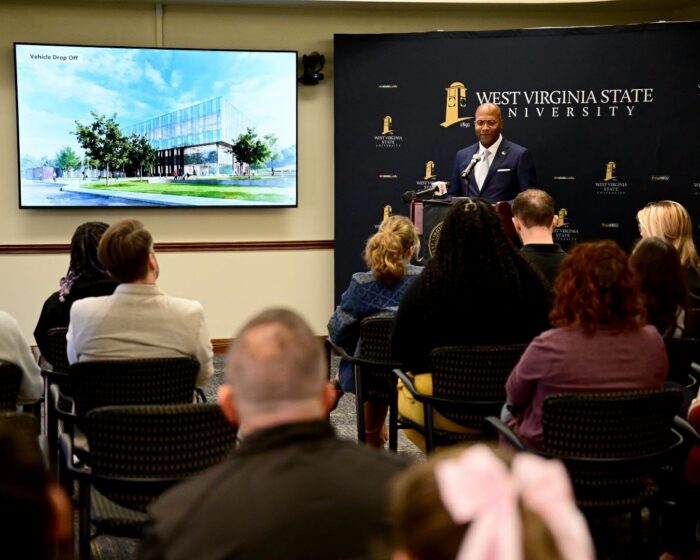
West Virginia State University (WVSU) has received a $26.5 million grant from the U.S. Department of Agriculture’s National Institute of Food and Agriculture’s (NIFA) Research Facilities Act Program.
It is the largest competitive grant award in the university’s history which, as a land-grant institution, centers agricultural and technical education.
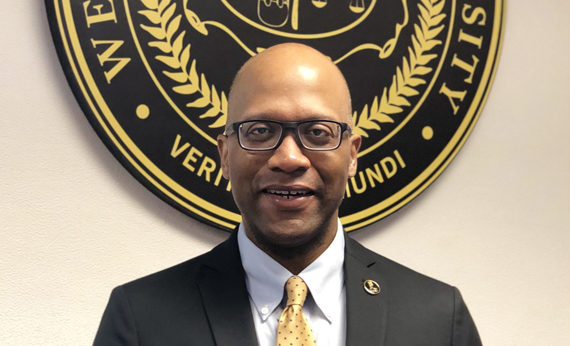
WVSU President Ericke Cage said the award is an achievement not just for the university but for the state as a whole.
“This is about bringing together two incredible organizations, West Virginia State being one, and the other being the West Virginia Department of Agriculture, bringing those two institutions together under one roof again to drive forward innovations in agriculture across West Virginia and our nation,” he said.
The money will help construct the West Virginia State University Agriculture Complex that will house laboratory space for WVSU’s Purdy School of Agriculture, Food and Natural Resources as well as the West Virginia Department of Agriculture.
WVSU’s award amount ranks second nationally among 36 universities that received funding in a competitive program. Cage said it was a vote of confidence in the university.
“When you look at that list, 36 other awardees, we’re talking about really major research institutions, R1, R2 research institutions. So to know that of that list of 36, West Virginia State was number two in terms of the total amount of funding received, it really makes us all at the institution feel good, but it also underscores what we’ve already known for a long, long time, and that is that West Virginia State University punches well above its weight,” he said. “Our researchers, our faculty, our staff, our students are second to none, and that when we are called to task, we deliver, and we deliver at a high standard for our students, for the state of West Virginia, and for our nation.”
The USDA award builds upon a previously announced, $50 million investment from the state of West Virginia.
Last year WVSU celebrated 25 years since regaining its land-grant status in 2000.
The system of land-grant schools was established by The Morrill Act of 1862 to provide federal support for agricultural and technical educational institutions in every state. The system was expanded by the Morrill Act of 1890 to ensure the education of black citizens in agriculture and the mechanical arts. The West Virginia Colored Institute was established one year later in 1891 as one of 19 land-grant institutions authorized by Congress.
But in 1956, shortly after the university desegregated, the state Board of Education voted to surrender WVSU’s land-grant status, which “resulted in subsequent loss of millions of dollars which could have been used by the institution to serve the needs of a severely depressed region of Appalachia.”
Cage recognizes that WVSU, like many other 1890 land grant institutions, has suffered historically from underfunding.
“It’s a fact that is well documented. But despite this underfunding, we have persevered. We have not allowed the financial shortcomings to define who we are as institutions,” he said. “Who we are as institutions are a collection of men and women who are dedicated to transforming lives through excellence in education, dedicated to bringing forth incredible research to discover new innovations that are helping to change our world.”
At approximately 40,000 gross square feet, the current Agriculture Complex will establish dedicated food science laboratories to run concurrent food safety, microbiology and shelf-life studies; create a commercial kitchen and sensory evaluation facility for value-added development and producer assistance; provide flexible agriculture and natural resources laboratories, agricultural AI computing and applied teaching space for WVSU’s new Purdy School of Agriculture, Food and Natural Resources; and bring WVDA’s accredited laboratories to campus, strengthening the state’s capacity for food safety testing and emergency response.
Construction is expected to begin in early 2027 with occupancy scheduled for Fall 2029.
Add WVPB as a preferred source on Google to see more from our team

The Public Service Commission of West Virginia wants to ensure that if discontinuation of the current landline system is approved, an adequate service will be continue to be available to both new and existing customers.
Continue Reading Take Me to More NewsFayette, Harrison and Kanawha counties have been approved for individual assistance from the Federal Emergency Management Agency (FEMA).
Continue Reading Take Me to More NewsWest Virginia has seen the largest population decline in the nation - nearly 1.5% - and many of those leaving are young people. In an episode that aired last month, Us & Them host Trey Kay heard from some young people who think they may stay in the state to launch their futures. This month, Kay talks with those who say living their dreams may well require moving away from the Mountain State. We listen to an excerpt from the latest Us & Them.
Continue Reading Take Me to More NewsThey love West Virginia, but love alone may not be enough to keep them here. In the second of two Us & Them episodes, Trey Kay talks with young West Virginians who say they may need to leave in search of careers, community and a place where they can imagine their futures. Their decisions reveal what the Mountain State risks losing when young people cannot see a place for themselves at home.
Continue Reading Take Me to More News