WVPB had a conversation with Us & Them host Trey Kay earlier this week on the significance today of the 250th anniversary of America’s founding. This week, WVPB is hosting a special screening event at Marshall University with excerpts from Ken Burns’ The American Revolution, and Kay will lead a panel discussion. We once again hear from Kay, this time speaking with one of the panelists — Marshall University political science professor George Davis — about why revisiting the nation’s founding story still matters.
By now, you may have heard of a new app for smartphones called Pokémon GO. It was released in the United States on July 6 and has taken the country by storm – including West Virginia. There’s a feature in the game that encourages you to visit historic, unique, or touristy spots in the real world, and West Virginia Public Broadcasting has been exploring the interest in this widely popular game.
But first – for full disclosure, I have been a big fan of the Pokémon franchise since it came to the U.S. in the late 90s. Pokémon was created in Japan in 1996, and through video games and trading cards, players collected Pokémon or Pocket Monsters unique to the game and even battled them.
Jump ahead 20 years and Pokémon can now be played on your smartphone.
I ran around Shepherdstown last week with a few friends who also play Pokémon GO. All of us are millennials who spent our childhoods either battling or trading Pokémon after school in the cafeteria or on Saturday mornings at the local book store.
Games Editor for Mashable, Chelsea Stark says what made the game so popular for the generation was the built-in sense of adventure and self-importance. And millennials are reliving that experience today at the touch of a finger.
“It was all these people who grew up loving Pokémon and becoming, like, huge Pokémon fans, and are now kind of adults and like, are able to have this awesome experience of kind of playing with Pokémon in the real world,” Stark said.
To fully play the game, you have to get out and explore the world around you. Pokémon GO uses something called augmented reality to bring those Pokémon to your front yard, your living room, or to your nearby park. The game’s main screen looks like a GPS map with your avatar standing in your current location.
Credit Pokémon GO
/
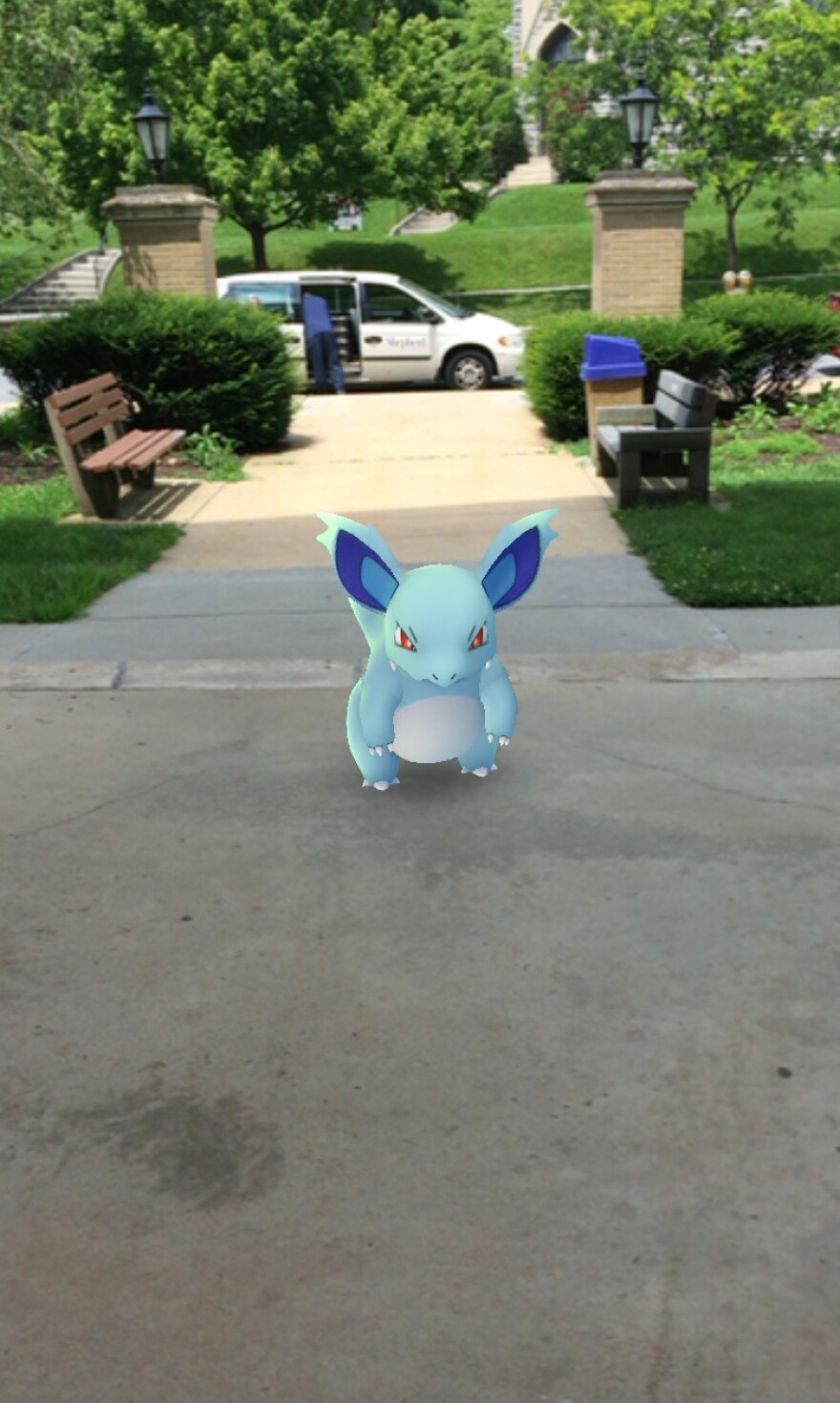
A Pokémon called Nidorina appears on my phone in front of Knutti Hall on Shepherd University’s campus.
As you walk around, wild Pokémon appear on your screen. Tap them with your finger, your camera turns on, and suddenly you see that Pokémon standing right in front of you.
“The fact that it kind of takes on this real world feeling, and gives you a feeling like there’s a layer of magic around us, it’s, I think, may have helped it spread like wildfire,” Stark explained.
That “layer of magic” comes in many forms, from the Pokémon themselves to little, blue, floating boxes that appear as you explore. These blue boxes are known as PokéStops, and they’re often placed at historic locations or landmarks.
There are dozens of PokéStops in historic Shepherdstown, from the Sweet Shop to the Rumsey Monument, celebrating James Rumsey – thought by locals to be the real father of the steamboat, the first of which was showcased in Shepherdstown.
So, is the game having an impact on local tourism? My friend Austin Susman, who is a student at Shepherd, and like me grew up in Charleston, thinks it’s entirely possible.
“The weekend it first came out, I was actually home in Charleston,” Susman said, “and I found some statues downtown that I’d never seen before; stuff in front of buildings I’d driven by every day that I never stopped to look at the statues before.”
Already, institutions like Shepherd University are looking at ways to incorporate this new phenomenon into their services, like a scavenger hunt for incoming freshmen to learn about Shepherdstown.
John Lustrea has been a seasonal park ranger there for the last four years. He’s also a Pokémon GO player. Lustrea says he’s noticed more people in the park playing the game, and he says rangers at the National Mall in Washington, D.C. are actually talking about starting hikes incorporating Pokémon GO.
Credit Pokémon GO
/
PokéStops in Harpers Ferry, WV.
“The idea is they will lead a group of people playing the game and help them catch Pokémon, and then they’ll probably talk about the variety of the monuments and historic things on the Mall,” Lustrea said.
There are concerns that come with the game, though, from distracted driving, to players getting mugged, to one player finding a dead body, and then there are also concerns in-game over data tracking and privacy.
Many of my friends say the privacy issue doesn’t really deter them from playing, including, Dylan Meushaw.
“I mean, I’m already on social media and all that crap, so my stuff’s out there already probably,” Meushaw said.
Chelsea Stark with Mashable says just a few days after the game’s release, programmers did improve some privacy aspects for users signing in with a Google account. As for the data tracking –
“I mean if you’re concerned about that, then you shouldn’t own a smartphone, because your smartphone – Apple is tracking you, Google is tracking you already if you own an Android phone, and your cell carrier is definitely tracking you,” Stark noted.
Pokémon GO has only been out for about two weeks, and it’s already left a mark on our culture. In just the first few days, it became the most downloaded cell phone app. EVER. During a summer full of political and social strife, many say the game has provided a nice getaway even if it’s only for a few moments.
So, to all my fellow GO players, get out there, explore your communities and catch Pokémon.
Add WVPB as a preferred source on Google to see more from our team
WVPB had a conversation with Us & Them host Trey Kay earlier this week on the significance today of the 250th anniversary of America’s founding. This week, WVPB is hosting a special screening event at Marshall University with excerpts from Ken Burns’ The American Revolution, and Kay will lead a panel discussion. We once again hear from Kay, this time speaking with one of the panelists — Marshall University political science professor George Davis — about why revisiting the nation’s founding story still matters.
WVPB will be screening excerpts of Ken Burns’ recent PBS documentary series "The American Revolution" this week at Marshall. Us & Them host Trey Kay will moderate the event, and he spoke recently with WVPB News Director Eric Douglas about why revisiting the nation’s founding story matters today. Also, a bill to temporarily delay moving a child to homeschooling during an active case of abuse or neglect hit a snag in the Senate on Monday.
One of America’s pioneering filmmakers had nothing to do with Hollywood but nevertheless left his mark on the emerging industry. Oscar Micheaux was a homesteader, who then turned his attention to making movies in the early 1900s. He was a Black man who made movies for Black audiences at a time when they weren’t allowed into mainstream, white-only theaters. And for several pivotal years in the 1920s, he operated out of Roanoke, Virginia.
This week, in the 1920s, Oscar Micheaux was an entrepreneur filmmaker in western Virginia. He became a world-renowned director and producer. Also, Kentucky’s poet laureate lives down the road from what has been called the country’s most lethal cryptid. Attempts to spot it have led to deaths. And, we talk soul food with Xavier Oglesby, who’s passing on generations of kitchen wisdom to his niece.