This week, ballads tell stories about all kinds of real-life events, but after Hurricane Helene, one group of ballad singers felt some topics were still too raw. Also, the author of a new book on ancient Ohio credits a former grad student with introducing him to the region’s mysterious earthworks. And, the legacy of Affrilachian poet Norman Jordan includes a summer camp for teens to study their heritage.
One of W.Va's Last Historic Gristmills Is Still Producing, But Future Is Unclear
Daniel Walker/West Virginia Public Broadcasting
Listen
Share this Article
A hundred years ago, gristmills weren’t just a place where people went to get cornmeal and flour, they were also gathering places for communities. But supermarkets replaced the local gristmill economy, and few working mills are still in operation today. One of West Virginia’s last remaining gristmills, Reed’s Mill in Monroe County, was placed on the list of endangered properties by the Preservation Alliance of West Virginia last year. The man who owns this mill, Larry Mustain, is wondering how long he can continue to keep his family’s business going.
Like so many people who grew up in West Virginia, Mustain said he had to leave the state to see the region’s real value.
“My mother and dad separated, and when I was 16 we moved away from here in 1952. They say absence makes the heart grow fonder, and I just always wanted to come back.” https://www.youtube.com/watch?v=d3Ww9bD_jgs
Mustain returned to West Virginia in 1975. He and his uncle, Orbrey Reed, farmed together, and Mustain spent a lot of time helping his uncle inside the mill. When his uncle passed away, Mustain decided to follow in his footsteps and takeover the mill.
“So much of what he taught me and knew, it’s just in me. I don’t even know it’s there.”
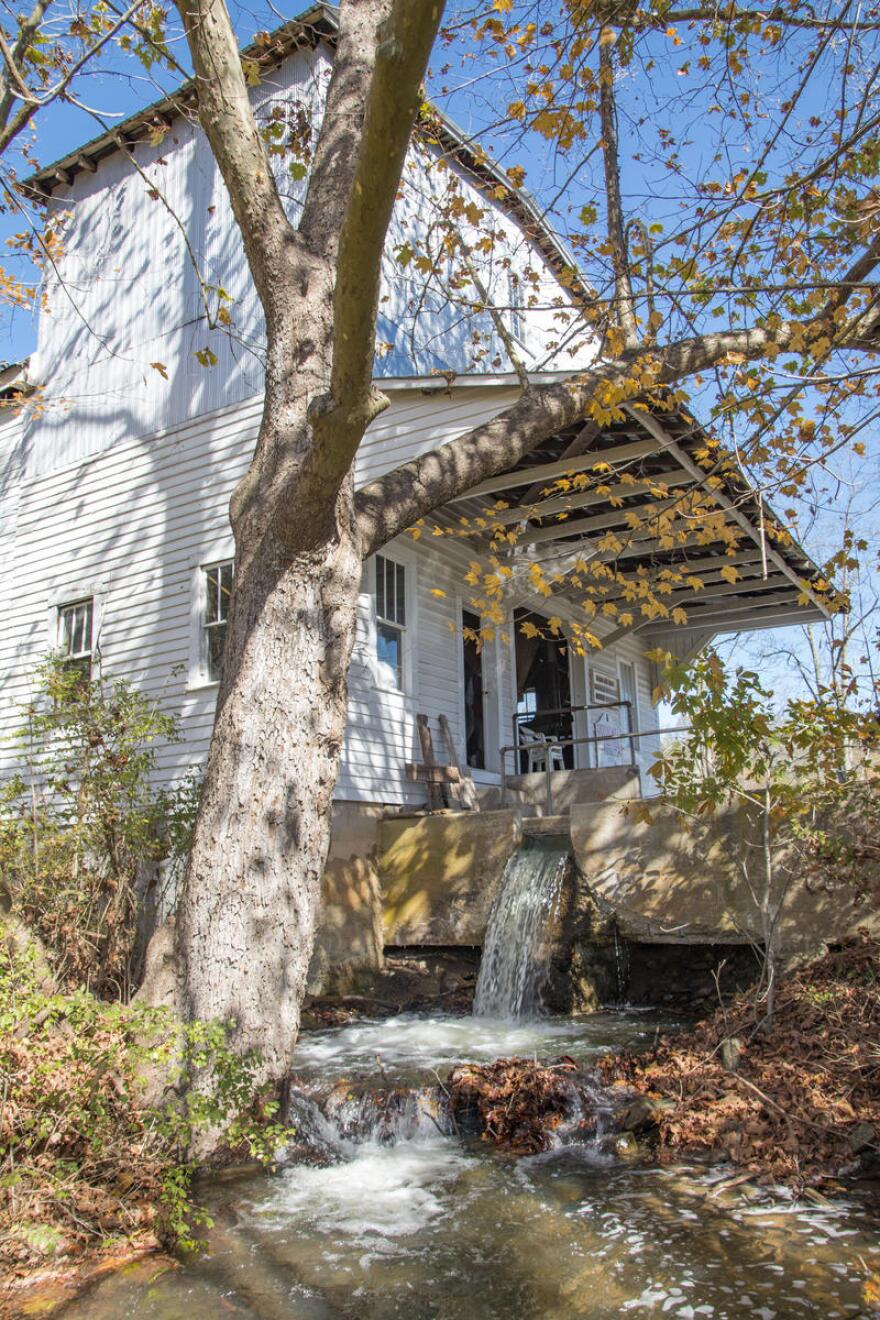
The creek that runs behind the mill, and which used to power the stone grinder, begins at the top of Peter’s Mountain. “This creek is unbelievable. It rises out of springs out of Peter’s Mountain,” Mustain said.
This small but mighty creek once powered dozens of mills. Today, only Reed’s Mill remains.
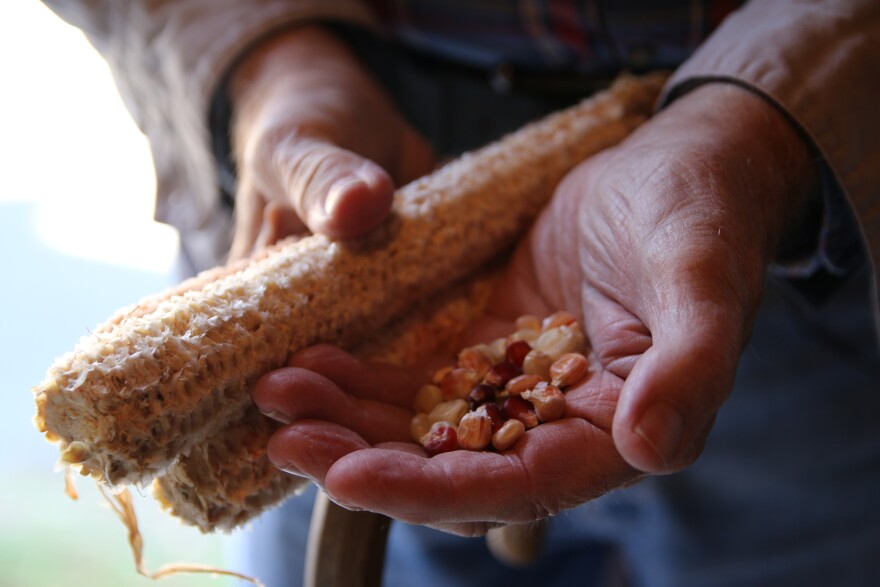
Mustain grinds and sells a special heirloom cornmeal, called Bloody Butcher. This corn has been passed down for generations, just like the mill. “It’s an open pollinated corn, you just plant it over and over.” Mustain’s uncle had a formula for selecting the corn that he would plant each year. “So many red, so many yellow, and I should have [written] all that down. But even though I was in my 40s and 50s, after I came back here, I guess I just always thought he would be here,” Mustain said.
Credit Daniel Walker/ WVPB
/
Photo credit: Daniel Walker/WVPB
Larry Mustain hold heirloom corn called Bloody Butcher, which he grinds inside his historic mill
Today, Reed’s Mill attracts visitors from all over the state, and beyond. “I keep coming back,” said Elmer Napier, who lives in Florida half of the year and in West Virginia during the summer. He said he’s visited 40 mills across West Virginia. Reed’s Mill was built in the late 1700s, but is in good shape, compared with others in the state. “I’ve become attached to it I guess,” Napier said. “I’ve been in four mills that are still grinding in the state. But they don’t do very much grinding at all anymore. I think the ones that are here will be here. Because it’s part of history and we’ve lost enough of them.”
Credit Daniel Walker/ WVPB
/
Photo credit: Daniel Walker/WVPB
Mill stones inside Reed’s Mill
Steve Dransfield lives a few miles from the mill. Like Mustain, his family has been farming in this valley for generations. He said Reed’s Mill is a part of his history too, and he’d like to help Mustain continue to keep the mill going. “I think it would be a real tourist draw to the area if we could have a few of these mills, that are left standing, to be fully operational. What [Mustain] is doing, it’s kind of amazing what he is able to do.”
Mustain is in his 80s, and he keeps this mill going the best he can. But he’s getting older, and he says he’s not sure who will be here to help take over the mill after him. He has hopes that someone in his family, maybe one of his sons, will decide to take it on. But he’s not ready to quit yet. Today, he grinds cornmeal and flour with an electric stone grinder. But his dream is to see the millstones up and running again, so the mill will grind cornmeal the old-fashioned way.
Credit Daniel Walker/ WVPB
/
Photo credit: Daniel Walker/WVPB
Reed’s Mill
And he might be getting some assistance from the Preservation Alliance of West Virginia. In 2017, the group listed Reed’s Mill as one of the top endangered properties in West Virginia. This designation is meant to highlight the risk of losing the property, and to attract attention from the public and encourage others to help restore the building. The group offers a 20 percent loan guarantee on renovation projects, which basically means they would assume part of the debt if a borrower defaults on a loan. If Mustain switched the mill to a non-profit business, he would be eligible for more assistance to help maintain and renovate the building.
For now, Mustain said he’s happy just to continue grinding. Mustain sells heirloom cornmeal, whole wheat flour, and, another West Virginia specialty, buckwheat flour.
“I am clear out of Buckwheat flour,” Mustain said, looking over his inventory inside the mill. “And I’ve had two people here today going to St. Augustine Florida [who] wanted Buckwheat. I just can’t keep up.”
Although drop in customers can sometimes find the mill open as they pass through Monroe County, Mustain recommends people call ahead, to make sure he can give visitors a tour.
Larry Mustain can be reached at 304-772-5665.
In October 2018, this video was screened at a live event in Beckley, West Virginia. Larry Mustain spoke with Inside Appalachia host Jessica Lilly about his response to the video, and his expectations for the future of his mill. https://www.youtube.com/watch?v=fAoNWcQ-GWk
This story is part of an episode of Inside Appalachia about people who are working to preserve a part of American culture and traditions. Click here to listen to the full episode.
Add WVPB as a preferred source on Google to see more from our team
An heir files suit to keep his community hospital open, disparities in the distribution of school choice vouchers, and a West Virginia lawmaker is among those targeted in White House UFC fight plot.
This week, ballads tell stories about all kinds of real-life events, but after Hurricane Helene, one group of ballad singers felt some topics were still too raw. Also, the author of a new book on ancient Ohio credits a former grad student with introducing him to the region’s mysterious earthworks. And, the legacy of Affrilachian poet Norman Jordan includes a summer camp for teens to study their heritage.
A group of off-duty, fired and retired park rangers have organized a series of Juneteenth events, including one at Harpers Ferry National Historical Park, to recognize African American history that is not approved for display at the federal sites.
































 Daniel Walker/West Virginia Public Broadcasting