This week, we reflect on Dolly Parton’s passing and her legacy in the region. Also, the Adaptive Climbers Festival at Kentucky’s Red River Gorge feels like home for climbers with disabilities from around the world. And, a new book spotlights Appalachian plants and encourages readers to get in touch with nature.
Home » Stories » Miners Worried About Losing Black Lung Benefits Through ACA Repeal
Published
Miners Worried About Losing Black Lung Benefits Through ACA Repeal
Listen
Share this Article
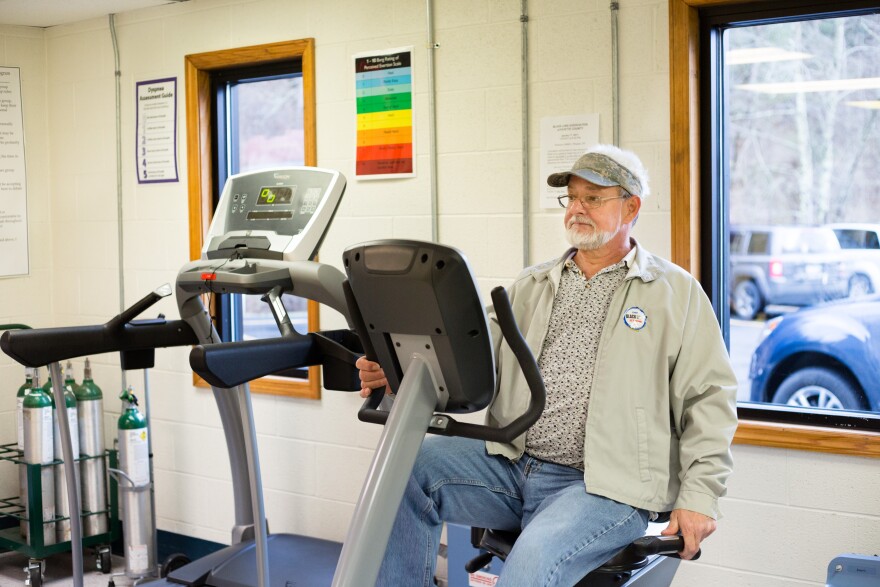
At the Pulmonary Rehabilitation Clinic in Scarbro, oxygen tubes dangle from the noses of three miners slowly pedaling on stationary bikes. All of these men have black lung – a disease caused by breathing in coal dust. Over time, the dust coats the lungs and causes them to harden. Hard lungs don’t easily expand and contract, and that makes it difficult to breath.
“You try to get air in them, and they don’t want to cooperate with you as they did before,” says retired miner James Bounds, speaking with great effort. Not every coal miner gets black lung, just as some smokers don’t get cancer. But for those who do, Bounds says, the disease is devastating.
“There’s no cure at all,” he says. “It keeps getting harder and harder until one day, I guess, you take your last breath and they won’t expand for you no more.”
Credit Kara Lofton / West Virginia Public Broadcasting
/
West Virginia Public Broadcasting
Lester Burnette bikes at the Pulmonary Rehabilitation Clinic in Scarbro.
Bounds is one of about 38,000 miners and widows currently receiving black lung benefits – compensation for the physical damage he sustained while doing his job. It took him four and a half years to get approved, despite the fact that his lungs are so bad he has to stop moving to talk.
But now the qualification process is supposed to move faster. The Affordable Care Act includes special provisions that make the process of getting black lung benefits easier for coal miners. If the ACA is repealed, gaining these benefits could become much more difficult, effectively harming a group of people President Donald Trump has promised to protect.
Debbie Wills coordinates the black lung program forValley Health primary care system. She says that prior to the ACA, it was almost impossible to qualify for the compensation benefits. Coal companies pay the benefits, and also pay into a federal trust fund that pays when coal companies can’t. Wills says theprocess was arduous for miners.
“Coal company lawyers would doctor shop around the country and find two, three, four, five, seven doctors to say, ‘Yes this miner is disabled, but it’s not because of black lung,’” she says.
The Affordable Care Act includes something called theByrd Amendments. One shifts the burden of proof -- instead of miners having to prove that mining caused their black lung, the coal companies have to prove that mining didn’t.
“You still have to prove the 100 percent disability, which is hard,” says Wills. “But if you can prove that, and if you’ve worked 15 or more years or longer in the mines, then you’re entitled to a presumption that your disease arose from your coal mine employment.”
Another part provides lifetime benefits to a dependent spouse who survives the death of a miner, if the miner had been receiving the benefits before death.
If the ACA is repealed without a replacement, cases that were approved after the ACA went into effect could be reopened, leaving the miner or surviving spouse vulnerable to losing the benefits. And, the burden of proof may shift again, making it difficult for applicants to qualify.
Earlier this month, both theHouse and theSenate introduced resolutions to preserve the Byrd Amendments from a broader ACA repeal. Rep.Evan Jenkins (R-W.Va.), an ACA opponent, introduced the measure in the House.
“I am a firm believer that Obamacare is already in a death spiral and desperately needs to be fixed,” Jenkins says. “While we are going to work to improve our health care system, I feel strongly about my resolution to make sure that the presumption relating to black lung is contained in whatever is the end product of this work this year.”
Appalachia Health News is a project of West Virginia Public Broadcasting, with support from the Benedum Foundation, Charleston Area Medical Center and WVU Medicine.
Add WVPB as a preferred source on Google to see more from our team
This week, a new report finds the number of black lung cases is at its highest since the 1970s. The human cost is high. Also, the author of a new book says reintroducing nearly extinct animals back into the wild can boost damaged ecosystems, but they can't repair them. And, roadside attractions pay tribute to our enduring fascination with weird.
A new report from the U.S. Centers for Disease Control and Prevention (CDC) finds that black lung rates are the highest they’ve been since the 1970s. Justin Hicks and Howard Burkes reported on that for the Appalachia + Mid-South Newsroom. Inside Appalachia’s Mason Adams spoke with Hicks and Burkes to dig a little deeper.
The United Mine Workers of America (UMWA) is demanding the immediate enforcement of federal silica dust protections in central Appalachian coal mines, in a statement released Thursday.
On this West Virginia Week, Gov. Patrick Morrisey gets pushback over school clothing vouchers, Huntington residents seek to ban Flock cameras, and black lung is big again.