This week, we reflect on Dolly Parton’s passing and her legacy in the region. Also, the Adaptive Climbers Festival at Kentucky’s Red River Gorge feels like home for climbers with disabilities from around the world. And, a new book spotlights Appalachian plants and encourages readers to get in touch with nature.
Marshall Co. Hare Krishna Village Reinvents Itself with Food, Color, and Community
Listen
Share this Article
A Hare Krishna community in rural Marshall County that’s been around for almost 50 years is trying to reinvent itself and its relationship with area residents. One way the community is reestablishing itself is through what’s becoming one of New Vrindaban’s biggest festivals of the year: The Festival of Colors.
Credit Chuck Kleine
/
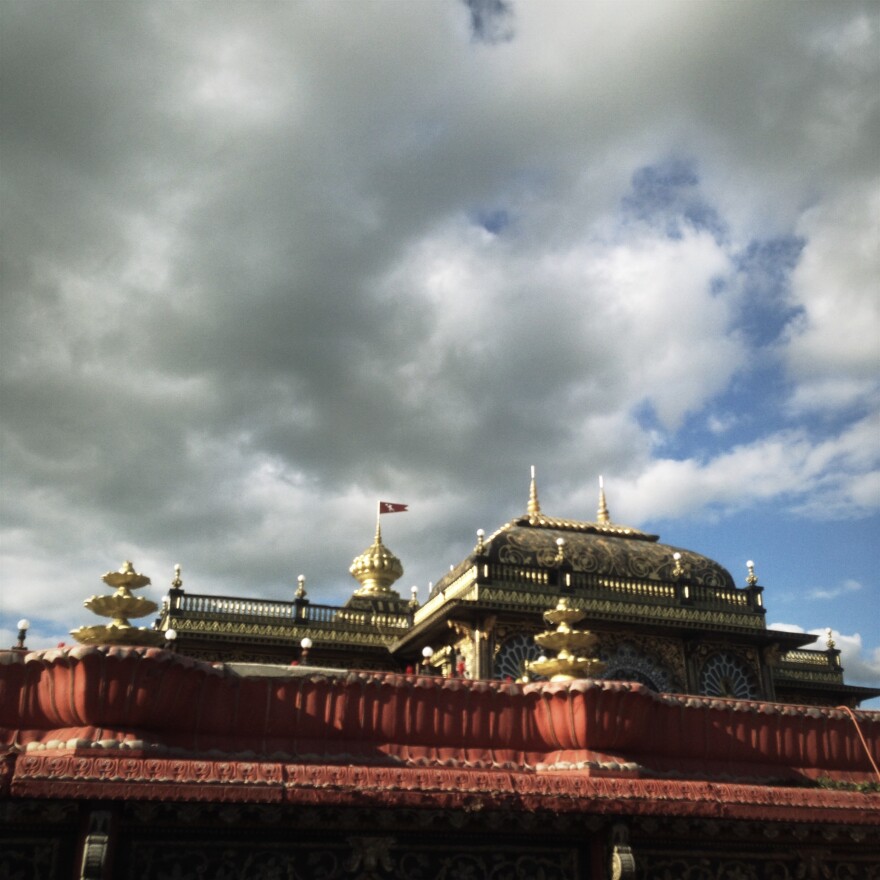
New Vrindaban’s Palace of Gold is an island of Indian culture in remote, rural West Virginia. There are rose gardens, flocks of peacocks, ponds with towering, dancing deities. With 30,000 annual visitors, it’s one of the largest tourist attractions in the state.
Rebuilding
In the early ’90s allegations of murder, fraud, and child abuse ended with several community leaders incarcerated. Many people who lived in the area through the ’80s and ’90s still cringe at the memory. Most of the then-700 devotees moved away.
Today, 20 years later, the community is made up of about 200 people. Some have been there from the beginning, some are from of the international Krishna community, and a small young group is new.
“My goal is really that we open ourselves and reconnect to the neighbors, and we are good neighbors in all perspectives,” said president of the New Vrindaban community Jaya Krsna.
“This festival was actually established so that we can invite our neighbors to come have fun with us and get to know us.”
Self-Sufficiency
Jaya Krsna is originally from Switzerland. The Krishnas recruited him three years ago to help revive New Vrindaban. One of his first goals was to move the community toward self-sufficiency, living simply, off the land.
That ideal is part of West Virginia’s heritage, too. Jaya even found and hired a local farmer, Kacey Orr, to help achieve the goal.
“The whole idea behind the religion is self-sufficiency,” Orr said. “We’re looking at about 5 years to full-seasonal self-sufficiency. It is completely doable with the resources we have.”
Credit Glynis Board / WVPublic
/
WVPublic
During the Festival of Colors Kacey Orr was passing out sweet potato fries made from the potatoes she grew on the property, and carting around flowers from one of her on-site gardens.
Community Connection
Orr’s involvement furthers Jaya’s goals to be more engaged with the community. Orr works with other local farmers as well as staff and volunteers from outside New Vrindaban.
Orr found her way to New Vrindaban through garden paths. But not many other area residents have that kind of connection to the community.
In nearby Wheeling the annual Sternwheel Festival was going on at the same time as the Festival of Colors. Area-resident Alan Cox, said he couldn’t feel further away from the Krishna community.
“We don’t see them around town, so I really don’t have an impression on them right now,” Cox said. “I drive by the place every day but, I don’t see them so they’re not really in my thoughts.”
Marshall County resident Matt Taylor, who was also at the Wheeling festival, said he remembers growing up with youth from the community, playing football. Taylor says he doesn’t harbor any animosity toward the Krishnas, but he admits there’s still some tension.
“I think that the apprehension between the communities is just the fact that they’re different,” Taylor said.
A New Day
But back up in the hills today, new generations in both communities are getting acquainted.
Area resident and high school student at John Marshall High School, Owen Minor attended this year’s Festival of Colors like he did last year.
“This is a nice festival,” Minor said. “Everybody is all happy. Everybody is kind. It’s just music playing and a lot of good energy and stuff.”
Jaya Krsna says in the late ’60s the community at New Vrindaban got a set of instructions from the founder of the Krishna faith. They are to protect cows, strive to be self-sufficient, develop a love for God, become a place of pilgrimage, and a place of spiritual training for all kinds of people. He thinks his community of 200 is walking, mindfully, in the right direction.
“We are having more and more Westerners visiting us,” said Jaya Krishna, New Vrindaban president. “It’s an interesting place to learn about another culture.”
Add WVPB as a preferred source on Google to see more from our team
On this West Virginia Week, a client for a big data center is revealed, flock cameras see resistance and social media settles in court.
Bill Lynch is our host this week. Our theme music is by Matt...
This week, we reflect on Dolly Parton’s passing and her legacy in the region. Also, the Adaptive Climbers Festival at Kentucky’s Red River Gorge feels like home for climbers with disabilities from around the world. And, a new book spotlights Appalachian plants and encourages readers to get in touch with nature.
In the wake of Dolly Parton's death on Tuesday, her Imagination Library of West Virginia has had an outpouring of comments and calls about the late singer's impact.