This week, a new generation is learning the story behind "Brown Hill," a song by influential bluegrass band The Lost and Found. Also, data centers are changing the landscape, and one project is planning to plow over an extremely rare stand of seed-producing American chestnut trees. And, small food producers embrace digital technology for the humble farm stand.
Fracking Waste Study Says States Aren't Doing Enough to Protect Public
Listen
Share this Article
A new report was published this month that looks at how states are dealing with dangerous waste produced during shale gas development. Not well, according to the report.
Defining Hazardous
The Environmental Protection Agency regulates the disposal of toxic or hazardous materials. Such waste includes things that may contain heavy metals, chemicals, dangerous pathogens, radiation, or other toxins. Horizontal drilling produces both liquid and solid waste streams which can contain heavy metals, dangerous chemicals, salts and radiation. But you will never hear it referred to as toxic or hazardous by anyone, officially.
Amy Mall, senior policy analyst with the Natural Resources Defense Council, a Washington-based nonprofit, explains that thirty years ago the EPA exempted oil and gas waste from the Resource Conservation and Recovery Act (RCRA).
“So right now, oil and gas waste, regardless of how toxic it is, can be treated like normal household waste in many parts of the country,” Mall said.
“Wasting Away”
There’s a new report: (Wasting Away – Four states’ failure to manage oil and gas waste in the Marcellus and Utica Shale) that examines this subject published by Earthworks – a nonprofit concerned with the adverse impacts of mineral and energy development. Lead author Nadia Steinzor explains that the EPA didn’t exempt the industry because the waste wasn’t considered a threat, but because state regulation of this waste was considered adequate. Of course, this was a couple decades before the horizontal gas drilling boom.
Steinzor and her colleagues decided to see what they could learn about waste practices in West Virginia, Ohio, Pennsylvania, and New York, where Marcellus and Utica shale gas are being developed.
The report indicates that states are well behind the curve in adapting to the natural gas boom: good characterizations of the waste is incomplete according to a 2014 study that’s cited; and not much information is available about where the waste is coming from, going to, or how it gets there.
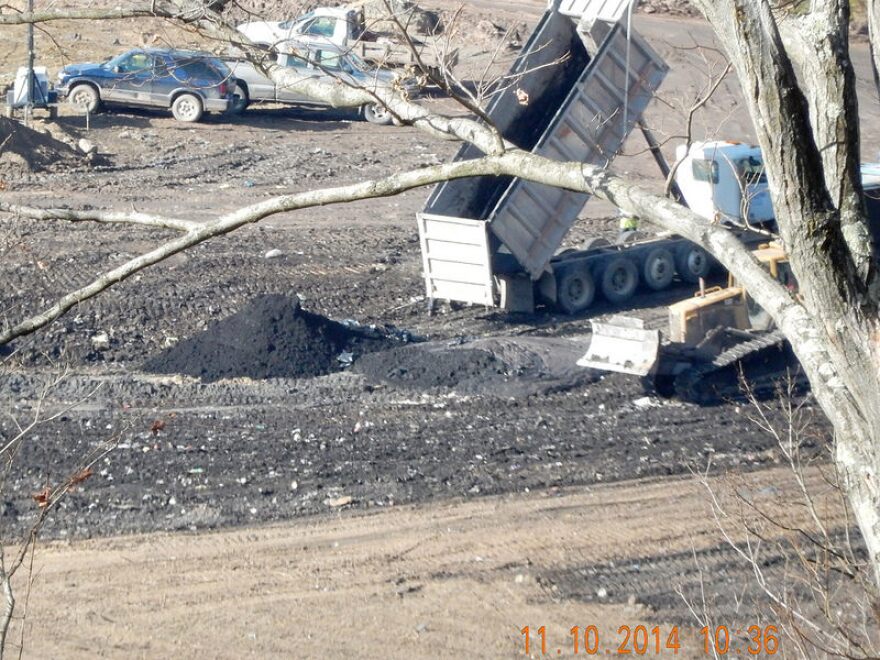
Credit Bill Hughes
/
Drill cuttings dumped at WV landfill.
West Virginia’s Oil and Gas Waste Management
West Virginia Department of Environmental Protection officials say most information that does exist about oil and gas production and waste disposal procedures is available online. What information isn’t public can be accessed with a fee and a Freedom of Information Act request.
DEP spokesperson Kelley Gillenwater says her agency is going above and beyond what’s required by law to make information more accessible and is currently working on a project to digitize and make public the information they collect. She says, however, that project is in the early stages and a timeframe for completion doesn’t exist yet.
Steinzor’s report argues that states don’t require enough information and often rely on operators to self-report in good faith.
The Earthworks report cites a 2013 study that says nearly half of all liquid oil and gas waste is shipped out of state, the remainder is injected underground. But Amy Mall from NRDC says rules for injection wells everywhere are also in need of attention.
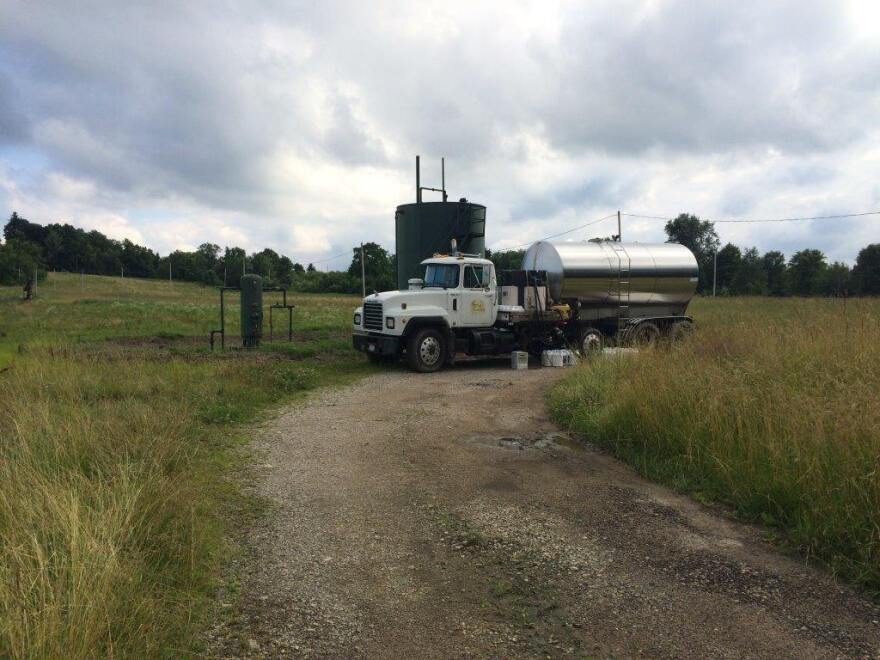
Credit Teresa Mills
/
Truck at an injection well in Ohio.
“We think the rules for those disposal wells need to be much stronger than they are now because those disposal wells are not designed to handle toxic waste.”
Steinzor does credit West Virginia for taking some steps to address solid waste problems in the state. The sheer volume of drill cuttings, which at one point was simply being buried onsite, may have helped force the issue. Municipal landfills do accept the waste even though it’s largely uncharacterized. Requirements are now in place for the waste to be held in separate storage cells within landfills and DEP is working with Marshall University to study the leachate from those facilities. Results from that study are scheduled to be presented to state lawmakers this July.
West Virginia University is also teaming with the Department of Energy to better characterize waste streams from two Marcellus wells in Morgantown. Drilling is expected to begin in November.
Environmental Advocates
One other thing West Virginia may have going for it is a small office within the DEP, the Environmental Advocate Office.
“The advocate office really grew out of DEP’s recognizing that there’s a growing environmental awareness in the public and that citizens want to be part of the conversation,” said John King, an Environmental Resource Analyst within the Advocate Office.
“More important than that: DEP recognizes that public participation is essential to environmental protection.”
King fields many calls from citizens concerned about oil and gas waste management as well as other issues related to gas development. While it may not be the responsibility of members of the public to be the boots on the ground for the DEP, King says protecting state resources and public health may nonetheless require participation and investment of communities throughout the state. His office is interested in facilitating better communication between industry and community stakeholders.
Add WVPB as a preferred source on Google to see more from our team
On this West Virginia Week, former governor and longtime U.S. senator Jay Rockefeller has died, West Virginia voted in the general election, and a new anthology explores science fiction and fantasy in Appalachia.
Bob Thompson’s annual holiday jazz celebration is back! Joining Thompson on stage is his long-time bandmates Timothy Courts on drums, Ryan Kennedy on guitar, John Inghram on bass, plus special guest vocalist Lena Seikaly with James Moore on trumpet. Buy your tickets today!
These Dreaming Hills is a new horror and science fiction anthology collecting stories from across Appalachia. Inside Appalachia's Bill Lynch spoke with editor Noah Ashley Blooms about the book.
West Virginia's Attorney General JB McCuskey continues his campaign against social media companies for putting children at risk. Thursday he announced a lawsuit against Snap Inc., the maker of Snapchat.