This week, we’re revisiting a show featuring storytellers out loud in front of audiences. Folks like five-time champion of the West Virginia Liars’ Contest, Bil Lepp. Also, musicians Anna & Elizabeth, whose storytelling used something known as a crankie. And, we’ll head to the International Storytelling Center in Jonesborough, Tennessee.
Home » Stories » Five Ways to Change Someone's Mind
Published
Five Ways to Change Someone's Mind
Listen
Share this Article
With the budget fight in West Virginia and larger battles nationally over Trump, it’s a good time to talk about talking with one another.
Here are five concepts from social science about how to change someone’s mind. (Hint: It’s not easy.)
1. Reframing – Use the other sides’ values when making a case for your side. For examples, liberals could reframe arguments for Medicaid around maintaining a strong defense (unhealthy Americans make poor soldiers.)
2. The Elephant and the Rider – The rational brain is trying to control emotions and instincts, which are much more powerful, Rick says.
Instead of just appealing to the elephant rider (rational mind), it is better to appeal straight to the elephant (emotion and instinct.) Strong personal ties can overcome political divides – as we’ve discovered on The Front Porch.
Credit Paul Wahrhaftig
/
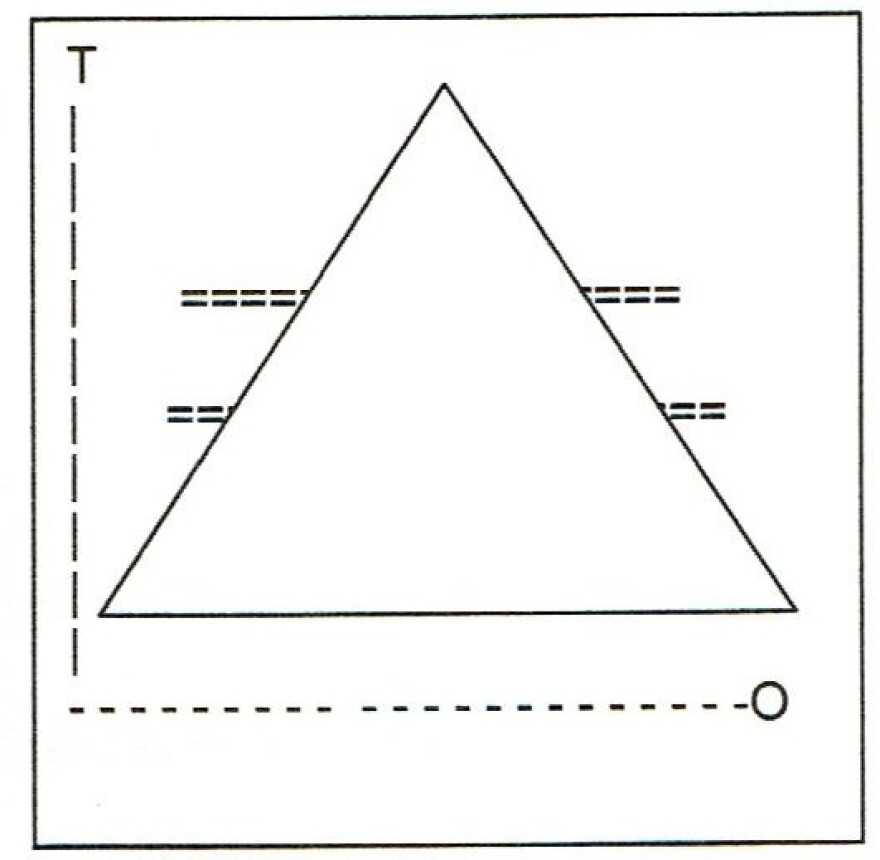
The tension triangle shows how as tension rises (T), perceived options (O) narrow.
3. Tension Triangle – The more stress you’re under, the fewer options you see. Rick says one strategy is to decrease the tension first, then try to find a solution.
4. Anchoring – This is about setting the terms of the negotiation. One example is selling a house – if you set the sale price high, it may lead to higher offers.
But as Laurie points out, if your anchor is seen as too ridiculous, you can lose credibility (like if you put a $1 million price tag on your double-wide trailer.)
5. Prisoner’s dilemma – In classic game theory, when two prisoners are unlikely to see each other again, they’re more likely to screw over the other person.
Or, as Rick explains on the podcast, never buy a Ford F-150 in a Wal-Mart parking lot.
Also on the podcast, we’ll discuss what social media is doing to us. Are we talking to each other or past one another?
Welcome to “The Front Porch,” where we tackle the tough issues facing Appalachia the same way you talk with your friends on the porch.
Hosts include WVPB Executive Director and recovering reporter Scott Finn; conservative lawyer, columnist and rabid “Sherlock” fan Laurie Lin; and liberal columnist and avid goat herder Rick Wilson, who works for the American Friends Service Committee.
An edited version of “The Front Porch” airs Fridays at 4:50 p.m. on West Virginia Public Broadcasting’s radio network, and the full version is available at wvpublic.org and as a podcast as well.
Share your opinions with us about these issues, and let us know what you’d like us to discuss in the future. Send a tweet to @radiofinn or @wvpublicnews, or e-mail S cott at sfinn @ wvpublic.org
The Front Porch is underwritten by the Pulitzer Prize-winning Charleston Gazette-Mail. Find the latest news, traffic and weather on its CGM App. Download it in your app store, and check out its website: https://www.wvgazettemail.com/
Add WVPB as a preferred source on Google to see more from our team
The WVPB News Department was honored with Overall Excellence in the Radio Small Market category. Us & Them, which is hosted by Trey Kay, was honored with Excellence in Diversity, Equity, and Inclusion for the episode Us & Them: Black West Virginians With Substance Use Disorder Face Unique Challenges. Regional winners automatically move on to the national round for consideration.
On this West Virginia Week, the primary election in the state turns ugly and racist, an ambulance driver is indicted for the death of a man in Elkview and Democrats call for an investigation of Senator Jim Justice.
On this West Virginia Week, an opioid settlement reaches a milestone, gas prices shock Sen. Shelley Moore-Capito, R-W.Va., and we have more information on the recent chemical spill near Nitro.