This week, a new roleplaying game gives folks in the workplace a chance to be a mythical Appalachian monster. Also, southeast Ohio’s Nelsonville Music Festival celebrates its 20th anniversary in June. We talk with the founder about what keeps people coming back. And, members of a Ukrainian Catholic church in Wheeling, West Virginia, make pierogies for their community every week. What makes them so good?
The Center for Disease Control reports that one in 68 children in the U.S. will have autism. That number jumps to 1 in 42 if we’re just talking about boys. And the risk increases if you already a have a child with autism. In West Virginia, new research is underway to try to get at how the autistic mind ticks.
Credit West Virginia University
/
West Virginia University
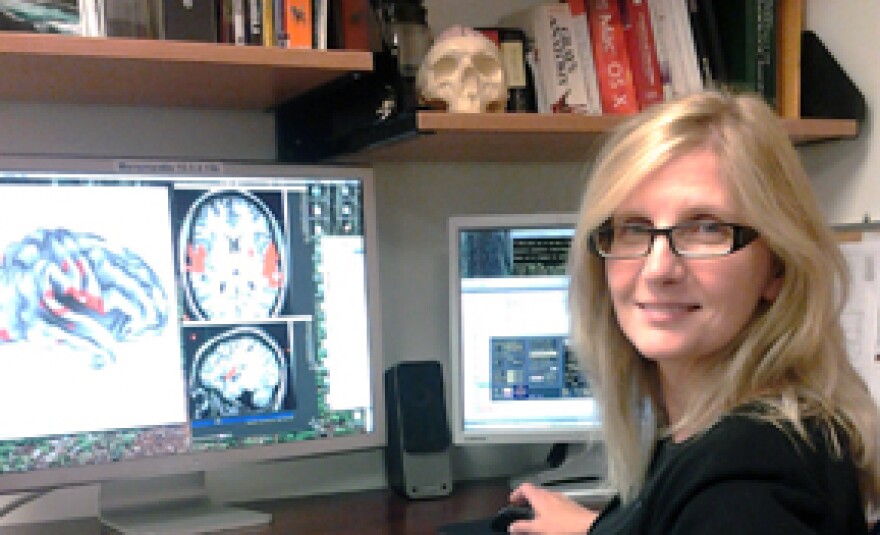
Paula Webster at the Center for Neuroscience at WVU.
Paula Webster is a neuroscience graduate who works in the Department of Neurobiology and Anatomy at the Center for Neuroscience at West Virginia University.
While a psychology major at Wheeling Jesuit University, Webster discovered her three-year-old son was on the Autism Spectrum. She became a therapist who practiced applied behavioral analysis (ABA). But Webster wants to know more than how to intervene after diagnosis.
This is the first biomedical research into autism at the university. The study hopes to incorporate subjects in a wide range of ages—children through adults.
Webster works with Assistant Professor at WVU James Lewis, a neuroscientist. They taking and studying images of the brains of people with and without autism performing certain tasks.
The research isn’t just focused on what parts of the brain kids and adults with autism use, but also how they process information. It’s clear, said Webster, that there are many with autism who compensate to accomplish tasks. She hopes that by imaging high-functioning individuals with autism she may be able to start to characterize some of the methods of compensation they’re using.
Webster speculates it may be those mechanisms that allow them to be high-functioning.
“I think we can get at trying to characterize some of those compensatory mechanisms a little bit better,” Webster said, “and correlate those with sub-scores of autism scores to try to get some sub-types of autism.”
Webster hopes the research will go towards influencing the various therapies that exist as well as possibly providing a way to diagnose autism earlier, which in and of itself would be a powerful tool to help abate the condition.
Add WVPB as a preferred source on Google to see more from our team
High school and college graduates can qualify for positions working with autistic children as well as people with a wide range of behavioral health needs.
The WVPB News Department was honored with Overall Excellence in the Radio Small Market category. Us & Them, which is hosted by Trey Kay, was honored with Excellence in Diversity, Equity, and Inclusion for the episode Us & Them: Black West Virginians With Substance Use Disorder Face Unique Challenges. Regional winners automatically move on to the national round for consideration.
Monsters in the workplace? Maybe. Carnegie Mellon University in Pittsburgh is developing a team building game using Appalachian cryptids like Bigfoot and the Flatwoods Monster. Inside Appalachia’s Mason Adams spoke with Jessica Hammer, associate professor and director of the university’s Center for Transformational Play, to learn more.