Alert (06/23/2026): Our Bluefield FM 88.5 signal is experiencing technical difficulties and is off the air. Our engineers are actively addressing the issue. Thank you for your patience.
On this West Virginia Week, the world’s largest transportable Ferris wheel arrives in Charleston, the SNAP ban on soda is blocked, and we look at an effort to expand local medical care through EMS.
Home » Stories » Artists, Scientists Collaborate on Sculpture Project at WVU
Published
Artists, Scientists Collaborate on Sculpture Project at WVU
Listen
Share this Article
For most college students, summer is the time to go home and relax from a year of hard work. But some students stayed in Morgantown to work on a unique project that brings the sciences and arts together.
Jessica Hoover created the Community Engaging in Science through Art program, also known as CESTA. She’s an assistant professor of chemistry at West Virginia University. Hoover came up with the idea to bring together students from the arts and sciences to create an installation that will live outside WVU’s Evansdale Campus Library, in Morgantown.
Six students from art, chemistry and engineering disciplines worked for a month to create, build and install the art piece.
“We selected students based on what we thought would be kind of the strength needed for this kind of program their ability to really collaborate and communicate well,” Hoover said. “And their ability to bring different disparate skill sets to the group.”
NSF-Funded Project
CESTA is a 4-year research program funded through the National Science Foundation with the intent of students improving the understanding and appreciation between chemists, engineers and artists.
Credit Aaliyah Brown / West Virginia Public Broadcasting
/
West Virginia Public Broadcasting
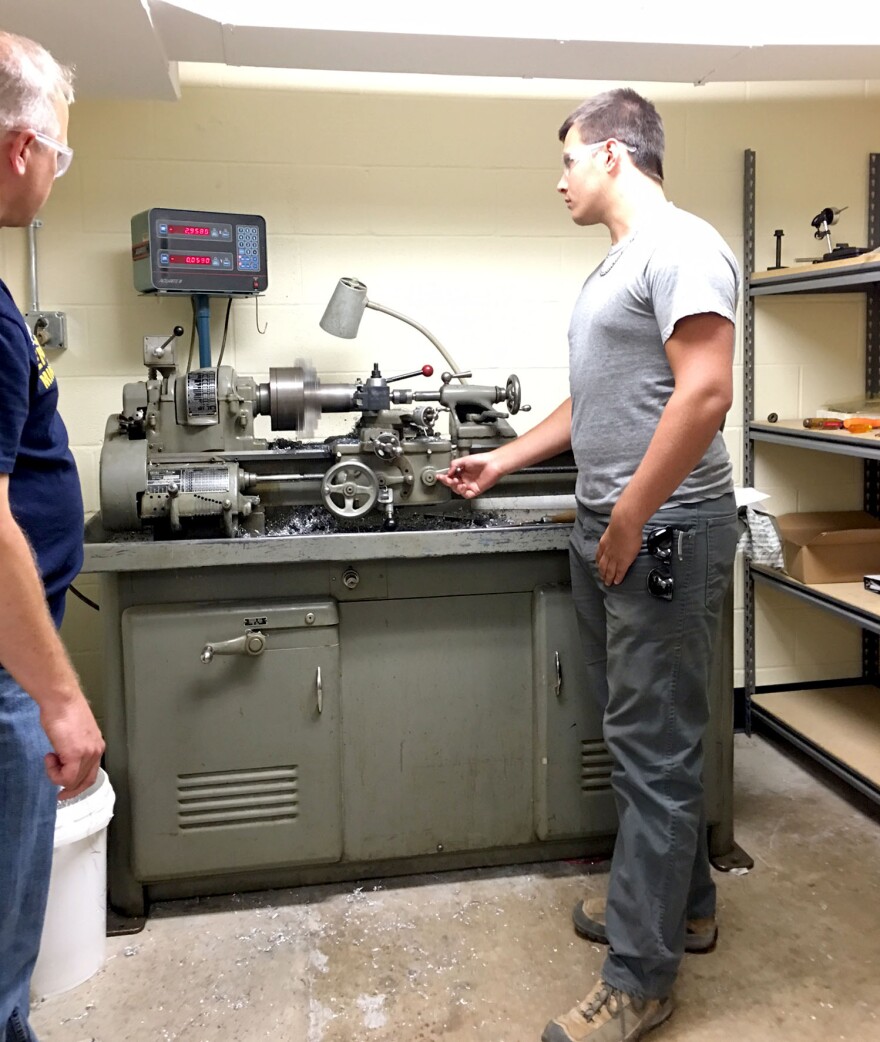
CESTA project participants work on the sculpture at WVU.
Students were intentionally given an idea that was logistically impossible to carry out. The challenge was to find a way to make it work. They decided to build a molecular sculpture that would represent the artistic side of chemistry.
Art student Ernie Williams worked on the project.
“The design is based off two different molecules, being glucose molecule and then a PTC,” he said. PTC stands for phenylthiocarbamide. “And the idea is that glucose represents the taste of sweetness and PTC is a molecule that tastes really bitter.”
Williams has an undergraduate degree from WVU and is now a graduate student at the University of Virginia, in Charlottesville.
Students were able to apply online. The application was open to all college students, and only the strongest applicants were selected based on their ability to work as a team.
There’s also an augmented reality aspect to the art installation. Those who have an AR device will be able to see a virtual library of quotes, articles and anything that has to with the theme of bitter-sweet.
Great Start
This is the first year of the CESTA program and Jessica Hoover said she’s really pleased with the way it went.
“This group of students has been fantastic they have done more and better than we expected them to, because we gave them a very nebulous task,” she said.
Hoover said she hopes for the same results of perfection and diligence from the students during the next three years of the program.
“It’s really cool to see how those skill sets align really well with one another and how each component or each background of each of these students has been really integral to the project,” she said.
Each summer, six different students from the same disciplines will continue to create these science-art pieces of their own until the research grant has ended.
Add WVPB as a preferred source on Google to see more from our team
This week, some folks are working to preserve the memory of Bristol, Virginia’s Black Bottom, a largely African American community wiped out by urban renewal. Also, small food producers embrace digital technology for the humble farm stand. And, kudzu; it’s coming for us.
Urban renewal in the last century was supposed to revitalize struggling cities, but it often sacrificed Black neighborhoods and business districts, like Black Bottom in Bristol, Virginia. Inside Appalachia’s Mason Adams spoke with organizer Tina McDaniel about “The Souls of Bristol’s Black Bottom,” a project in Bristol that remembers the community through interpretive signs, public art and digital storytelling. McDaniel says learning about Black Bottom was a revelation.
Construction is underway for the America 250 Wheel, the world's largest portable Ferris wheel and a centerpiece of West Virginia's America250 celebration.