Alert (09/10/2026): Our Parkersburg TV transmitter is undergoing maintenance for a few days and will not be operational. We apologize for any inconvenience.
All our programming is available via our TV livestreams on our website and WVPB Passport. Thank you for your patience!
Appalachians have always made use of the region’s wide variety of plants. A new book, called Appalachian Plants: In the Garden, In the Yard, and In the Wild, explores some of the history and lore of regional staples. It’s written by Linda Hager Pack and illustrated by Pat Banks. Inside Appalachia Host Mason Adams spoke with them.
Home » Stories » A New Disease Strikes Oak Trees in W.Va.
Published
A New Disease Strikes Oak Trees in W.Va.
Listen
Share this Article
Last fall, Danielle Martin, a forest pathologist for the U.S. Forest Service in Morgantown, and her colleagues noticed something different about the oak trees in Seneca State Forest. The trees secreted an amber-colored sap, and bore cankers – which look like canker sores – underneath their bark.
“We saw a vertical crack with perhaps some weeping, a bleeding appearance – like an amber bleeding – and that’s when we’d remove the bark and look for cankers,” Martin said.
Martin worked with Matt Kasson, an assistant professor of forest pathology at West Virginia University, and his graduate students to diagnose those trees with diplodia corticola. Diplodia corticola is an aggressive disease that limits the ability of oak trees to access essential nutrients and water, ultimately killing them. It was first reported in Europe, and has since emerged in Florida, California, Massachusetts and Maine. This is the first time that it’s been found in oak trees in West Virginia.
While the timber industry is aware of the new disease, they’re not concerned just yet. Kasson says West Virginia residents should be concerned because as oak trees weaken, they are more likely to fall and hurt people – especially in recreational areas.
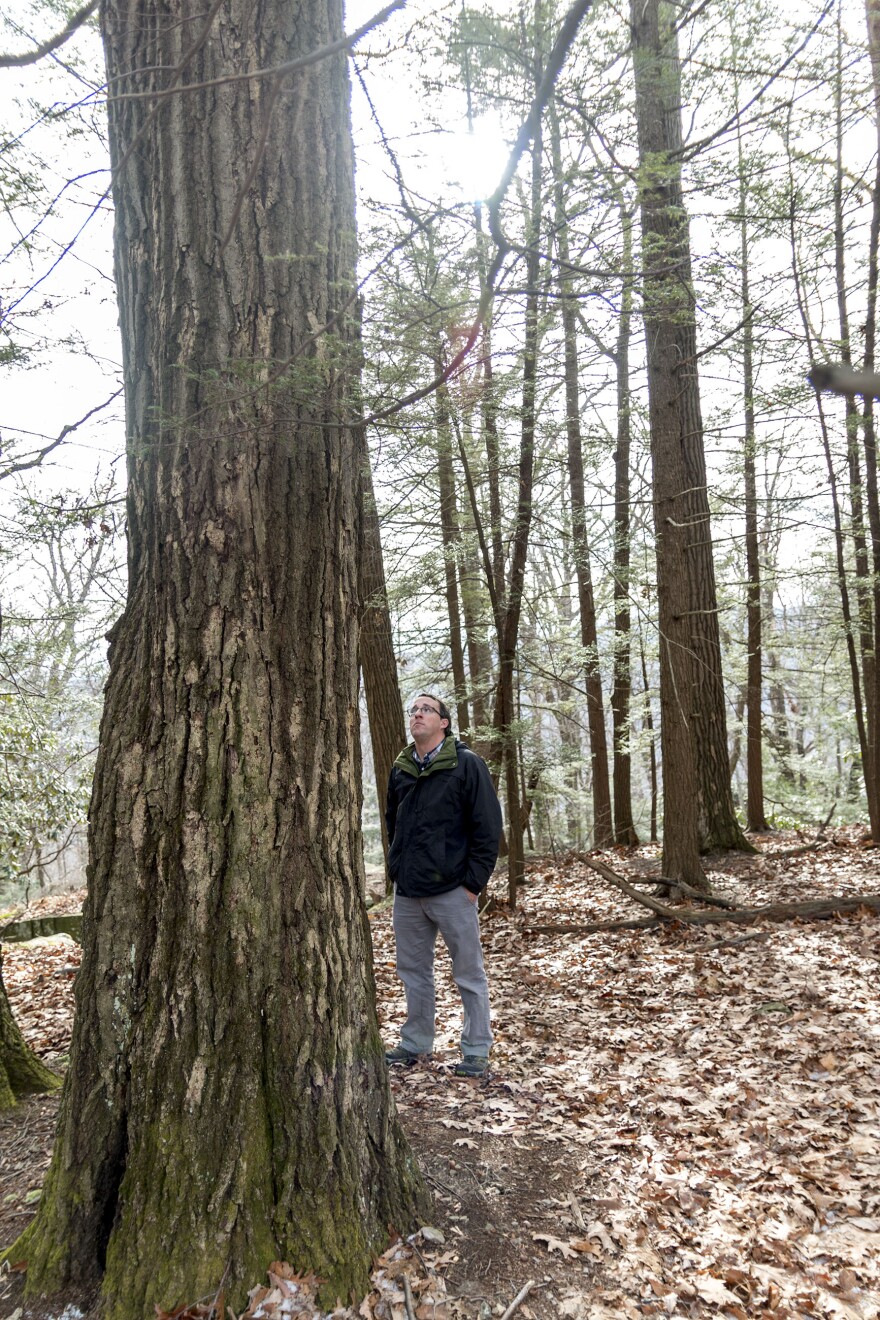
Credit Jesse Wright / West Virginia Public Broadcasting
/
West Virginia Public Broadcasting
Matt Kasson, an assistant professor of forest pathology at WVU, examines an oak tree at Coopers Rock State Forest in Morgantown.
“Look at that tree! You can see that it’s dead. That tree is completely dead,” Kasson said, pointing at a tree near a playground at Coopers Rock State Forest in Morgantown. “That tree has been in a state of decline for a number of years, and it poses a great risk, especially to the playground area.”
Tree diseases aren’t new to West Virginia. In the early 1900s, chestnut blight wiped out billions of chestnut trees in the United States, including those in Appalachia. Hemlocks and ash trees are also battling illnesses. In fact, Martin says, these tree diseases coupled with mass logging may have helped diplodia get its start in southern West Virginia.
“The majority of the Appalachian forests were cut about 100 years ago, so all of our trees are about the same age,” she said. “So they’re all kind of equally susceptible in a way to these pathogens. If something affects them, it could potentially affect all of them.”
Fortunately, Martin isn’t concerned about diplodia wiping out oak trees on a large scale in the area. She does think the disease will weaken the trees as a whole, making them more vulnerable to stressors like drought or insect infestations or flooding that could serve as the final blow to the tree’s health. Kasson agreed.
“I think us detecting this diplodia canker on oak is only the beginning. I think with all this flooding that we’ve had this past summer, we will see a sharp rise in the amount of predisposition and subsequently in the rise of fungal infections in oaks and in other tree species in that part of the state,” he said.
The two will look into what is causing the outbreak in West Virginia and what could be used to cure it, in hopes that they can find an end to what seems to be the beginning of a new tree disease outbreak.
Add WVPB as a preferred source on Google to see more from our team
West Virginia has seen at least five major flood events over the last two years, but the head of emergency response in the state says changes coming to the Federal Emergency Management Agency (FEMA) are throwing a monkey wrench into federal support.
Many West Virginians may not remember the name Doris “Dorie” Miller, but he served on the USS West Virginia when it was attacked at Pearl Harbor. While Miller was never trained to fight, he raced to the deck on the day of the attack and fought back - shooting down at least one enemy plane. In 2020, a new aircraft was commissioned by the U.S. Navy and named for Miller. But recent stories have surfaced with talk of renaming it after President Donald Trump. We speak with Scott Womack, the commander of American Legion Post 100 in Monroe, West Virginia, to discuss the group’s recent resolution that the Navy should retain Miller’s name on the ship.
On this West Virginia Week, the state signs a memorandum of understanding about nuclear energy, the Public Service Commission disputes need for a transmission line, and 9/11 is remembered.
A staff engineer testified that there is little evidence of the project’s benefit to West Virginians and the most likely outcome of the MARL project not being built is the energizing of fewer data centers in Virginia.