This week, ballads tell stories about all kinds of real-life events, but after Hurricane Helene, one group of ballad singers felt some topics were still too raw. Also, the author of a new book on ancient Ohio credits a former grad student with introducing him to the region’s mysterious earthworks. And, the legacy of Affrilachian poet Norman Jordan includes a summer camp for teens to study their heritage.
Home » Stories » Series Will Explore The Past And Present Of Cancer Research
Published
Series Will Explore The Past And Present Of Cancer Research
Share this Article
Special thanks to Charleston Area Medical Center, exclusive underwriter for West Virginia Public Broadcasting’s presentation of Ken Burns Presents Cancer: The Emperor of All Maladies, A Film By Barak Goodman.
A Charleston Area Medical Center doctor, Suzanne Cole, is featured in episode three’s exploration of the current state of cancer treatment. Watch episode three, “Finding An Achilles Heel,” April 1 at 9 p.m. on WVPB.
Credit Courtesy of the Dana Farber Institute.
/
Dr. Sidney Farber with colleagues, c. 1950.
CANCER: THE EMPEROR OF ALL MALADIES tells the comprehensive story of cancer, from its first description in an ancient Egyptian scroll to the gleaming laboratories of modern research institutions. At six hours, the film interweaves a sweeping historical narrative with intimate stories about contemporary patients, and an investigation into the latest scientific breakthroughs that may have brought us, at long last, within sight of lasting cures.
In addition to the television series, the website cancerfilms.org contains a producer’s blog, media gallery and story wall.
The film comprises the following three episodes:
Episode 1 (9 p.m., Monday, March 30) MAGIC BULLETS: The search for a “cure” for cancer is the greatest epic in the history of science. It spans centuries and continents, and is full of its share of heroes, villains and sudden vertiginous twists. This episode follows that centuries-long search, but centers on the story of Sidney Farber, who, defying conventional wisdom in the late 1940s, introduces the modern era of chemotherapy, eventually galvanizing a full-scale national “war on cancer.” Interwoven with Farber’s narrative is the contemporary story of little Olivia Blair, who at 14-months old is diagnosed with T-cell acute lymphoblastic leukemia, which spreads to her brain and spinal column. The film follows her as she and her parents struggle with the many hardships and decisions foisted upon a cancer patient. She remains in full remission a year after her diagnosis, but is still on her journey to finish her three-year treatment plan.
Episode 2 (9 p.m., March 31) THE BLIND MEN AND THE ELEPHANT: This episode picks up the story in the wake of the declaration of a “war on cancer” by Richard Nixon in 1971. Flush with optimism and awash with federal dollars, the cancer field plunges forward in search of a cure. In the lab, rapid progress is made in understanding the essential nature of the cancer cell, leading to the revolutionary discovery of the genetic basis of cancer. But at the bedside, where patients are treated, few new therapies become available, and a sense of disillusionment takes hold, leading some patients and doctors to take desperate measures. It is not until the late 1990s that the advances in research begin to translate into more precise targeted therapies with the breakthrough drugs Gleevec and Herceptin. Following the history during these fraught decades, the film intertwines the contemporary story of Dr. Lori Wilson, a surgical oncologist who is diagnosed with invasive breast cancer in both breasts in 2013. Her emotional and physical struggles with the disease provide a bracing counterpoint to the historical narrative.
Credit Courtesy WETA.
/
Emily Whitehead with Dr. Grupp.
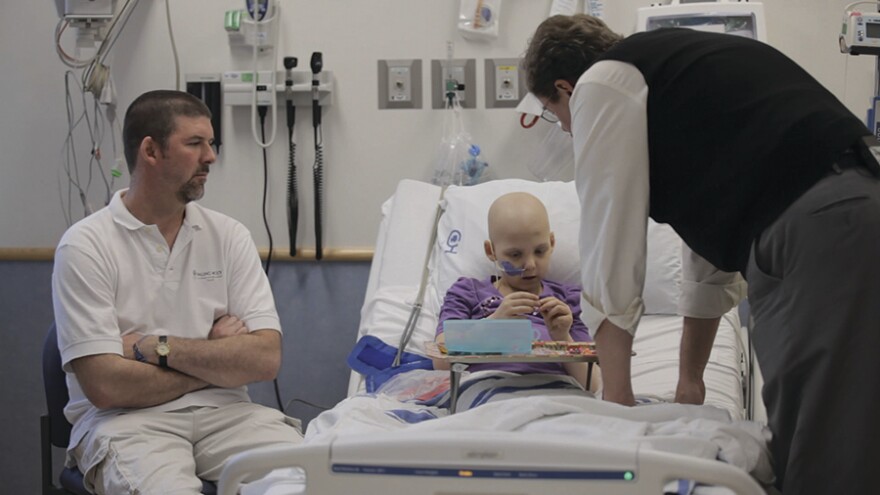
Episode 3 (9 p.m., Wednesday, April 1) FINDING AN ACHILLES HEEL: This episode picks up the story at another moment of buoyant optimism in the cancer world: Scientists believe they have cracked the essential mystery of the malignant cell and the first targeted therapies have been developed, with the promise of many more to follow. But very quickly cancer reveals new layers of complexity and a formidable array of unforeseen defenses. In the disappointment that follows, many call for a new focus on prevention and early detection as the most promising fronts in the war on cancer. But other scientists are undeterred, and by the second decade of the 2000s their work pays off. The bewildering complexity of the cancer cell, so recently considered unassailable, yields to a more ordered picture, revealing new vulnerabilities and avenues of attack. Perhaps most exciting of all is the prospect of harnessing the human immune system to defeat cancer. This episode includes patients Doug Rogers, a 60-year-old NASCAR mechanic with melanoma, and Emily Whitehead, a six-year-old child afflicted with leukemia. Each is a pioneer in new immunotherapy treatments, which the documentary follows as their stories unfold. Both see their advanced cancers recede and are able to resume normal lives.
The Film Project
A collaboration of Florentine Films, Laura Ziskin Pictures and WETA Washington, DC, in association with Ark Media, the series is based on the Pulitzer Prize-winning book The Emperor of All Maladies: A Biography of Cancer (Simon & Schuster 2010) by Siddhartha Mukherjee, M.D. Hollywood producer Laura Ziskin (Pretty Women, Spider-Man), a Stand Up To Cancer co-founder, had wanted to produce a documentary about cancer from the time she had been diagnosed with breast cancer in 2004. Having read an advanced review of the book, Ziskin quickly contacted Dr. Mukherjee, who awarded the rights to the Entertainment Industry Foundation on behalf of SU2C in December 2010. Simultaneously, WETA president and CEO Sharon Percy Rockefeller read the book during her treatment for cancer at The Johns Hopkins Kimmel Comprehensive Cancer Center in Baltimore. Shortly thereafter, Rockefeller connected with Burns, who lost his mother to cancer when he was 11. The two connected with Ziskin, and in early 2011 brought on filmmaker Goodman. (Ziskin, who lived with cancer for seven years, died in June 2011.)
Add WVPB as a preferred source on Google to see more from our team
The Golden Horseshoe is a long-standing West Virginia tradition dating back to 1931 that honors eighth grade students who excel in West Virginia history.
Monsters in the workplace? Maybe. Carnegie Mellon University in Pittsburgh is developing a team building game using Appalachian cryptids like Bigfoot and the Flatwoods Monster. Inside Appalachia’s Mason Adams spoke with Jessica Hammer, associate professor and director of the university’s Center for Transformational Play, to learn more.
A cancer diagnosis can be devastating. And tragic when it happens to a child. But when multiple childhood cancer cases appear in a community, folks start asking questions. That’s what’s happening in Scott County, Virginia. Scott County has seen a dramatic rise in childhood cancer diagnoses. Marina Waters is a reporter who’s been covering the issue.