This week, call it a superstition, but plenty of knitters definitely believe in "the sweater curse." Also, students at Floyd, Virginia’s Handmade Music School take a lesson from Alice Gerrard. And, one in three Appalachian coal miners is affected by black lung. Even though we’ve known how to prevent it for decades.
WVPB’s Us & Them Podcast To Host Taping At West Virginia University
Share this Article
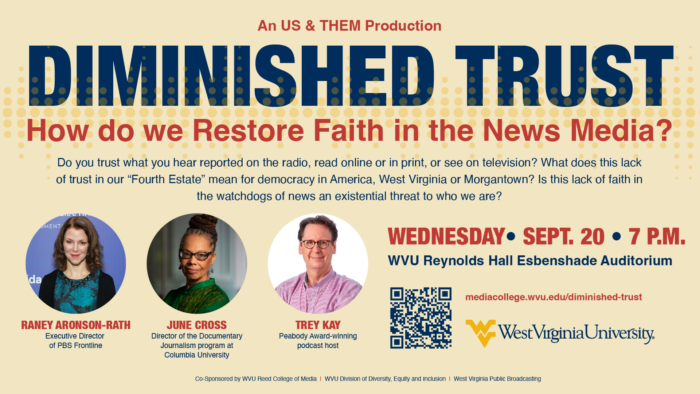
Join us Wednesday, Sept. 20 at 7 p.m. in Reynolds Hall on the WVU Campus
MORGANTOWN, WV — The public is invited to join Us & Them podcast host Trey Kay for a deep discussion on journalism and trust in the news media.
“Diminished Trust: How Do We Restore Faith In The News Media?” will take place Wednesday, Sept. 20 at 7 p.m. in Reynolds Hall on the West Virginia University (WVU) campus. Kay will talk with special guests Raney Aronson-Rath, editor-in-chief and executive producer of PBS Frontline, and June Cross, director of the documentary journalism program at the Columbia Journalism School.
The event is free and open to the public and includes a Q&A section for attendees with precedence given to students. The live event will be taped for use in a future episode of Us & Them.
The event is co-sponsored by WVU’s Reed College of Media, the WVU Division of Diversity, Equity & Inclusion, the West Virginia Humanities Council and West Virginia Public Broadcasting, the broadcasting home of Us & Them.
Kay says the premise of the episode is right in the title. “Do you trust what you hear reported on the radio, read online or in print, or see on television?” Kay asks. “What does a lack of trust in our “Fourth Estate” mean for democracy in America? In the Mountain State? In Morgantown? At a land-grant university like West Virginia University? Is this lack of faith in the watchdogs of news an existential threat to who we are? How do we regain this trust? These are critical questions today.”
Us & Them guests and host are respected in their fields:
Raney Aronson-Rath is the editor-in-chief and executive producer of Frontline, PBS’ flagship investigative journalism series, and is a leading voice on the future of journalism. She oversees the program’s acclaimed investigative reporting on air and online, and directs the series’ editorial vision — executive producing more than 20 in-depth documentaries each year on critical issues facing the country and the world. At a time when broad skepticism of the news media has reached new highs, Aronson-Rath has cemented her program’s reputation as a source of trustworthy and consistent investigative journalism. Under her leadership, Frontline has won every major award in broadcast journalism including Peabody Awards, Emmy Awards, and, in 2019, the first Alfred I. duPont-Columbia Gold Baton to be awarded in a decade. Frontline has been honored with myriad other journalism awards including Overseas Press Club Awards, Scripps Howard Awards, and in 2020, for the first time in the series’ history, the Nieman Foundation’s Bingham Prize for Investigative Journalism and the Peabody Institutional Award. She led an ongoing charge for transparency in journalism – through the Frontline Transparency Project, an effort to open up the source material behind the program’s reporting. She served as the sole public media representative on the Knight Commission on Trust, Media, and Democracy, a blue-ribbon panel that published a landmark report on the causes and consequences of growing distrust in democratic institutions, including the press.
June Cross is Columbia University’s Fred W. Friendly Professor of Media and Society and director of the Documentary Journalism Program. She is a winner of the duPont-Columbia Journalism Award, a National Emmy and a 2021 Peabody Award. Her career has highlighted stories of the dispossessed and the intersection of race, politics and public health. She is best known for “Secret Daughter,” an autobiographical documentary made in 1996 which was later developed into a memoir by the same name. She began her career as an intern at The Boston Globe and PBS’ flagship station, WGBH. She went on to what is now PBS NewsHour, and then to CBS News, before obtaining a job as staff producer at PBS Frontline, where she worked for nine years. She joined the Columbia Journalism School in 2001 and received tenure in 2006.
Us & Them host Trey Kay speaks with a class of podcasting students at WVU‘s Reed College for Media Studies. These students will help Kay‘s team with the presentation of the live event that will focus on “restoring faith in the news media.” This event will feature Raney Aronson-Rath, editor in chief and executive producer for PBS Frontline, and award-winning documentarian June Cross. This event will be recorded and used in a future episode of WVPB‘s Us & Them.
Courtesy WVU
Trey Kay is the creator and host of Us & Them, a podcast/radio program produced by PRX for play on West Virginia Public Broadcasting. Kay’s passion for reporting on culture wars began in his hometown of Charleston, W.Va., with “The Great Textbook War” (2009), a radio documentary he produced with Deborah George. It was honored with Peabody, Murrow, and duPont-Columbia journalism awards. He later produced “The Long Game: Texas’ Ongoing Battle for the Direction of the Classroom” (2013), which he researched as a Spencer Fellow for Education Reporting at the Columbia Journalism School. In 2005, he shared in another Peabody for his contribution to Studio 360’s “American Icons: Moby Dick.” He’s produced for This American Life, The New Yorker Radio Hour, Marketplace, American RadioWorks, Morning Edition, Inside Appalachia and PBS Frontline. Kay also taught at the Columbia Journalism School, Marist College and at the State University of New York at New Paltz. He splits his time between New York’s Hudson Valley and West Virginia’s Kanawha Valley.
The taping at WVU is the first in a series of public Us & Them events focused on diminished trust in America. In October 2023, the show will travel south to Marshall University in Huntington for a discussion on trust in science.
Just one day after the midterm elections, Us & Them host Trey Kay brings together eight strangers in Morgantown for a potluck conversation across the political divide. The guests range in age from 19 to 69 and they debate a range of issues including affordability, the war in Iran, immigration, politics on college campuses and the role of faith in public life. Despite some sharp disagreements, the group finds room to listen, challenge one another and leave the table with a better understanding of people who see the country differently.
On this West Virginia Week, the board of education is in charge of rulemaking for schools according to a ruling from the Court of Appeals of West Virginia, Sen. Jim Justice is admonished and a rule to weaken silica limits in mines is proposed.
More than 1,600 counties in the U.S. are so-called news deserts - places with limited options for local news. Most of West Virginia’s 55 counties fall into that category. In this encore episode of Us & Them, host Trey Kay visits one online startup in Greenbrier County that’s bucking the trend.
The West Virginia First Foundation (WVFF) is partnering with six universities to strengthen the state's response to the opioid crisis through research, innovation, and collaboration.