Alert (09/29/2026): Our Parkersburg TV transmitter is still undergoing maintenance and remains temporarily inoperative. We apologize for the inconvenience.
All our programming is available via our TV livestreams on our website and WVPB Passport. Thank you for your patience!
This week, author Silas House returns with a sweeping new novel. Also, some folks say, you have to fake it 'til you make it, even if you're trying to establish a state park. And, the story of the first Mothman sightings as written by a small town journalist in 1966.
Student Leaders Ask Legislators To Fund Anti-Tobacco Programs
Students from all over the state joined the Rally to Support Increased Funding for Tobacco Prevention and Cessation" to encourage legislators to spend more on smoking cessation programs. Eric Douglas/West Virginia Public Broadcasting
Listen
Share this Article
Dressed in plastic ponchos and carrying umbrellas, high school students from all over the state rallied at the capitol Tuesday in support of House Bill 5108 for the annual Tobacco Free Day at the legislature. The rally was called the “Rally to Support Increased Funding for Tobacco Prevention and Cessation.”
The bill has been introduced in the House of Delegates and has been sent to both the Finance and Banking and Insurance committees, but hasn’t moved any farther.
“House Bill 5108 directs $5 million of interest from the Rainy Day B fund into tobacco prevention,” Doug Hogan, the Government Relations Director for American Cancer Society, Cancer Action Network, said. “That $5 million really is a drop in the rain bucket, or the rain gauge, so to speak.”
That explains the ponchos.
Hogan said the $5 million is about six weeks of interest from the fund. West Virginia has two Rainy Day funds. Together they hold nearly $1.4 billion.
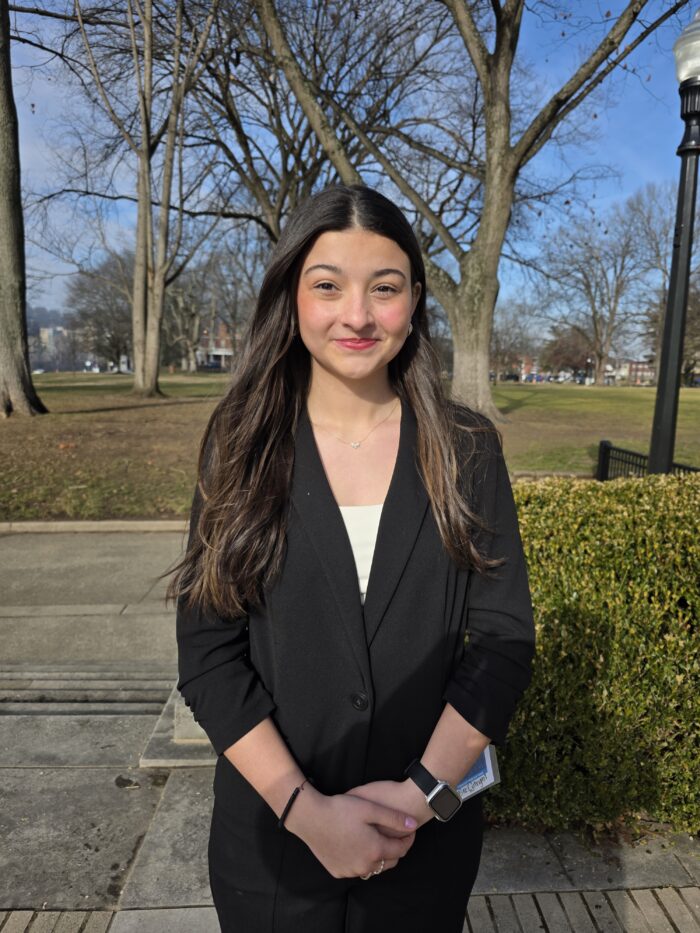
Breanna Cutright, a senior at Robert C. Byrd High School, is a youth advocate to stop smoking.
Photo by Eric Douglas/West Virginia Public Broadcasting
“When a youth comes forward and says, ‘This is something that I’m passionate about, this is something that needs to be changed,’ it changes the way that our lawmakers and leaders of West Virginia understand and see that issue,” Breanna Cutright, a senior at Robert C. Byrd High School in Clarksburg, said.
“I especially started seeing it within my peers, starting in, like, the seventh grade time sneaking off to the bathroom,” Cutright said. “So it’s starting to smell like cotton candy in the bathrooms and multiple feet under the stalls. And you just know that it’s not perfume that they’re spraying in there.”
The state spends a little more than $300,000 a year in smoking cessation, and lost all federal funding last summer with the passage of President Donald Trump’s One Big Beautiful Bill. That federal funding was used to support programs like the state’s Quitline and educational programs.
The Centers for Disease Control and Prevention recommends the state spend around $27 million on cessation and intervention programs. Nearly 38% of cancer deaths in West Virginia can be attributed to smoking — the highest smoking-attributable cancer death rate in the country.
Add WVPB as a preferred source on Google to see more from our team
On this West Virginia Week, our voter's guide is out, and it has all the information you need to know about the upcoming general election in the state. Also, another lawsuit targets the state's public school funding formula. And, a million dollar giant troll is making its way to the woods of West Virginia.
Silas House is a major voice for Appalachia. The Kentucky native has written more than 15 books and served as the state's poet laureate. His latest book is The Tulip Poplars, a sweeping novel about the lives of four people as they navigate friendship and forbidden love throughout the 20th century. Inside Appalachia's Mason Adams spoke with House.