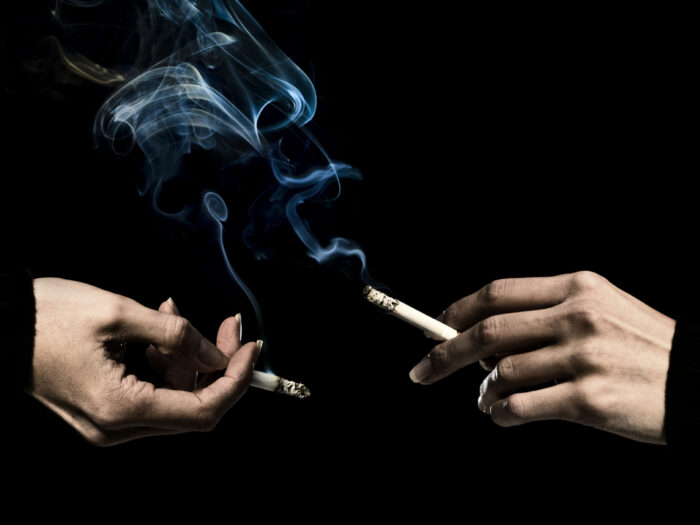
Tobacco use is the leading cause of preventable death in West Virginia, accounting for about 4,200 deaths annually. About 20% of adults in the state smoke. The American Lung Association released its annual report Wednesday giving each state grades on the efforts it is making to lower that number. West Virginia got Ds and Fs.
The “State of Tobacco Control” report grades states and the District of Columbia in five areas that have been proven to prevent and reduce tobacco use and save lives.
In the 2026 report, West Virginia received the following grades:
- Funding for State Tobacco Prevention Programs – Grade F
- Strength of Smokefree Workplace Laws – Grade D*
- Level of State Tobacco Taxes – Grade F
- Coverage and Access to Services to Quit Tobacco – Grade D
- Ending the Sale of All Flavored Tobacco Products – Grade F
Federal Grades Overview
The 2026 “State of Tobacco Control” report grades the federal government in five areas:
- Federal Regulation of Tobacco Products – Grade D
- Federal Coverage of Quit Smoking Treatments – Grade D
- Level of Federal Tobacco Taxes – Grade F
- Federal Mass Media Campaigns to Prevent and Reduce Tobacco Use – Grade I*
- Federal Funding for Tobacco Prevention and Control – Grade: B
*The federal government gets an I for Incomplete in this category due to data not being able to be obtained about the duration, reach and frequency of the Real Cost campaign in 2025.
News Director Eric Douglas spoke with Elizabeth Hensil, the director of Advocacy at the American Lung Association, to better understand what the grades mean. She covers both West Virginia and Pennsylvania.
The transcript below has been lightly edited for length and clarity.
Douglas: Tell me about the State of Tobacco Control report nationwide. What’s the process that goes into it?
Hensil: Every year, the American Lung Association starts back in late summer, very early fall, starting to collect all of the data from all of the states. They work with us, the advocacy directors. There’s about 25 of us, one for two states. We reach out to all of the states, and we get as much information from their Department of Health on some of these data points, like funding, cessation services, things like that. And then we also do a review of all of the laws and regulations in each state, and we just see if anything has changed from the year before. And that’s how we come up with all of our data. So our data is always based on the same things every year.
Every year, we can go back and see if there have been any positive or negative changes made to our data. And we do this, it’s not a shame on you. A lot of people see it that way. You’ll see, if you look at a lot of the states, the majority of the states are in the D and F range and that’s that’s very common. It’s because our criteria is very high.
Douglas: I look at the West Virginia numbers or the grades, it’s Ds and Fs, but you just said that there’s no states getting all As. Are there any good states?
Hensil: Maine is the only state that gets an A for funding, and that is because they’re the only state in the union that reaches the Center for Disease Controls (CDC) recommended level of funding. In West Virginia, the CDC recommends that West Virginia spend $27.4 million in order to properly and effectively fight tobacco dependence. West Virginia spends about $1.5 million. So that’s about 5.6% of what the CDC is recommending.
Douglas: So let’s walk through West Virginia real quick. So funding we just talked about, that’s a grade F. That’s a failing grade. Strength of smoke free workplace laws is a grade D. But I see a star beside that.
Hensil: West Virginia is a little bit different than the majority of the country. So back in the early 2000s the country was out there passing Indoor Air Act legislation. West Virginia did theirs a little bit differently. Instead of passing a statewide law, they put it in the hands of local control. So each county gets the opportunity to decide if they are smoke free or not. So with that little asterisk there with your D, it’s about 60% of all of West Virginia’s population is covered by smoke free air laws on the local level. And that’s actually not bad, because the way West Virginia has it set up, there’s no exemptions. So if your local county has determined that you are a smoke free county that includes all of your bars, it’s going to include your casinos.
Douglas: The level of state tobacco tax is also a grade F. I have noticed West Virginia’s excise taxes on tobacco has been decreasing. Not the taxes, the revenue from in that monthly revenue reports from the state have been dropping in the last several months or year or so. But one point that the State Revenue Department always makes is, I guess vapes are taxed in a different way. They’re not taxed under tobacco excise tax. So, as you said earlier, while fewer people are smoking and the tax revenue is going down, it’s not a great victory.
Hensil: What happens, 10 years ago or so when vaping became like this new big phase here in Pennsylvania, and I’m sure it was very similar in West Virginia and around the country, states were kind of scrambling to figure out exactly how to tax it. And unfortunately, the majority of the states didn’t really do it properly, so they’re not really getting the same equivalent amount of tax from the vape products and they would have been getting from the cigarette products. So yes, that’s why you’re going to see a decrease in that tax revenue. I know that there are organizations, such as the American Cancer Society, we’re working in collaboration with them to work on changing how those taxes are collected, so that vaping is properly collected.
Douglas: Where does West Virginia stand? What should we be doing? What do you recommend?
Hensil: I don’t have a specific number, but I can tell you, Pennsylvania’s [tax] is $2.50 right now, and we’re looking to increase it by another $1.50 per pack. Currently, West Virginia is at $1.20.
Douglas: Pennsylvania is looking to go to $4 a pack and West Virginia is at $1.20? Let me clarify that, the American Lung Association wants Pennsylvania to go, not necessarily the state Legislature.
Hensil: We are looking to introduce legislation in the next month or so to increase our tobacco taxes, but we’re also looking to change the way that vapes are taxed, so that it is in parity, so that it is on equal footing.
Douglas: The coverage and access to services to quit tobacco. So these are the RAZE program from the federal government or local area quitting tobacco helpline.
Hensil: These would be things like the Quit Line that you have in West Virginia. We also look at what West Virginia offers to state employees with the state insurance. We look at, does West Virginia require commercial insurance to provide any types of services? I would say one of the main reasons why West Virginia gets a D in this is their low investment on the Quit Line. West Virginia invests about $0.83 per smoker on the quit line. Nationally, the average is about $2.62 per smoker per year.
Douglas: We’re about a third of the national average, right?
Hensil: Not every smoker is going to call that quit line every year, but it’s important to invest enough so that when somebody calls the quit line looking for help, by the time they call the quit line, they’re usually kind of desperate, right? They really, really want to quit, and we want to make sure that that quit line has the resources available to actually help them and not just be an information and referral type service.
Douglas: The last category is ending the sale of all flavored tobacco products. I assume that’s menthol cigarettes.
Hensil: Menthol is absolutely considered a flavored tobacco product, and unfortunately, for many years, the tobacco industry has targeted the Black communities across the country with menthol cigarettes. So we would like to see those products be taken off the market, but at the same time, we are really strongly focused on flavored tobacco, specifically with the vapes. A lot of those vape products are coming out with flavors that are really attractive to the youth in our country. They’re coming out with flavors such as banana ice and blue raspberry, things that don’t actually occur in nature, but they’re very tempting to our youth. That is what encourages them to actually start vaping. That’s what hooks them. The tobacco gets them addicted for a lifelong addiction, unfortunately.
In West Virginia specifically, we are looking at a high school tobacco use rate of 28.5%. That means that in the last 30 days, 28.5% of West Virginia youth admit to using a tobacco product. That’s not including those kids that don’t trust anonymous surveys and say no. West Virginia has some of the highest smoking rates in the country. So vaping flavors is something that would absolutely help West Virginia’s youth getting rid of that.
Douglas: Just for clarity, you say youth. Is that middle school? Is that high school?
Hensil: For West Virginia, we don’t have a middle school statistic. Not all states ask their middle school those questions, but that’s the high school tobacco use. The high school smoking rate is only 6.7%, but if you look at tobacco use [including vaping], it’s 28.5% so they’re really more interested in those vape products.