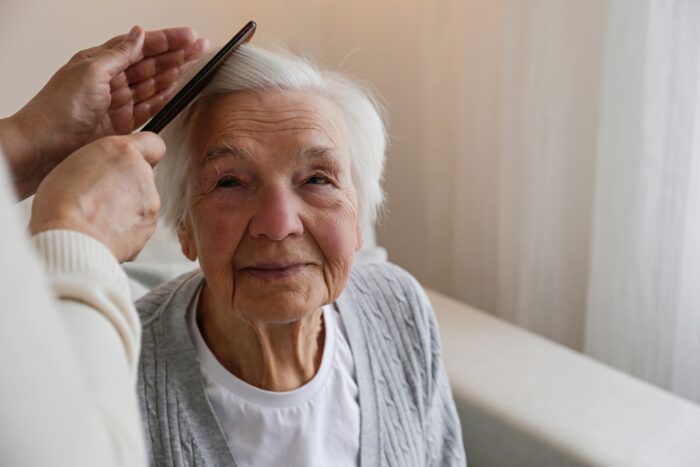
More than a quarter of adult West Virginians are serving as caregivers for a family member. That comes with stress, as well as emotional and physical tolls.
News Director Eric Douglas found himself in this position over the last few years. The AARP just released a new nationwide report on caregiving, so he spoke to Jane Marks, the state president of the organization, to find out more.
This interview has been lightly edited for clarity.
Douglas: I am just now realizing how much stress I was under. I knew I was under a lot of stress, and to be honest with you, sought help for myself because of that, but I can still feel it bleeding off. I also appreciate what you were saying about being a secondary caregiver.
Marks: I personally don’t like that term, but a lot of people out there in caregiving world use that term, and I understand sometimes the need to distinguish between the primary caregiver who, again, as I said, is changing sheets and and feeding the person and doing all those things, but any of us who are caregivers are under extraordinary pressure. That’s part of the challenge is you often are so focused on caring for that person that you’re not thinking about yourself. You’re not recognizing the fact that you may be having some health challenges because of your stress. You are solely focused on the other person. And you know, that’s one of the things we try to do in AARP, is make sure that caregivers do stop for a moment and think about themselves. We don’t want you to think of that as being selfish, because certainly, if you aren’t taking proper care of yourself, you won’t be available, or you won’t have as much energy that you will need as you’re providing that care.
Douglas: I remember two years ago, when I was talking to my mom 10 times a day before we actually moved her into care, I didn’t feel like I could go to a baseball game, or I couldn’t do the things I wanted to do, because I knew mom was going to call and I had to be there and be available for her. It was tough.
Marks: I was in a conversation with somebody this week, and she was saying that it seemed like every time she went out of town, because we were both at a national AARP meeting this past week, and she said, “Every time I go out of town, I get that call about my mother.” And I laughed and said, “Every single time I went out of town, that’s when my mother fell — every time.”
Douglas: Give me your definition of what a caregiver is.
Marks: To me, the caregiver is that person who either oversees the care or provides extensive care for a loved one, family member, a spouse, you know, who can’t adequately care for themselves.
Douglas: I know AARP broadly released new caregiving data. Give me some numbers. Tell me what the condition or the situation is in West Virginia?
Marks: Well, the situation in West Virginia is 26%, that’s more than a quarter of West Virginians, are caring for someone or acting as a caregiver. I’m not a math person, but that’s roughly 375,000 people. If you step back and realize as a small state, over a quarter of our adults here in West Virginia are caregivers. That’s something that clearly we need to pay attention to, and we need to provide them with as much support and resources as we can, because they’re doing a tough job.
Douglas: But what does that do to the caregiver? What’s some of the effects of that for a caregiver?
Marks: Some of the effects are one in four caregivers express the fact that they are having their own health issues related to the stress and the challenges of caregiving. Many, many West Virginia caregivers are spending their own money, and sometimes that’s hard. I mean, you know, it’s hard enough to feed your own family and cover all those bills, but if you’re having to also reach into your pocket. It’s estimated that caregivers spend, on average, $7,000 annually of their own money in providing supplies and other things that the person for whom they’re caring might need.
It’s certainly a physical challenge. You’re not getting sleep. We talked about that 3 a.m. phone call. But you’re also distracted if you’re working, and a good many West Virginia caregivers are still out there in the workforce, and so you’re trying to balance that. You’re trying to do your job while you’ve got this other major job that you’re trying to shoulder as well. So it’s certainly very stressful. It certainly has a financial impact on you as well.
Douglas: What can we do to help caregivers?
Marks: Well, first of all, AARP always focuses on having adequate dollars in our home and community-based services budget, in the state budget, because we know that certainly folks prefer to stay at home, in their own home, if they can.
One of the things that we worked on last year — and of course, it didn’t go anywhere, so we’re going to push it again this year — is a tax credit for family caregivers. You know, it won’t take away completely that financial burden that they may be facing, but it can certainly be a help. There’s also a federal piece of legislation, our own Sen. Shelley Moore Capito was the lead sponsor on this, called the Credit for Caring Act, and it too, would be a caregiving tax credit. Again, sometimes just relieving a bit of that financial burden can be important.
We also want to make sure that people know that they are not alone. This blew me away. With this caregiving survey, one in four adults who are caregivers say they feel alone. That just breaks my heart. I’ve been doing this for over 20 years now, and engaging with caregivers, working with caregivers, and that makes me sad that they still feel so alone.
One of the things we offer at AARP is actually an online caregiving community, if you will, so that caregivers from anywhere can sort of engage with each other, share their experience and understand that they’re not alone. So we think those two things are very important. We also have some caregiving guides that are free. You can go on our website (aarp.org/caregiving) and find free resource booklets that can talk about forming your caregiving team, that can talk about managing finances if you’re a caregiver. So we have those kinds of resources, and again, they’re free. You can order them, or you can just download them and print them off. But from the policy standpoint, those are the two areas right now that we try to focus on.
Douglas: Pie in the sky. What do you want to see happen?
Marks: I want to see caregivers acknowledged for the hard work that they’re doing. Caregivers across the country are providing what it’s valued at, are you ready for this? $63 billion with a B, $63 billion worth of care. So if these people had to be placed in long-term care, or someone had to pay for their care, we’re providing $63 billion worth of that care.
I think it’s important that we recognize that, we give family caregivers the attention and the kudos that they deserve.