This week, during the Great Depression, Osage, West Virginia was a raucous river town. It’s sleepier now, but music is keeping the magic alive. Also, a poet remembers growing up in a secret city in Tennessee that was built during World War II. And, rock climbing is usually for warmer months, but some climbers have taken to climbing frozen waterfalls.
Berkeley Medical To Resume Full Operations Next Month After ‘Man-Made’ Flooding Accident
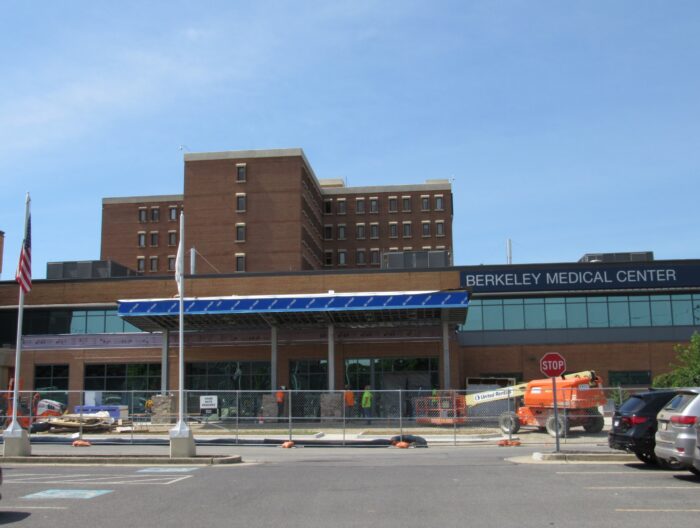
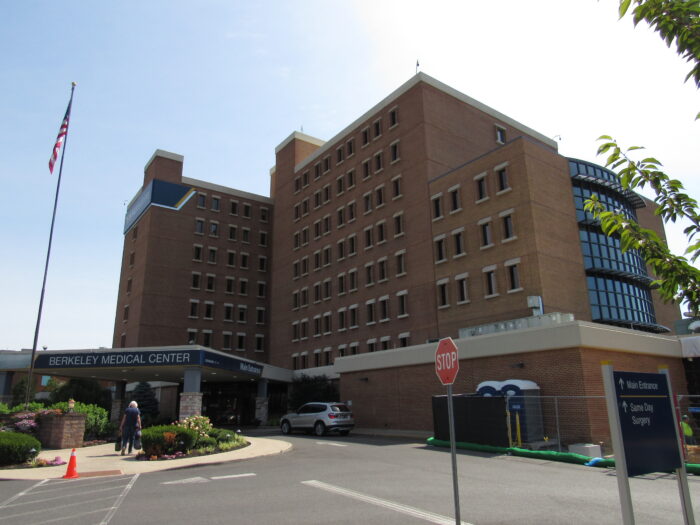
The Berkeley Medical Center, operated by WVU Medicine, suspended use of its operating rooms due to flooding in late May.Jack Walker/West Virginia Public Broadcasting
Listen
Share this Article
The Berkeley Medical Center will be “totally back up and running” by July 14 after flooding closed the facility’s operating rooms last month, according to Albert Wright, president of the West Virginia University (WVU) Health System.
Wright said the Martinsburg medical facility, operated by WVU Medicine, was undergoing construction on its second floor in late May.
During the construction, parts of the facility’s first floor — home to its 10 inpatient operating rooms — were exposed to the elements.
Wright said the “construction mishap” caused a “breach between the second floor of their building and the first floor,” which “allowed water to penetrate into that operating room floor.”
“It was a man-made breach by accident,” he said.
The facility was flooded with dirty rainwater, which caused significant damage. In the weeks since the flooding, construction teams have had to demolish and replace significant portions of the operating rooms to ensure they meet medical standards.
“Operating rooms are really some of the most sterile areas you have in a hospital. We have to make sure that they’re clean and free from infection,” Wright said.
Despite the damages, Wright said teams on site have made fast progress on the repairs.
By July 3, WVU Medicine anticipates that five of the 10 operating rooms will be operational again. By July 14, Wright said the remaining five operating rooms will be back as well.
“When I first saw the flooding, if you would have told me we’d be back up and running by the middle of July, I would have been thrilled,” Wright said. “That’s a compliment to the work that’s been done.”
Berkeley Medical Center has referred most patients with non-emergency needs to nearby medical facilities in Berkeley and Jefferson counties in the weeks following the flooding incident.
Photo Credit: Jack Walker/West Virginia Public Broadcasting
Wright said Berkeley Medical Center will also receive two mobile operating rooms July 3 to aid the facility’s transition back to full operations.
In the weeks after the flooding, Berkeley Medical Center temporarily only admitted trauma, obstetric and emergency surgery cases.
Patients with other needs were referred to the facility’s Outpatient Surgery Center or nearby facilities like the Jefferson Medical Center, which has three operating rooms.
Wright said WVU Medicine expanded hours of operation for some medical facilities to meet increased demand.
Still, the sudden bump in patient need put a strain on nearby facilities, Wright said. Plus, some patients had specific care requirements that surrounding facilities had difficulty meeting.
To meet additional needs, Wright said the Berkeley Medical Center also referred patients to facilities farther away, including Morgantown and Winchester, Virginia.
While some of those referrals pushed patients outside of the WVU Health System, Wright said ongoing coordination between medical facilities made referrals like these easier.
“One of the good things about health care is, even though we sometimes compete with other systems for patients, when any health care facilities are in a challenging situation, everybody steps up for good patient care,” he said.
While the flooding might have put a strain on medical facilities in Berkeley and Jefferson counties, Wright said he was “so proud” of staff members at the hospitals for picking up the slack.
“The team has really done a good job of making sure patients receive the care they need,” he said. “I’m proud of how they [have] come through this, but I’ll also be glad when this is all over and behind us.”
Full operations at the Berkeley Medical Center in Martinsburg are slated to resume in early July, following works of construction work.
Photo Credit: Jack Walker/West Virginia Public Broadcasting
Add WVPB as a preferred source on Google to see more from our team
Volunteers trying to help a Wyoming County community recover from the February 2025 floods have found distrust hampering their efforts. According to one pastor, the town of Oceana did not qualify for a disaster declaration because too few people – wary of volunteers and the application process – did not declare the damage to their homes.
Dels. Johnathan Pinson, R-Mason, and Hollis Lewis, D-Kanawha, tell us about the West Virginia Legislature’s perennial work on child protective and foster care services. We also get a look at both chambers’ first pass at the state budget.
On this episode of The Legislature Today, issues with Child Protective Services (CPS) and the state foster care system are persistent. The West Virginia Legislature faces questions on how to correct the problems that arise every year. News Director Eric Douglas speaks with Dels. Jonathan Pinson, R-Mason, and Hollis Lewis, D-Kanawha, to get their take on the issue.
U.S. Sen. Shelley Moore Capito joined leaders from Marshall University and Marshall Health Network Thursday to announce $31.8 million in federal funding that will strengthen medical education, research and health care delivery across West Virginia and Appalachia.