Alert (09/29/2026): Our Parkersburg TV transmitter is still undergoing maintenance and remains temporarily inoperative. We apologize for the inconvenience.
All our programming is available via our TV livestreams on our website and WVPB Passport. Thank you for your patience!
Through early October, the Blowing Rock Art and History Museum in North Carolina is hosting an exhibit celebrating one of the region’s most notable fiber artists – Barbara Grennell. The exhibit does more than expose people to great art; it asks people, what makes art, art? Folkways Reporter Wendy Welch reports.
Wyoming County Coffee Shop Steps Up To Help In Flood Recovery
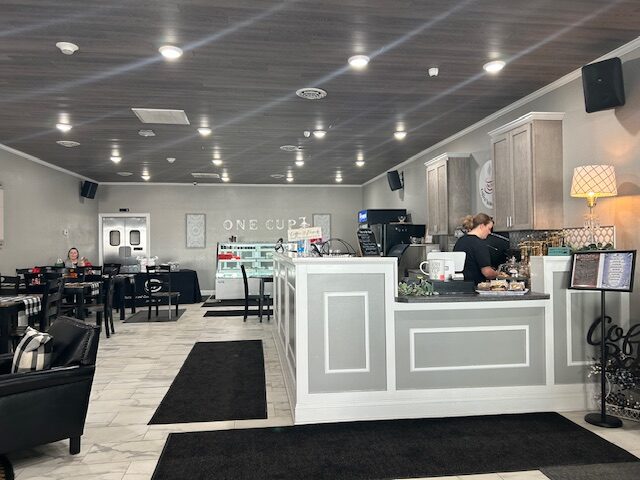
One Voice, a charity in Oceana, provides free meals for the unhoused by selling coffee and meals to other customers. The charity became a community hub during the February 2025 floods. Wendy Welch/West Virginia Public Broadcasting
Oceana is a town of some 1,200 people in Wyoming County. It boasts a well-appointed coffee shop and warehouse run by a nonprofit called One Voice. After the February 2025 floods, One Voice staff and volunteers became rescue and repair workers.
Caitlin Davis, a peer recovery support specialist duly certified in substance use disorder and mental health, works through Mountain Laurel Integrated Healthcare, and is based out of the One Voice coffee shop in Oceana.
Davis lives in Mullens, 25 miles away from Oceana, so, “The day before the flood, when the heavy rain started, we actually had to leave early so I could get home because it was already in Matheny coming over the road. I’m a single mom with two kids, so I had to get home,” she recalls.
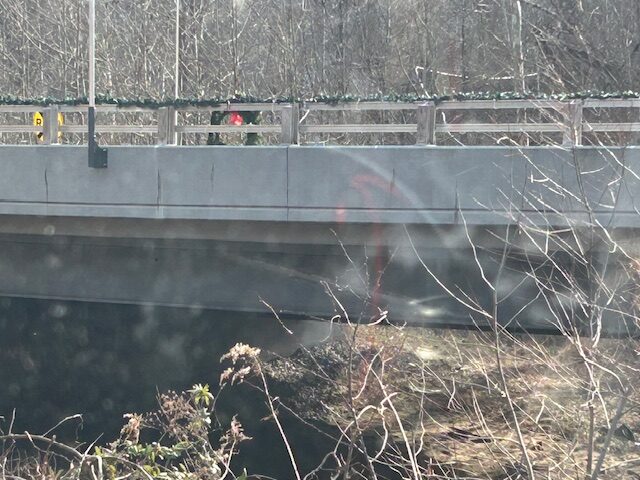
Davis did make one stop, at a bridge on a curve going through town.
This bridge in Oceana used to have a dozen or so tents regularly pitched beneath its shelter. The floods took most of the tents, and the town now has an ordinance prohibiting camping outside designated area.
Photo Credit: Wendy Welch/West Virginia Public Broadcasting
As she explains, “A lot of the homeless people used to pitch tents under there as their shelter. I actually spoke to one client of mine, and luckily he had noticed it rising. So he went ahead and packed his stuff up. But some of them lost whatever they owned.”
No official flood deaths were reported in Wyoming County. The tent community was destroyed and three people never reappeared, but neighbors said they left. As for the rest of Oceana, it was heartbreaking, said Davis.
“People not from our area who have not been affected by a flood, I don’t think they really understand how much damage water itself can do. After it goes down, you’ve got the stagnated water. You’ve got dirt, mud, debris all in your house, all in your cars, all in your yard. Damaged belongings. A lot of people, it took every bit of clothing they had. Sentimental mementos that you can’t get back. You can’t buy those back,” Davis said.
David Birchfield, another member of the One Voice community, is a pastor with the Wyoming Charge of Methodist Churches who networks One Voice and municipal services like 911 with a national group called VOAD, or Voluntary Organizations Active in Disaster. He recalled the scene in Oceana.
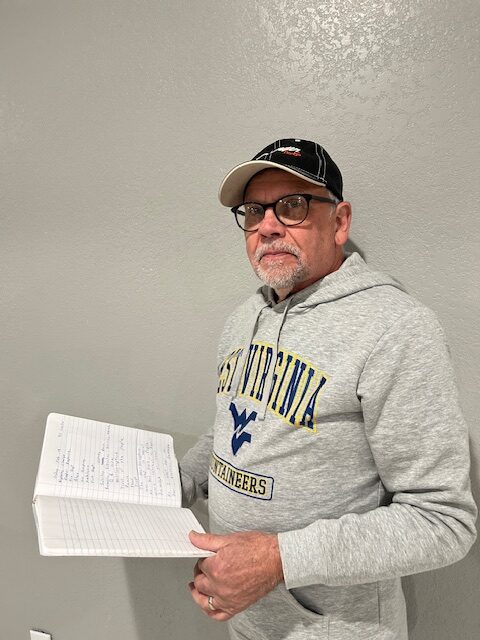
David Birchfield looks at his field notebook from door to door calls made after the floods. He is concerned that Oceana lost funding due to underreported flood damage.
Photo Credit: Wendy Welch/West Virginia Public Broadcasting
“Down below One Voice, it looked like a lake. In the Delilah Church, water was shooting up from the toilets, hitting the ceiling. Tables were floating, stoves, the refrigerator floating. When the debris comes, it stops up the storm drains,” he said.
Birchfield had also been through other floods, so he got busy coordinating VOAD teams. They went door to door to help homeowners sign up for house repairs. Birchfield reckons at least 800 households in Wyoming County experienced significant damage. Yet only about 100 registered for help, too few for the area to be declared a disaster.
“The reason I feel that Oceana wasn’t recognized about how bad it was, was people were reluctant to report. Some people are old-fashioned and they’re reluctant to ask for help,” he said.
Birchfield said the worst problem was the QR codes most relief agencies use. When volunteers found people unfamiliar with QR codes, they offered to scan codes on their own phones for the flood victims.
He describes what happened next. “And it wasn’t an hour that there was a post on Facebook, do not do this. This is a fraudulent scheme. Do not talk to these people. Do not do the QR code.”
Refusal to report became surreal, Birchfield said. Take the woman rescued from her home by boat, along with her son and dogs. A few days after they were able to return home, Birchfield knocked on the woman’s door to help her claim damages.
He asked, “Did you have water in your home?”
She replied she did not.
Davis said he tried again. “Ma’am, I don’t have an ulterior motive here. It will cost you nothing. Did you get water in your house?”
Still she answered no.
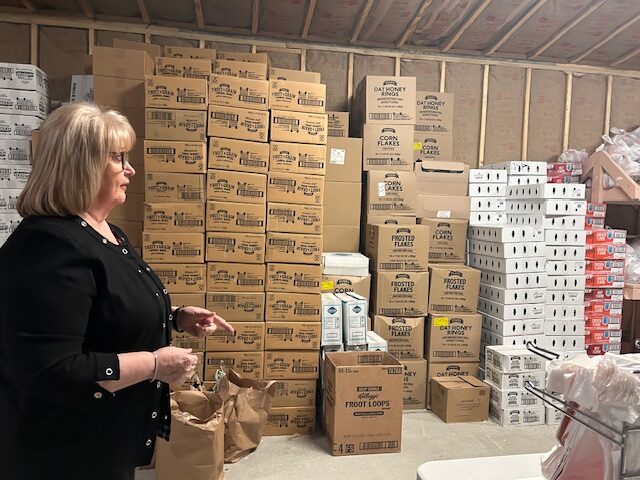
Debbie Davis, executive director of One Voice, shows where donations came into the warehouse during the floods. In addition to massive quantities of food, people dropped off cleaning supplies and repair tools.
Photo Credit: Wendy Welch/West Virginia Public Broadcasting
Debbie Davis, the executive director of One Voice, recalls people from the neighborhood bringing food, but also “shovels, wheelbarrows, buckets, bleach. We had thrown open our doors and were feeding people as fast as we could; we didn’t think what else they might need, but they thought of these things for us.” She credits the community and wider church responses with bringing comfort and compassion to the people of Oceana.
One year after the floods, about 75% of damaged homes have been repaired, Birchfield said, and the work continues.
“There’s two in particular that are top of my list that have to be re-insulated and heat systems put back. And they do not qualify for assistance. It’s like I could get help for this person, but I couldn’t get help for a different person,” he said.
But he, and the rest of the One Voice staff and volunteers, and the people of Oceana keep going forward, one rebuild at a time.
Add WVPB as a preferred source on Google to see more from our team
More than $4 million in funding through the Rural Health Transformation Program will be used to improve healthcare access in rural communities, Gov. Patrick Morrisey said Wednesday.
Across the Appalachian Mid-South, local law enforcement is doing more to support U.S. Immigration and Customs Enforcement (ICE) in detaining people. Morgan Watkins with the Kentucky Center for Investigative Reporting analyzed the latest data on ICE arrests in Kentucky, Tennessee and West Virginia. Louisville Public Media's Bill Burton spoke with her about what she learned.
A U.S. Energy official visited the West Virginia University campus Tuesday, to promote an effort to increase the number of graduates with expertise in mining, minerals and associated supply chain technologies.