Alert (09/29/2026): Our Parkersburg TV transmitter is still undergoing maintenance and remains temporarily inoperative. We apologize for the inconvenience.
All our programming is available via our TV livestreams on our website and WVPB Passport. Thank you for your patience!
This week, author Silas House returns with a sweeping new novel. Also, some folks say, you have to fake it 'til you make it, even if you're trying to establish a state park. And, the story of the first Mothman sightings as written by a small town journalist in 1966.
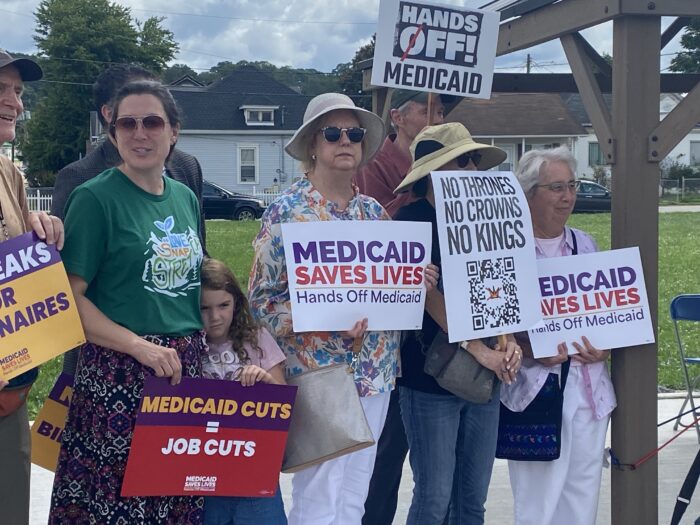
Sign holders at Medicaid rally. Randy Yohe/West Virginia Public Broadcasting
Listen
Share this Article
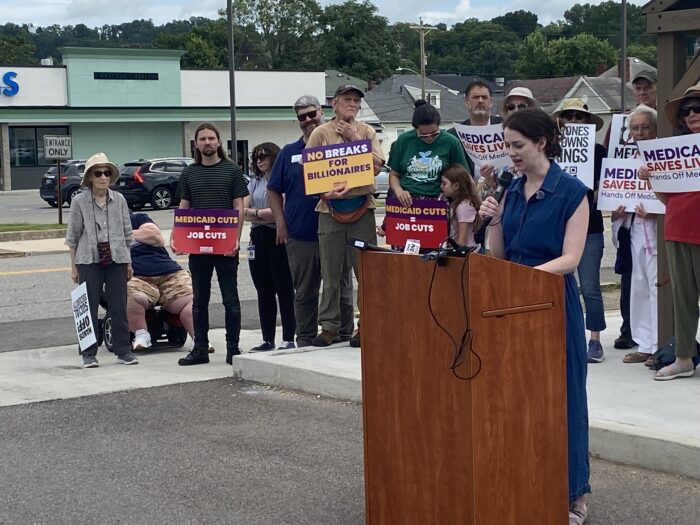
About one hundred people gathered on Charleston’s West Side Tuesday morning to rally against proposed federal Medicaid cuts.
Set up across the street from the federally fundedCabin Creek Health Care Center, advocates, clients and healthcare providers spoke out against the federal budget bill that – if passed in its current form – would cut $700 billion in Medicaid funding.
Rally organizers said the cuts would be catastrophic for West Virginians who rely on the program, including 49,000 seniors, 196,000 children, and 86,000 people with disabilities.
Full time care-giver Mariah Plante from Wyoming County told the crowd how Medicaid is a lifeline for her disabled brother Matt.
Mariah Plante spoke abut her disabled brother Matt.
In a press release, rally organizers explained that the House of Representatives advanced its budget bill last month, with support from both of West Virginia’s Republican U.S. Representatives, Riley Moore and Carol Miller.
“He has lifelong disabilities, including autism,” Plante said. “He’s legally blind and he’s non verbal, which means that he does not communicate through words or speech. He needs help with nearly every aspect of daily life. Since his parents passed away, he lives with my boyfriend and me in rural Wyoming County. Resources for families like ours are limited out where we live in the holler, but Medicaid provides his medical care, his eyeglasses, behavioral support, prescriptions and access to specialists that we could never afford on our own. Most importantly, Medicaid allows for us to care for Matt at home where he’s loved, not in a facility.”
The press release noted that the budget bill also includes a 30% cut to the Supplemental Nutrition Assistance Program, or SNAP, the state’s most important anti-hunger program, by shifting significant costs for the program to our strained state budget; enacting what organizers call ineffective and bureaucratic paperwork requirements; and lowering benefits over time by freezing the Thrifty Food Plan which allows benefits to keep pace with the rising costs of a healthy diet.
Rally organizer Lida Shepherd with the American Friends Service Committee said that over time it is projected that 2 million children will lose access to food if these proposals are enacted.
“That’s 84,000 people in West Virginia would be projected to lose their lifeline to food via the SNAP program,” Shepherd said. “Should this bill become law, and additionally it zeros out the snap education program.”
The so-called “big beautiful” budget bill that contains the Medicaid and SNAP proposals has passed the House, and now heads to the U.S. Senate.
Add WVPB as a preferred source on Google to see more from our team
On this West Virginia Week, our voter's guide is out, and it has all the information you need to know about the upcoming general election in the state. Also, another lawsuit targets the state's public school funding formula. And, a million dollar giant troll is making its way to the woods of West Virginia.
Silas House is a major voice for Appalachia. The Kentucky native has written more than 15 books and served as the state's poet laureate. His latest book is The Tulip Poplars, a sweeping novel about the lives of four people as they navigate friendship and forbidden love throughout the 20th century. Inside Appalachia's Mason Adams spoke with House.
Ryan Saxe, superintendent of Berkeley County Schools, said the suit is about whether West Virginia school funding system adequately supports what school districts are responsible for providing their students.