'Haunted' Town Already Celebrating Spooky Season
Halloween is still several weeks away, but one West Virginia town is already celebrating the season.
Continue Reading Take Me to More NewsAlert (09/29/2026): Our Parkersburg TV transmitter is still undergoing maintenance and remains temporarily inoperative. We apologize for the inconvenience.
All our programming is available via our TV livestreams on our website and WVPB Passport. Thank you for your patience!




To Educate, Inform, and Inspire by Telling West Virginia's Story
Mountain Readers Week will be held Oct. 5-9, 2026! Celebrate and foster a love of reading in children across West Virginia.
Nominate an exceptional West Virginia K-12 teacher today!

On Demand

On Demand

Stream original productions from WVPB

Watch locally produced documentaries & more.

On Demand

On Demand






West Virginia Morning

Inside Appalachia

West Virginia Week

Mountain Stage

Us & Them

The Legislature Today

The Legislature This Week

Send us your comments and questions.

Stream our board meetings.

Check out the latest WVPB news.

Sign up for our newsletter and get weekly updates.

Meet the WVPB staff.

WV Educational Broadcasting Commission, the WVPB Foundation, and the Friends of WVPB.

Come work with us!

Read our annual report and learn how we educate, inform and inspire with your support.

Sponsor impactful and engaging media and entertainment.

Use your IRA to make a gift to WVPB.

Become a member with your gift of $1,000 or more.

Make WVPB part of your legacy.

Manage your membership account.

Learn how you can Protect and Sustain West Virginia Public Broadcasting.
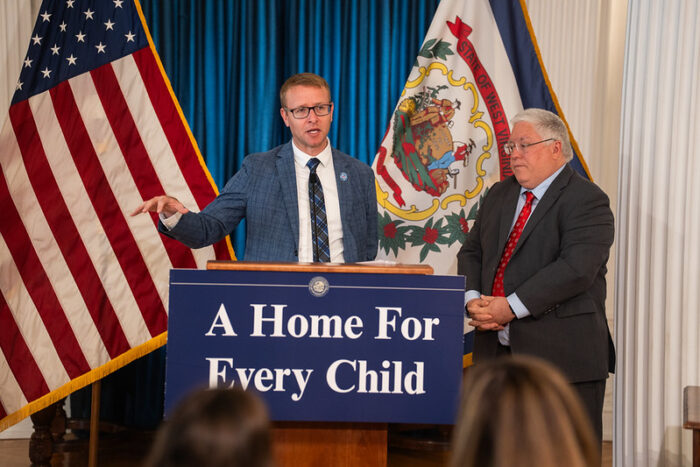
West Virginia is the 19th state to join a national initiative aimed at improving the foster care system.
At a press conference Thursday, Gov. Patrick Morrisey joined Assistant Health and Human Services Secretary Alex Adams to sign the paperwork to officially join the Home For Every Child initiative.
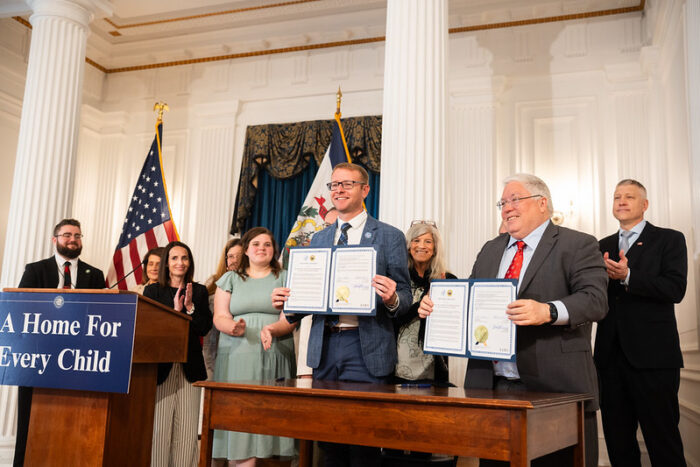
The national effort is part of Fostering the Future for American Children and Families, an executive order signed by President Donald Trump in November.
A Home For Every Child initiative has two primary goals: decreasing the number of children entering the foster care system and increasing the number of available homes for those who do.
“When we launched this campaign, we talked to states and said, ‘There’s two ways to get your ratio of homes to kids up. You can recruit more homes or retain more of your existing homes and the faith-based community has a major role to play in that. Most importantly, you can shrink the number of kids coming into foster care through effective prevention services,’” Adams said.
“What really excites me about what I’ve heard from Governor Morrissey and his whole team is they’re going to focus on both sides of that equation, preventing entry, shortening length of stay, and recruiting and retaining through faith-based partnerships and other means,” he said.
Morrisey said the state is in the process of redesigning its foster parent certification process to reduce both barriers and delays that discourage good families from stepping forward.
“We want to make it easier for caring, qualified families to help children in need,” he said. “At the same time, we’re also strengthening oversight of taxpayer dollars by implementing additional verification systems to reduce waste and ensure resources are directed to where they belong – and that’s helping kids and families who are in need.”
Morrisey emphasized the importance of churches and other faith-based institutions playing a significant role in addressing child welfare challenges.
“So much work has been done over a long period of time by our churches, our faith-based community, all across different denominations. We think that’s critical,” Morrisey said.
With a focus on faith-based support and less red tape for case workers, West Virginia will report its progress to the federal government each month, and a leaderboard will track improvements state by state.
“Governor Morrissey will be able to see monthly how his data compares to other states, and often what we see is the competitive juices starting to go so having actionable data and competition we think will drive more meaningful progress,” Adams said. “If we do this right, if we execute on this, we will have homes waiting on children, not children waiting on homes.”
Adams said nationwide, there are currently 57 available homes for every 100 children entering the foster care system.
Add WVPB as a preferred source on Google to see more from our team

The $26.5 million grant from the U.S. Department of Agriculture will help construct the West Virginia State University Agriculture Complex that will house laboratory space for the university, as well as the state Department of Agriculture.
Continue Reading Take Me to More NewsThe Public Service Commission of West Virginia wants to ensure that if discontinuation of the current landline system is approved, an adequate service will be continue to be available to both new and existing customers.
Continue Reading Take Me to More NewsFayette, Harrison and Kanawha counties have been approved for individual assistance from the Federal Emergency Management Agency (FEMA).
Continue Reading Take Me to More NewsWest Virginia has seen the largest population decline in the nation - nearly 1.5% - and many of those leaving are young people. In an episode that aired last month, Us & Them host Trey Kay heard from some young people who think they may stay in the state to launch their futures. This month, Kay talks with those who say living their dreams may well require moving away from the Mountain State. We listen to an excerpt from the latest Us & Them.
Continue Reading Take Me to More News