This week, during the Great Depression, Osage, West Virginia was a raucous river town. It’s sleepier now, but music is keeping the magic alive. Also, a poet remembers growing up in a secret city in Tennessee that was built during World War II. And, rock climbing is usually for warmer months, but some climbers have taken to climbing frozen waterfalls.
Internet Service Providers Required To Display Consumer Friendly Product Labeling
Broadband labels must be easy-to-read and include broadband prices, introductory rate details, data allowances and broadband speeds.
pressmaster/Adobe Stock
Listen
Share this Article
Broadband labeling has been in development since 2015, and was completed by the Federal Communications Commission (FCC) and the Biden Administration.
The new federal rules take effect April10, 2024. They say any company, large or small, that offers standalone broadband internet service is required to prominently display consumer friendly labels at the point of sale, including in store and online.
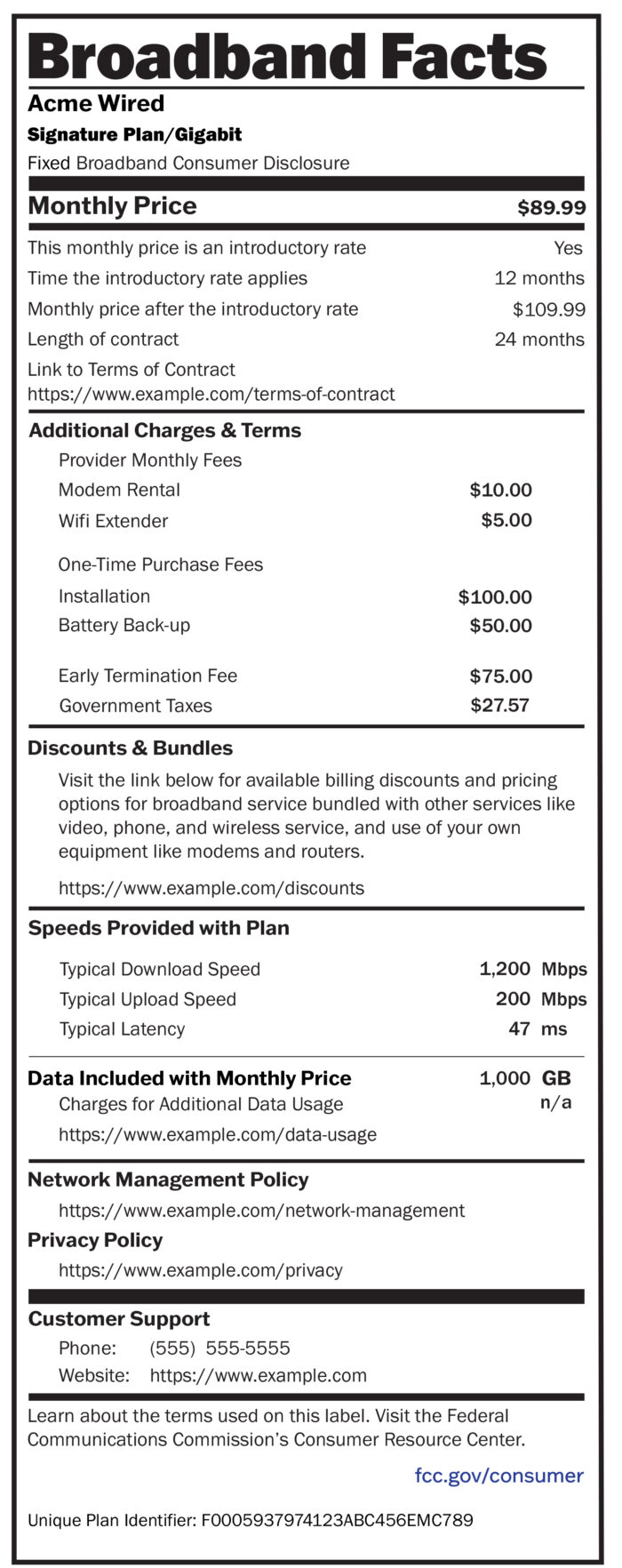
This broadband label was purposefully stylized after food nutrition labels.
Courtesy of the Federal Communications Commission (FCC)
The labeling will resemble the nutrition labels found on food products. The labels must be easy-to-read and include broadband prices, introductory rate details, data allowances and broadband speeds. The labels must also include easy-to-navigate links to learn more about available discounts or service bundles, network management practices and privacy policies.
Separate labels must be displayed for each standalone broadband service offered and it cannot be buried where multiple clicks are reduced to a link, thumbnail or icon that a consumer might miss.
FCC Consumer and Governmental Affairs Bureau Chief Alejandro Roark said it was vital to get internet access service clarified and simplified.
“The FCC borrowed the nutrition label model format from food products because we wanted to make basic information about broadband internet service easily recognizable and easy to understand,” Roark said. “Our rules require that these labels be fully displayed at the point of sale, including on the main purchasing pages that providers may have online.”
Deputy Director of the White House National Economic Council Jon Donenberg said the labels will help consumers comparison shop for internet service, eliminating obscure terms and fine print.
“It will make sure that you have a clear, straightforward explanation of your home internet and mobile plans and services before you sign up for anything,” Donenberg said. “That transparency will also save you money. By making it easier to directly compare plans from one provider to another. Consumers will be able to get the best and most affordable deal on the market or the exact type of service that they need. And companies can compete on offering better terms, not just more confusing ones.”
Roark said the labeling requirements will be extended to the consumer’s monthly bills.
“We’re also making sure that consumers access the standardized, easy to understand information about their internet service plan and doesn’t end when they sign up for service.” Roark said. “In particular, the commission required internet service providers to make the labels accessible on a consumer’s online account. That means that consumers will be able to find this information whenever they pay their bill, compare their current plan to other plans, or engage in any other activity online.”
Regarding potential violations of the broadband labeling laws, the FCC Enforcement Bureau and other bureaus will monitor public reporting consumer complaints to the commission, notices from partner agencies and use other investigative tools to monitor compliance with the law, and refer matters to the Enforcement Bureau as appropriate.
Consumers who feel that the transparency rules are not being met may file complaints with the FCC. The commission will follow up on those complaints to see if there is some larger pattern that may need to be acted on.
To view a glossary that helps consumers better understand the information displayed on the label, click here.
On this West Virginia Week, last winter’s floods are remembered, Trump signs an order aimed at supporting the coal industry, and the federal government wants information on hundreds of thousands of West Virginia voters.
Dels. Johnathan Pinson, R-Mason, and Hollis Lewis, D-Kanawha, tell us about the West Virginia Legislature’s perennial work on child protective and foster care services. We also get a look at both chambers’ first pass at the state budget.
On this episode of The Legislature Today, issues with Child Protective Services (CPS) and the state foster care system are persistent. The West Virginia Legislature faces questions on how to correct the problems that arise every year. News Director Eric Douglas speaks with Dels. Jonathan Pinson, R-Mason, and Hollis Lewis, D-Kanawha, to get their take on the issue.
With just three weeks left in the 2026 legislative session, the list of completed bills is getting longer. And many of them are focused on election reforms.