Alert (09/10/2026): Our Parkersburg TV transmitter is undergoing maintenance for a few days and will not be operational. We apologize for any inconvenience.
All our programming is available via our TV livestreams on our website and WVPB Passport. Thank you for your patience!
This week, it’s not easy to find a place to play hockey in Appalachia, and if you happen to be young and ambitious, it can be harder. Also, rappers and musicians across West Virginia come together for a song challenge. And, farmers learn to turn unwanted sheep’s wool into home insulation.
House Completes Action On 5 Bills, Passes More Election Bills
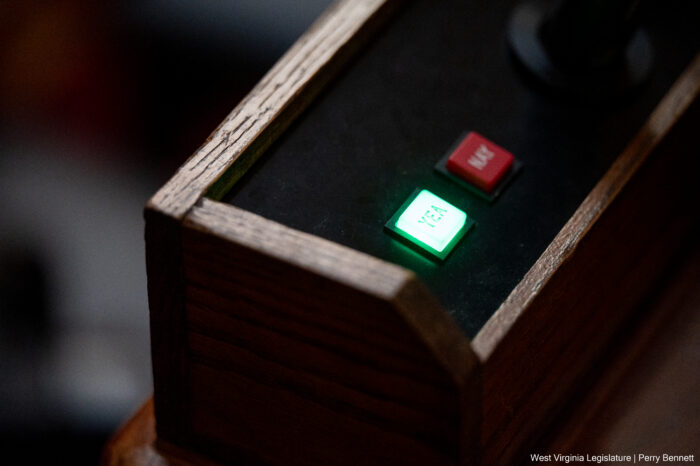
A delegate's vote is registered in the House of Delegates' chamber Feb. 19, 2026.Perry Bennett/WV Legislative Photography
Listen
Share this Article
With just three weeks left in the 2026 legislative session, the list of completed bills is getting longer.
The House of Delegates completed five pieces of legislation Friday after the Senate’s consideration.
They include House Bill 4982, the Make West Virginia Healthy Act of 2026. The bill authorizes the use of nutrition-based interventions, known as Food Is Medicine services, as a strategy to improve health outcomes and reduce the use of avoidable medical interventions.
The House also passed House Bill 4196, which will offer long-acting reversible contraception to patients receiving certain treatments for addiction.
The other bills to complete legislative action Friday are:
HB 4335 Relating to Medicaid providers and facilitating delivery of care
HB 4696 Authorize the Department of Environmental Protection to deposit funds granted pursuant to federal programs
HB 4740 Statutory Commitments in Rural Health Transformation Program
Per the state constitution, both chambers must read a bill on three separate days before it becomes law.
So far 11 bills have completed legislative action this session.
Del. J.B. Akers, R-Kanawha, said a donor’s name, occupation and contribution amount will still be reported. But he recounted how his own public business address led to harassment at his business after he voted on a controversial bill.
“We’re just going to provide a little bit of protection for the donor in terms of where they work, so that their employer won’t be harassed, so that their employment won’t potentially be jeopardized, so they can donate and exercise their First Amendment rights and not have to worry about whether their co-workers will be harassed, intimidated and yelled at,” he said. “Someone’s going to walk in off the street maybe, I mean, it’s easy enough to find folks, but this just provides a little bit of extra protection so that the people who aren’t running for office, people who aren’t in this building, but the people who just want to participate, get a little bit extra protection.”
Del. Mike Pushkin, D-Kanawha, acknowledged the privacy concerns being addressed, but called the bill an overreaction that would hurt transparency.
“There is a very good reason why we report over a certain dollar amount, their employer, where they work, and all that has to be reported,” he said.
Democrats pointed to an instance in Monongalia County where an employer coerced employees into making political contributions to skirt state limits.
“This is how you identify it. And you could say, ‘Well, if the Secretary of State has it?’ Well, I’d like for the public to see it,” Pushkin said. “I’d like for the press to be able to see it, because that’s often how things get uncovered. You cannot always rely on government to police itself, and that’s why we’ve had these laws in place for so long.” The House also passed House Bill 5228 which clarifies the definition of electioneering and House Bill 5273 which simplifies the campaign financial statements candidates for municipal office must file.
Add WVPB as a preferred source on Google to see more from our team
The suit, filed with the support of the American Civil Liberties Union of West Virginia, asks the court to declare the state’s school funding system unconstitutional and order the state to meet its duty to provide a thorough and efficient education to every child in West Virginia.
Hockey is still finding fans and players in central Appalachia, but just because it’s an emerging sport in this region doesn’t mean we don’t have hockey heroes. Inside Appalachia’s Abby Neff met with Gwyneth Phillips, a goalie for the gold-medal winning U.S. Olympics Women’s team, to learn more.
Duties of poll workers can include delivering election supplies to polling places, verifying voter identities and registrations and securing the materials after polls close.
A series of storm systems moved across West Virginia earlier this week, bringing repeated periods of heavy rainfall and thunderstorms, overwhelming streams, creeks, drainage systems, and low-water crossings.