


The Old Louisville Demon Leaper’s Mischief In One Of America’s Largest Victorian Neighborhoods
In the late 1800s, tales of a creature that bounds between rooftops emerged in Old Louisville — The Demon Leaper.
Continue Reading Take Me to More NewsAlert (09/29/2026): Our Parkersburg TV transmitter is still undergoing maintenance and remains temporarily inoperative. We apologize for the inconvenience.
All our programming is available via our TV livestreams on our website and WVPB Passport. Thank you for your patience!




To Educate, Inform, and Inspire by Telling West Virginia's Story

Mountain Readers 2026 has concluded! Please fill out our volunteer post-survey.

Nominate an exceptional West Virginia K-12 teacher today!

On Demand

On Demand

Stream original productions from WVPB

Watch locally produced documentaries & more.

On Demand

On Demand






West Virginia Morning

Inside Appalachia

West Virginia Week

Mountain Stage

Us & Them

The Legislature Today

The Legislature This Week

Send us your comments and questions.

Stream our board meetings.

Check out the latest WVPB news.

Sign up for our newsletter and get weekly updates.

Meet the WVPB staff.

WV Educational Broadcasting Commission, the WVPB Foundation, and the Friends of WVPB.

Come work with us!

Read our annual report and learn how we educate, inform and inspire with your support.

Sponsor impactful and engaging media and entertainment.

Use your IRA to make a gift to WVPB.

Become a member with your gift of $1,000 or more.

Make WVPB part of your legacy.

Manage your membership account.

Learn how you can Protect and Sustain West Virginia Public Broadcasting.
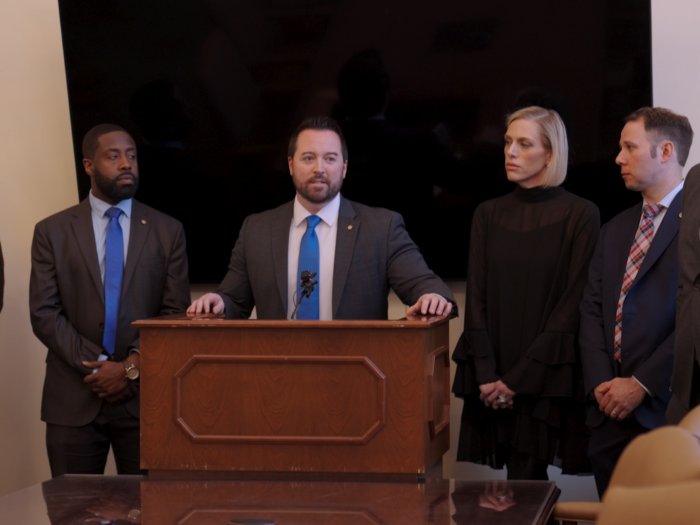
West Virginia’s Democratic lawmakers represent a minority of the West Virginia Legislature, and say stonewalling from some Republicans can make it hard to pass bipartisan legislation. But this year, they hope cannabis policy reform is something both parties can agree on.
Democrats from the West Virginia House of Delegates and West Virginia Senate gathered at the State Capitol Monday afternoon for a joint press conference on this year’s legislative session thus far. Monday was the twentieth day of the 60-day session, marking it one-third of the way complete.
House Democrats brought attention to two policies that would reform the state’s policies surrounding cannabis use: House Joint Resolution 27 and House Bill 2887.
Under House Joint Resolution 27, a new measure would appear on West Virginia voters’ ballots during the 2026 general election: whether to modify the West Virginia Constitution to legalize the possession of two ounces of marijuana or fewer per person, and to expunge past marijuana possession convictions in the state.
“The possession of cannabis for purposes of consumption by adults 21 years of age or older shall be lawful in quantities of no more than two ounces, or four individual plants per person,” the constitutional amendment would read. “The legislature may enact laws relating to lawful sales and manufacturing of cannabis in this state. Any prior conviction for possession of two ounces or less of cannabis is subject to dismissal or expungement by petition to the circuit court in the county where the conviction occurred.”
The bill’s lead sponsor is House Minority Leader Del. Sean Hornbuckle, D-Cabell. It is cosponsored by four other Democratic delegates: Del. Hollis Lewis, D-Kanawha; Del. Mike Pushkin, D-Kanawha; Del. Evan Hansen, D-Monongalia; and Del. Rick Garcia, D-Marion.
During Monday’s press conference, Lewis advocated for the passage of the bill. He said that it aligns with Gov. Patrick Morrisey’s “backyard brawl” economic development plan, which aims to make West Virginia more enticing to new residents and businesses than neighboring states.
Lewis said that Morrisey has talked about “not starting programs” funded by the state “unless we have new revenue,” and pointed to marijuana legalization as a possible solution.
“When we look at being competitive in that backyard brawl, we have states like Virginia, Maryland, D.C. and Ohio all have recreational use cannabis, and I think Pennsylvania has a bill coming out to legalize recreational cannabis,” he said. “The longer we wait to do this, the less competitive we are, the more money we lose.”
The bill was referred to the House Judiciary Committee on Feb. 25 and is waiting on committee review.
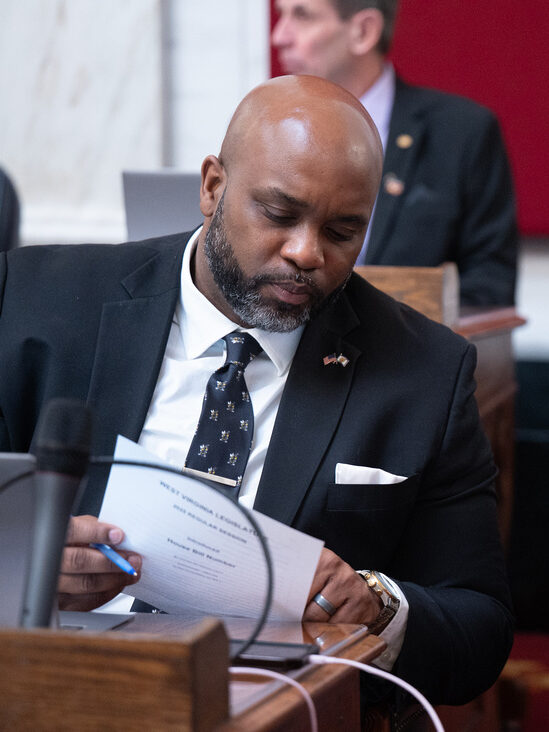

House Bill 2887 would allow county commissions in West Virginia to determine “whether the manufacture and sale [of cannabis] to persons 21 years of age or older is allowed in the county,” the bill reads — placing the decision in the hands of local governments.
Hansen is lead sponsor on the bill, but it is cosponsored by every Democratic member of the House.
The bill also sets standards for cannabis sale regulation, as well as taxes on cannabis sale and distribution. Under the bill, county governments would be entitled to retain 50 percent of the local sales tax for marijuana sales within their jurisdiction.
Other funds generated from the marijuana industry would go toward areas like the Public Employees Insurance Agency Stability Fund, which helps stabilize finances for West Virginia’s state employee insurance program.
At a separate press conference held by House Democrats on Feb. 24, Hansen described the bill as a statewide opportunity for “increasing revenue.”
“There’s some level of local control, but what’s important about that is that that would create a new revenue stream that could be in the tens to hundreds of millions of dollars,” he said.
“It would be a great revenue to generate in West Virginia, and go nicely with our tourism market here,” Lewis said regarding House Bill 2887 during Monday’s press conference.
The bill was referred to the House Judiciary Committee on Feb. 24, and still awaits committee review.
Add WVPB as a preferred source on Google to see more from our team

Secretary of State Kris Warner has announced that 66,855 ballots have been cast across the state in absentee voting and the first four days of early voting.
Continue Reading Take Me to More NewsNearly $1.4 million in funds from the state's Rural Health Transformation Program will be used to help replace a mobile cancer screening unit that serves rural communities.
Continue Reading Take Me to More NewsOn this West Virginia Week, our voter's guide is out, and it has all the information you need to know about the upcoming general election in the state. Also, another lawsuit targets the state's public school funding formula. And, a million dollar giant troll is making its way to the woods of West Virginia.
Continue Reading Take Me to More NewsPeople can drop off medications that are no longer being used at more than 65 National Prescription Drug Take Back Day locations across the state.
Continue Reading Take Me to More News