Alert (09/29/2026): Our Parkersburg TV transmitter is still undergoing maintenance and remains temporarily inoperative. We apologize for the inconvenience.
All our programming is available via our TV livestreams on our website and WVPB Passport. Thank you for your patience!
This week, author Silas House returns with a sweeping new novel. Also, some folks say, you have to fake it 'til you make it, even if you're trying to establish a state park. And, the story of the first Mothman sightings as written by a small town journalist in 1966.
House Passes Resolution Against Reclassifying Potomac River Section For Climate Concerns
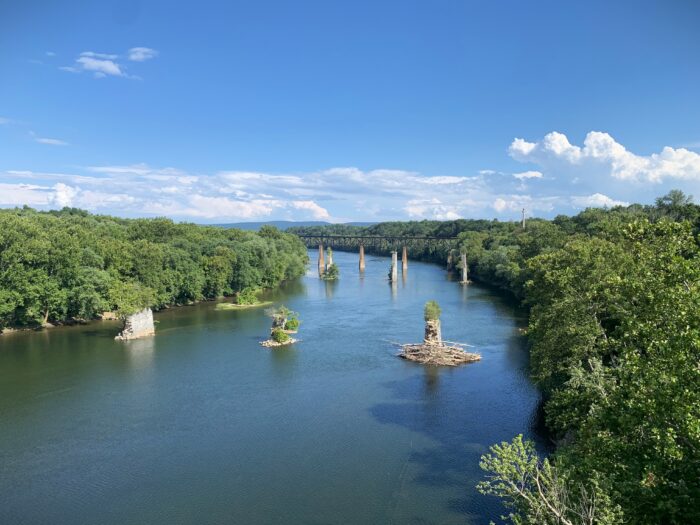
The Potomac River runs alongside the eastern edge of Shepherdstown, pictured here. A separate portion of the river near Mineral County was central to a House floor discussion Tuesday.Jack Walker/West Virginia Public Broadcasting
Listen
Share this Article
The West Virginia House of Delegates passed a resolution Tuesday opposing the redesignation of a segment of the Potomac River.
The federal government classifies waterways according to the aquatic life species that live in them, namely as cold water, warm water or mixed aquatic life zones.
The Potomac River runs along the border of western Maryland and West Virginia’s Eastern Panhandle.
Recently, the Maryland Department of the Environment has sought to expand the designation of cold water aquatic life areas, arguing that the ecological impacts of climate change demand closer monitoring of changes to water temperatures.
“As climate change causes stream temperatures to rise, cold water habitats like those in the North Branch Potomac River are becoming increasingly rare,” reads a department webpage. “Protecting these habitats is essential for species like trout, which are highly sensitive to warming.”
But West Virginia House Concurrent Resolution 49 argues that reclassifying the waterway would be detrimental to local industrial projects, because it would require them to monitor the temperature of discharges into local waterways.
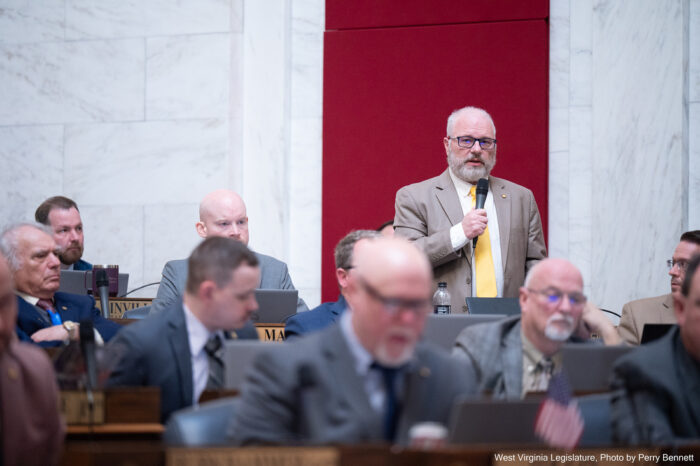
Del. Gary Howell, R-Mineral, discusses House Concurrent Resolution 49 on the floor of the West Virginia House of Delegates Tuesday.
Photo Credit: Perry Bennett/WV Legislative Photo
The resolution specifically refers to a segment of the Potomac River that begins at the mouth of Maryland’s Savage River, and continues through the community of Pinto, Maryland.
The reclassification would “impose an unreasonable burden on interstate commerce and on the State of West Virginia,” the resolution reads. The resolution also urges the attorney general to investigate the constitutionality of a reclassification.
“Discharges from the West Virginia side of the river will have to be cooled down… adding costs to West Virginia businesses,” said the resolution’s lead sponsor, Del. Gary Howell, R-Mineral. Howell’s House district is bordered by a portion of the Potomac that would be affected by a reclassification of the northern branch of the river.
“The resolution is requesting that Maryland reject this so that we don’t have to go to court if they do this to fight for West Virginia,” he said.
Members of the House did not discuss the resolution after Howell introduced it, and voted to pass it by a verbal vote majority.
To be fully adopted by the West Virginia Legislature, the resolution must first pass a vote from the West Virginia Senate, which will now have the opportunity to consider the proposal.
Add WVPB as a preferred source on Google to see more from our team
On this West Virginia Week, our voter's guide is out, and it has all the information you need to know about the upcoming general election in the state. Also, another lawsuit targets the state's public school funding formula. And, a million dollar giant troll is making its way to the woods of West Virginia.
West Virginia Attorney General JB McCuskey has launched a broad investigation into many of the state's leading environmental groups, demanding a decade of internal records involving their fundraising and climate change advocacy as part of a probe into “alleged unfair or deceptive acts."
Silas House is a major voice for Appalachia. The Kentucky native has written more than 15 books and served as the state's poet laureate. His latest book is The Tulip Poplars, a sweeping novel about the lives of four people as they navigate friendship and forbidden love throughout the 20th century. Inside Appalachia's Mason Adams spoke with House.