Alert (09/29/2026): Our Parkersburg TV transmitter is still undergoing maintenance and remains temporarily inoperative. We apologize for the inconvenience.
All our programming is available via our TV livestreams on our website and WVPB Passport. Thank you for your patience!
Our premiere fall broadcast season of Mountain Stage continues this week when host Kathy Mattea welcomes Tony Trischka’s EarlJam featuring Michael Daves, Buffalo Wabs & The Price Hill Hustle, Jack Barksdale, and Sarah Borges.
EPA Lists Union Carbide South Charleston Landfill As Superfund Site
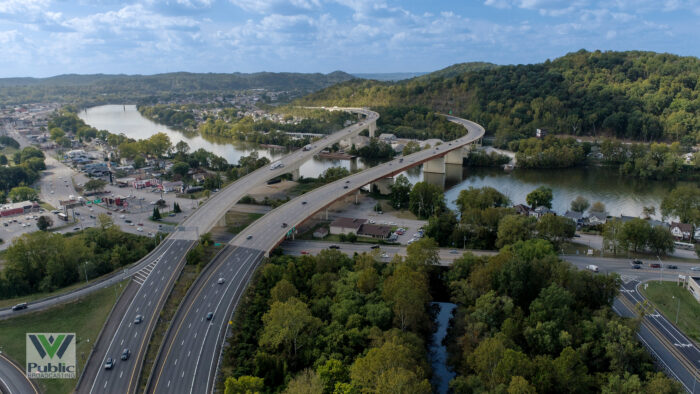
Union Carbide's South Charleston Landfill is adjacent to Davis Creek, which drains into the Kanawha River on the right.Troy Rankin/West Virginia Public Broadcasting
Listen
Share this Article
This is a developing story and may be updated. The original story misstated the number of National Priorities List sites in West Virginia. It has been corrected.
An ongoing case in the U.S. District Court for the Southern District of West Virginia will determine whether Union Carbide, a subsidiary of Dow Chemical, will pay civil penalties.
Courtland, a property owner that sued Union Carbide, is seeking a $1.4 billion civil penalty against the company over pollution resulting from the dumping of toxic material. Courtland also has sought an injunction from the court that would put the cleanup under EPA supervision.
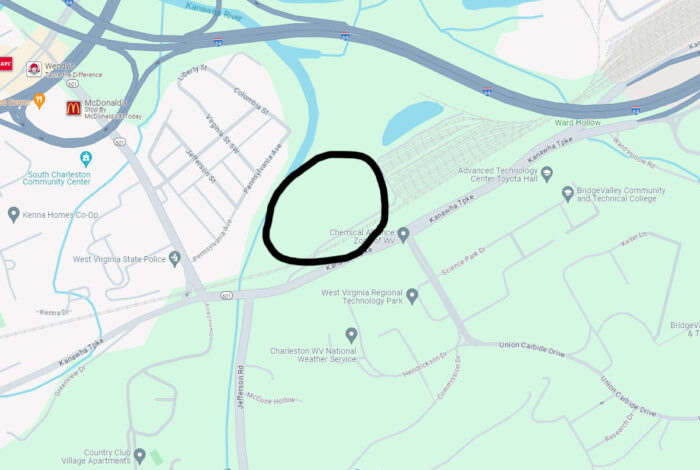
The Courtland and Union Carbide Filmont sites are directly beside Davis Creek and close to where the creek enters the Kanawha River.
Illustration by Eric Douglas
Last year, Senior Judge John T. Copenhaver Jr. found that the site, called the Filmont landfill, was an illegal open dump under federal law. He also found that Union Carbide violated the Clean Water Act by failing to seek a stormwater discharge permit for the facility.
Copenhaver dismissed two of Courtland’s four lawsuits against Union Carbide.
Last month, Union Carbide asked Copenhaver to reject the civil penalty and the injunction.
The company has said it’s pursuing a voluntary remediation with the West Virginia Department of Environmental Protection that would achieve the same goals as an EPA-supervised cleanup and would take less time to complete.
Pat McGinley, a law professor at West Virginia University who specializes in environmental law, said the Superfund listing could affect the outcome of the case.
“It brings EPA into the process of determining the appropriate remedial action,” he said, “obviously not what the defendant prefers.”
In a court filing dated April 30, Mike Callaghan, an attorney for Courtland, noted that the Superfund listing did not place the Filmont site on the National Priorities List. That list currently includes 1,340 of the most polluted sites across the country. Eleven are in West Virginia.
“Counsel is further exploring the significance of this site being listed under EPA’s Superfund Site Information and the impacts that may have on this litigation,” Callaghan wrote.
A new book called "Appalachian Plants: In the Garden, In the Yard, and In the Wild" explores some of the history and lore of plants that have been used by many in the region. Inside Appalachia’s Mason Adams spoke with author Linda Hager Pack and illustrator Pat Banks about their book.
State leaders including Gov. Patrick Morrisey and Sen. Shelley Moore Capito reacted positively to the announcement Monday that the U.S. Environmental Protection Agency will abandon Biden-era rules that force coal-burning power plants to capture most of their CO2 emissions.