


The Old Louisville Demon Leaper’s Mischief In One Of America’s Largest Victorian Neighborhoods
In the late 1800s, tales of a creature that bounds between rooftops emerged in Old Louisville — The Demon Leaper.
Continue Reading Take Me to More NewsAlert (10/27/2026): Our 88.5 FM signal in Charleston is experiencing intermittent outages. Our engineers are working with our provider to find a solution. We apologize for the inconvenience.
Our radio livestream is available at wvpublic.org and through the WVPB app. Thank you for your patience.




To Educate, Inform, and Inspire by Telling West Virginia's Story

Mountain Readers 2026 has concluded! Please fill out our volunteer post-survey.

Nominate an exceptional West Virginia K-12 teacher today!

On Demand

On Demand

Stream original productions from WVPB

Watch locally produced documentaries & more.

On Demand

On Demand






West Virginia Morning

Inside Appalachia

West Virginia Week

Mountain Stage

Us & Them

The Legislature Today

The Legislature This Week

Send us your comments and questions.

Stream our board meetings.

Check out the latest WVPB news.

Sign up for our newsletter and get weekly updates.

Meet the WVPB staff.

WV Educational Broadcasting Commission, the WVPB Foundation, and the Friends of WVPB.

Come work with us!

Read our annual report and learn how we educate, inform and inspire with your support.

Sponsor impactful and engaging media and entertainment.

Use your IRA to make a gift to WVPB.

Become a member with your gift of $1,000 or more.

Make WVPB part of your legacy.

Manage your membership account.

Learn how you can Protect and Sustain West Virginia Public Broadcasting.
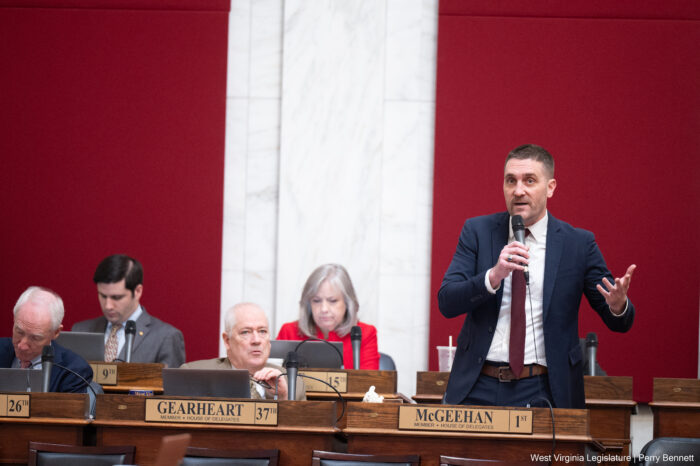
The West Virginia House of Delegates suspended its own rule Monday to provide emergency funds to Hancock County Schools.
The West Virginia Board of Education declared a state of emergency on Friday due to the district’s financial issues.
The West Virginia Constitution states that “No bill shall become a law until it has been fully and distinctly read, on three different days, in each house, unless in case of urgency.” Lawmakers voted to suspend rules because House Majority Leader Pat McGeehan, R-Hancock, said gross mismanagement has led to a situation where current funds available to the district would not carry them through March.
“The state school board and the Department of Education have said they’ve never seen anything like it, where a county superintendent or administration doesn’t make the proper adjustments at the beginning of the year and then just allows the deadlines for being able to kind of make sure things get back on track with a balanced budget, allows that to pass,” McGeehan said. “Now they have no more money, and they’re insolvent, even though there’s obligations, they have to make payroll for the rest of that school year.”
Delegates passed House Bill 4574 to grant the state Board of Education the ability to administer supplemental funds beyond the state school funding formula. The bill creates a loan program titled, “Temporary Shortfall Supplement Fund for County Boards of Education” for financially distressed counties whose reserve funding has fallen below 5% of available funding. The funds carry with them limitations to only be spent to honor personnel obligations and other essential operating expenses and reporting requirements to both the state Board of Education and the Legislative Oversight Commission on Education Accountability.
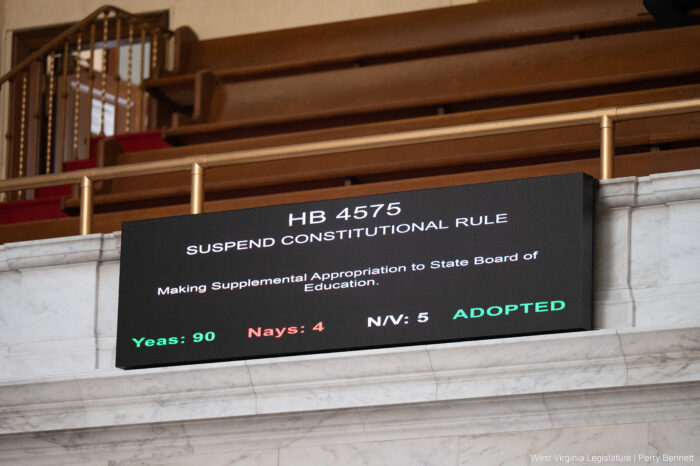
Lawmakers also approved of House Bill 4575, which appropriates an additional $8 million to the state school system to fund the Shortfall Supplement Fund. Both bills passed with overwhelming majorities.
The West Virginia Department of Education estimated the Hancock County Schools has overspent its budget by close to $8 million, starting fiscal year 2024 with a $5.5 million fund balance to now having a projected deficit of $2 million. McGeehan said much of the overspending came from the district having more than 140 employees over what the school funding formula budgeted for, as well as large spending on athletic facilities at several schools.
“Then there was also a number of other things that took place, and there may have been potentially some… well, it was gross mismanagement,” he said. “Hopefully it’s not more, something worse than that.”
McGeehan said he was made aware of the situation last month, and he expected the situation is likely to prompt a reevaluation of school finances and legislative oversight.
House Minority Leader Sean Hornbuckle, D-Cabell, urged passage, but urged caution due to the direct effects the situation has on children and local jobs.
“I would also say to piggyback off the gentleman from the first looking at oversight measures and what we can do in auditing,” Hornbuckle said. “But more importantly than that, I would recommend to this body we need to re-evaluate also what we have done and what we will do to make sure we are not putting financial hardships on counties, so that we are not sitting here yet again, having to make emergency action, because if we do not, we will be here.”
Both bills now head to the Senate for its consideration.
Add WVPB as a preferred source on Google to see more from our team

Spending via the Hope Scholarship Program has increased by more than 50% over the past year, with most of the money going to nonpublic, private schools.
Continue Reading Take Me to More NewsThe Governor's Highway Safety Program is offering tips on roadway safety during Halloween.
Continue Reading Take Me to More NewsSecretary of State Kris Warner has announced that 66,855 ballots have been cast across the state in absentee voting and the first four days of early voting.
Continue Reading Take Me to More NewsNearly $1.4 million in funds from the state's Rural Health Transformation Program will be used to help replace a mobile cancer screening unit that serves rural communities.
Continue Reading Take Me to More News