Alert (09/29/2026): Our Parkersburg TV transmitter is still undergoing maintenance and remains temporarily inoperative. We apologize for the inconvenience.
All our programming is available via our TV livestreams on our website and WVPB Passport. Thank you for your patience!
This week, ballroom culture offers LBGTQ folks a chance to be as fabulous as they want to be. Also, national media reports on the deaths of notable people, but small, hometown papers add a more personal touch. And, alpha-gal syndrome takes red meat off the menu, but what about ostrich?
Law Reversal Would Help Residents With Disabilities Find Work, Advocates Say
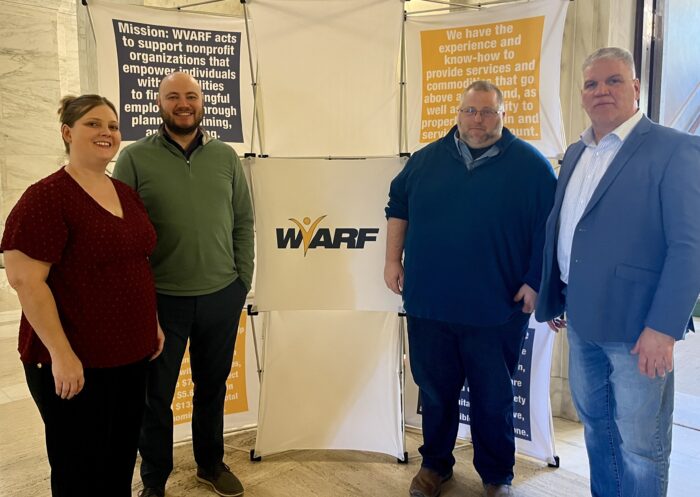
From left, state use program advocates Nita Hobbs, Morgan Hassig, Dathum Cummings and Gary Wolfe stand in the State Capitol rotunda.Jack Walker/West Virginia Public Broadcasting
Listen
Share this Article
More than one-third of West Virginia adults have some form of disability, according to 2022 estimates from the Centers for Disease Control and Prevention. These range from vision and hearing difficulties to mobility challenges to cognitive disabilities.
Since 1989, West Virginia’s state use program has given residents with disabilities first crack at certain state-requested jobs without facing outside bids — fields like janitorial work and mail processing. But a 2022 state law removed the program’s preferred purchasing status, deprioritizing its participants in the hiring process.
Now, some advocates are urging members of the West Virginia Legislature to reinstate the state use program’s purchasing status so it can help more residents with disabilities get hired. Earlier this year, Del. Joe Statler, R-Monongalia, sponsored House Bill 2107, which would do just that.
Similar bills passed the West Virginia Senate and West Virginia House of Delegates in 2023 and 2024 respectively, but failed to garner support from the other chamber necessary to become law. House Bill 2107 currently awaits review from the House Government Administration Subcommittee, and has not been taken up for a reading on the House floor.
Nita Hobbs is deputy director of the West Virginia Association of Rehabilitation Facilities, which oversees the state use program.
“We connect nonprofits across the state of West Virginia who employ individuals with disabilities with state agencies who buy the services and commodities that they produce,” she said. “We’re helping the economy in West Virginia by putting people to work. Then we’re also getting people off social subsidies.”
Hobbs called the 2022 bill a blow to both the disabled community and the state’s workforce.
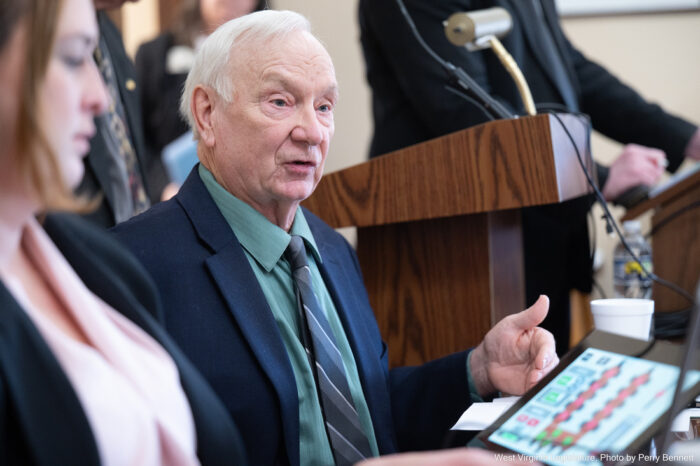
Del. Joe Statler, R-Monongalia, is the lead sponsor on House Bill 2107. He is pictured here delivering remarks at a House Education Committee meeting on Feb. 25, 2025.
Photo Credit: Perry Bennett/WV Legislative Photography
“A good example would be someone who might have worked at the same location for 15 years and maybe has autism. They get used to the same schedule over and over again, and they take pride in their work,” she said. “If their job becomes insecure and they don’t have that place to go to work anymore, it can be very unsettling.”
Since the 2022 law took effect, Hobbs said the program has lost out on connecting participants with more than 28,000 paid work hours — equal to the pay for 25 full-time positions. In addition to shrinking the state’s workforce, she worries this could require more residents with disabilities to rely on social services from the state.
“It could actually cost our taxpayers a lot more money if the state use program went away, because you have individuals who are being put to work who might not have been chosen for employment otherwise,” Hobbs said. “So, instead of going and spending money in their local community — becoming taxpayers, becoming self-sufficient — they are then out of work.”
Hobbs visited the State Capitol Tuesday alongside several program advocates to urge lawmakers to support the program and help advance House Bill 2107 through this year’s legislative session. Historically, she said the program has received bipartisan support.
State lawmakers have affirmed the importance of the program and had a “great response” to reinstating its purchasing status, Hobbs said. Still, she and other program advocates are waiting to see that reinstatement take effect.
“This is our third year that we’ve had a similar bill introduced to change the language back to ‘preferred purchasing,’” she said. “What we need this year is to get it on the Government Organization Committee agenda here on the House side to be able to put that bill through to the next step.”
Add WVPB as a preferred source on Google to see more from our team
On this West Virginia Week, nuclear power in West Virginia takes a step back, Child Protective Services (CPS) settles with five children, and we make a visit to a fire tower.
Local leaders continue to promote the state's aviation industry as the country continues to face a shortage of specialized workers including mechanics, technicians and air traffic controllers.
An autism non-profit says a series of barriers including low Medicaid reimbursement rates have made it all but impossible for the majority of West Virginia children diagnosed with autism to receive the treatment they need.
West Virginia brought in $16 million more than projected for September, 3% ahead of estimate. For the first three months of the fiscal year, collections are up $62 million with increases in most – but not all -- categories.