Alert (09/29/2026): Our Parkersburg TV transmitter is still undergoing maintenance and remains temporarily inoperative. We apologize for the inconvenience.
All our programming is available via our TV livestreams on our website and WVPB Passport. Thank you for your patience!
This week, author Silas House returns with a sweeping new novel. Also, some folks say, you have to fake it 'til you make it, even if you're trying to establish a state park. And, the story of the first Mothman sightings as written by a small town journalist in 1966.
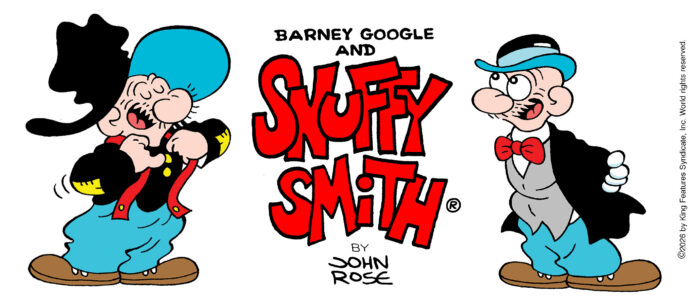
The hillbilly stereotype is frequently used to shame mountain people, but there are gentler versions, like Snuffy Smith, the long-running comic strip character.
Snuffy still appears in newspapers, but these days, it’s easier to find him online. Snuffy Smith originally started out as a supporting character in his comic strip, which first launched in 1919 when Billy DeBeck created Barney Google. Artist Fred Lasswell was brought in during the ‘30s to create Snuffy Smith and his friends. And now the strip is written and drawn by John Rose, who lives in Virginia’s Shenandoah Valley.
Inside Appalachia host Mason Adams spoke with Rose.
The transcript below has been lightly edited for clarity.
Adams: Snuffy Smith traces his roots back to 1934 when he first appeared in Barney Google’s then 15-year-old comic strip. So much of our world has changed since then. How do you keep Snuffy Smith fresh all these decades later?
Rose: The world’s definitely picked up a lot of speed since 1934, Also, in a lot of ways, folks themselves haven’t changed that much, I guess, like Snuffy, people still love their families, they dodge their chores, they get a little stubborn and dream up small schemes and make their life easier. And all those kinds of things have been true in Hootin’ Holler since Snuffy’s introduction in 1934. I guess I’ve got a little bit of Snuffy Smith in me. Hopefully you got a little bit of Snuffy in you, and hopefully my readers do too. But as for keeping it fresh, I’ll try to bring sometimes new contemporary twists to familiar situations.
For example, a few years ago, I had Jughead, Snuffy’s nephew, learn to play the guitar, and he plays the guitar often now. I had a strip where I had that he wanted to get on American Idol one day. I think Loweezy was in the middle, and he said something like, he wanted to get on American Idol. Snuffy is on the other side of Loweezy, and he’s resting against his stump, asleep, and Loweezy says something like, “You know, here I’ve got one that wants to get on American Idol, while the other remains an idle American.” I just try to sometimes bring in contemporary themes, but I always want to stay true to the characters. I don’t want to put them in any situations that aren’t true to their personalities.
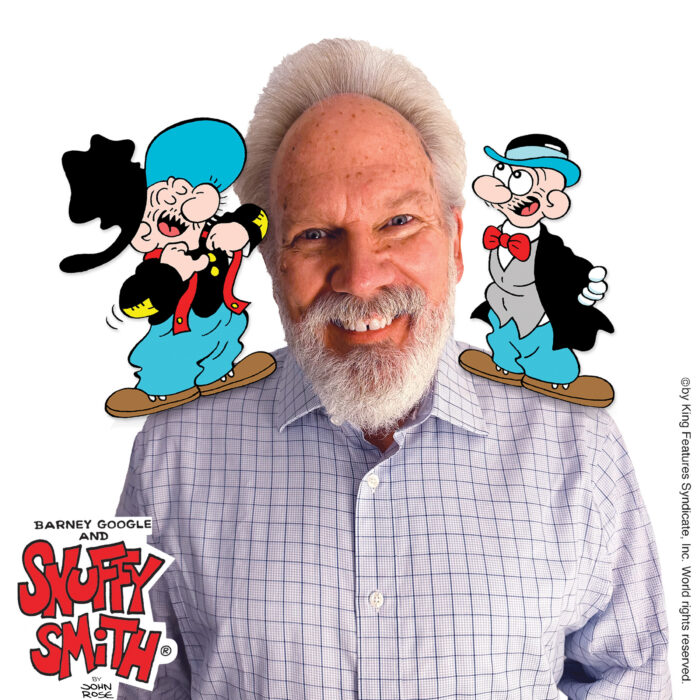
John Rose with Snuffy Smith (left) and Barney Google.
Courtesy of John Rose/King Features Syndicate
Adams: How did you become Snuffy Smith’s cartoonist?
Rose: I was working as an editorial cartoonist and was a member — I still am — of the National Cartoonists Society, and we have an annual meeting. At this meeting, I was talking with a fellow editorial cartoonist, and he told me that he was working as an assistant on a syndicated comic strip. I didn’t really know that comic strip cartoonists used assistants. Ever since I was a child, I’ve always wanted to be a comic strip cartoonist, and I thought maybe this was a way I could enter the world of comic strip cartooning. So, I thought about it. And the first comic strip, really, that I thought of was Snuffy Smith. I’d grown up reading it in the papers in Covington, Virginia. I loved it. I didn’t always understand the gags when I was a kid, but I love the artwork. I didn’t know Fred Lasswell, who was the longtime cartoonist on the comic strip, but because I was in the National Cartoonists Society, I had access to his physical address and phone number. I did a couple sketches, I did a sample Sunday comic strip, I did some character sketches, and I mailed it in a package with some of my other work.
Fred Lasswell was a legend in the comic strip business. He drew this comic strip for over 60 years, and he just had a personality that could light up a room. Everybody loved him. He was a true legend. So, as a cartoonist, you know, you get a lot of rejection. This was just a cold call, and when I sent it to him, I thought I might hear a “thanks, but no thanks”, or I might get a rejection letter of some kind back from him. I didn’t know if I’d hear or not, but about two weeks after I mailed him the package, it was a Saturday, it was lunchtime, and I was eating a nutritious lunch of Cocoa Puffs, and the phone rang. I picked up the phone and the voice on the other end said, “John, this is Fred Lasswell.” I kind of choked on my Cocoa Puffs. I was surprised that he had called, and he said, word for word, he said, “I got the packet of samples that you sent me, and I really like the way you draw big noses.” So, to make a long story short, he hired me as his inking assistant.
Basically, he would write the comic strip, he would sketch out the comic strip, and then he would — this was in the days of fax machines — he would fax me his beautiful sketches. Then I would take his sketches and ink those in, scan them into the computer, kind of clean it up a little bit, email it back to him, and then he would approve it or suggest changes. I worked with him like that for about three and a half years as his inking assistant. I went down to visit him on three long weekends over the time that I worked for him. He was in Tampa, Florida, and I was here in Virginia, and he didn’t mind at all. He was very into technology. So, we talked every day. I worked at the newspaper office during the day; I came home and then worked with him in the evenings. He was a wonderful man, a great teacher, a wonderful mentor to have. In 2001, he passed away, and King Features Syndicate offered me an audition to become the cartoonist on the comic strip. It ended up they liked my work the best, so I’ve been drawing the comic strip ever since 2001. So that’s kind of how I’ve gotten into working on the strip.
Adams: I love that line about the big nose, because Snuffy is definitely known for his big nose. He’s known as a sort of hillbilly stereotype too. He was originally introduced as a North Carolina moonshiner, and a lot of people associated him with that and the hillbilly stereotypes and humor that go along with it. So, as a cartoonist writing and drawing the strip in 2026, how do you deal with that history and that legacy?
Rose: Actually, the moonshining was stopped in the mid-1990s by Fred Lasswellll, before I began assisting on the strip in 1998. I think he did a strip, or a series of strips, that were referred to as “Snuffy’s Last Still.” I think it was ‘95 or ‘96, and so since that point, we rarely refer to moonshine or alcohol, except maybe like Snuffy eating rum cake over the holidays or rum cookies, something like that. As far as the mountains and the hillbilly aspect, I try to stay true to the characters, their mountain roots and their personalities, because that’s who the readers fell in love with a long time ago and who they want to spend time with, visiting in the newspapers or on websites every day.
I was born in Clifton Forge, Virginia, and I grew up in my young childhood in Covington, Virginia, and we still have a family farm in Alleghany County. So, I’m no stranger to mountain communities. I love them and I and I live in them. I live in Virginia’s Shenandoah Valley now in Harrisonburg. So, in my mind, I guess the way I think about it is that Hootin’ Holler is definitely a very rural mountain community. It’s kind of like Camp Swampy in Beetle Bailey is a military base. Hootin’ Holler itself is a made-up, fictional, fun comic strip-type mountain community that could be in North Carolina, Kentucky, Virginia, Tennessee, etc., wherever. But that’s the way I feel.
Adams: What is it about Snuffy that connects with people? It’s specific to its time and place, but it’s lasted for all these years, and it seems to be popular not just in Appalachia, but around the country. What is it that resonates with people about Snuffy Smith and Hootin’ Holler?
Rose: I really think the secret is in the characters, which, of course, most of them were created before me. But I feel like that’s the secret to any successful comic strip, is you want to have characters that readers can relate to, readers have fun with, that readers want to come back and visit with day after day. That’s what I’ve always felt. It’s this wonderful cast of characters that we have in the strip.
Adams: So, what’s the future for you and Snuffy? Where are you all going from here?
Rose: I don’t have any plans to retire anytime soon. I’m bodacious-ly blessed to get to create this comic strip every day. It’s the greatest joy in my professional career, and it continues to be. We just had a brand-new book come out. Up to Snuff is the name of it. I think it’s my biggest collection. I hope to get to do more books. I hope to travel and speak to groups. I just hope to keep being able to do what I’m doing for many more years to come, hopefully in newspapers and on websites and I guess whatever platform comes next.
Add WVPB as a preferred source on Google to see more from our team
This week, author Silas House returns with a sweeping new novel. Also, some folks say, you have to fake it 'til you make it, even if you're trying to establish a state park. And, the story of the first Mothman sightings as written by a small town journalist in 1966.
The annual West Virginia Book Festival, a free event for book lovers of all ages, will be held on Saturday, Oct. 24, at the at the Charleston Coliseum and Convention Center.
Silas House is a major voice for Appalachia. The Kentucky native has written more than 15 books and served as the state's poet laureate. His latest book is The Tulip Poplars, a sweeping novel about the lives of four people as they navigate friendship and forbidden love throughout the 20th century. Inside Appalachia's Mason Adams spoke with House.