Wildlife advocates are pushing to bring large species back across the East. It has worked with some species, like elk, and not so much with others. A new book looks at the process. It’s called "The Beasts of the East: The Fall and Rise of America’s Eastern Wilderness." Inside Appalachia Host Mason Adams spoke with author and Pittsburgh journalist Andrew Moore.
When the first European explorers reached Appalachia in the 1500s, they found a wild landscape full of large animals: elk, wolves and even bison.
Nearly 500 years later, the landscape today looks much different. But advocates are pushing to reintroduce some of those species. Elk reintroduction in particular has taken off across several Appalachian states.
The transcript below has been lightly edited for clarity.
Moore: The animals that I feature in my book — the elk of central Appalachia, the bison of Midwestern prairies and the red wolf of the Southeast — were found throughout the East until we killed them all for various reasons. For the big meaty animals, we killed them for their meat and hide. And the predators, we killed them because we couldn’t imagine sharing the land with them.
But since the late 20th century really, we’ve been trying to put the pieces back together. We’ve been trying to restore biodiversity. We’ve been trying to restore game animals. And then the trickiest thing of all has been trying to restore large predators. The idea for this book really came about when I learned that the state of West Virginia was going to be reintroducing elk to its southern coalfield counties.
And it was shocking to me because I couldn’t picture these big western animals in the hills and hollers of southern West Virginia — this densely forested part of the world. I realized that it was my own lack of understanding of the ancient East and in this wilder time of the eastern United States. Of course, elk were found in West Virginia, Kentucky, all throughout Appalachia and the Southeast.
I was captivated by this idea of trying to bring these animals back. I thought it was a hopeful story. At a time when we’re surrounded by climate disaster and no shortage of bad news related to the environment, I was attracted to these stories of bringing wildness back to the East and by focusing on these large, charismatic animals.
Adams: A lot of the early part of the book really focuses on elk, which have been reintroduced in multiple states across Appalachia. But your book focuses mostly on Kentucky, where the process started earliest, in the late 1990s. How’s it going there so far?
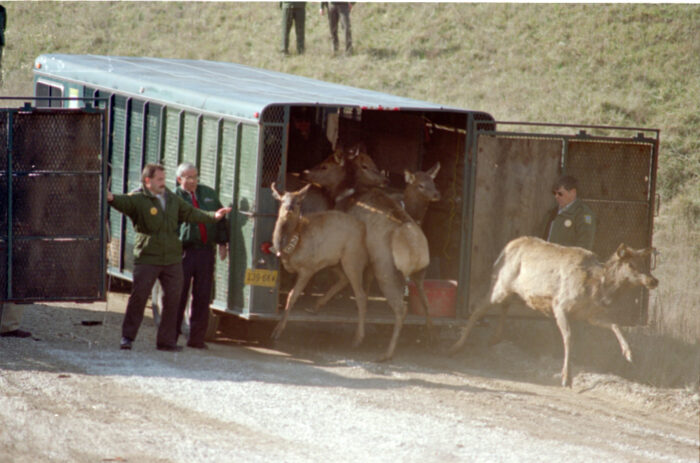
Kentucky Gov. Paul Patton, second from left, watches as five elk are released at a reclaimed strip mine near Hazard Thursday, Dec. 18, 1997. These are the first free-ranging elk to set hoof in Kentucky since the 1840s.
Photo Credit: John Perkins/Kentucky Department of Fish and Wildlife Resources
Moore: From the perspective of elk on the ground, it’s going really well! I focused on Kentucky because what started there in the late 1990s was a revolution of stocking elk in the East. There were a couple states that had done it earlier in the 20th century, like Pennsylvania and Michigan.
But what they were trying to do in Kentucky was unlike anything they’d done before. They were moving not just a few animals and putting them out and seeing how it went. The plan in Kentucky was really bold: they started with 1,500 animals over the course of five years in eastern Kentucky. That is a lot of large animals.
It’s thought that maybe this is the largest movement of large animals at any point in history, the largest intentional movement and translocation of large animals. The reason why Kentucky was so different from, say Pennsylvania or Michigan, is that the folks who were driving this process had something at their disposal that these other places hadn’t had. And what they had was vast amounts of reclaimed mountain top removal coal mine sites.
What that meant was the process of extracting the coal, and then the reclamation of those landscapes, resulted in these artificial novel grasslands. Local communities struggle to find uses for this land. So, when the idea of putting elk on them came up, it was supported. It was supported by the coal industry, and it was supported by the outdoorsman of East Kentucky, who saw this as an opportunity to restore a game species and a piece of Kentucky’s natural heritage that had been lost. Because of that, those grasslands, they were able to bring in so many more elk than anyone had ever attempted elsewhere.
Adams: Each elk reintroduction has been a little different. But a lot of these projects, including the ones you just talked about in Kentucky, are focused on former mountain top removal coal mines. So, why do surface mining and elk reintroduction go together so often?
Moore: It’s as simple as grass, as a one-word answer. The ridges are blasted and the tops of these mountains are pushed into the valleys below. The coal is then extracted. Then the land is reclaimed. And you know “reclaim” doesn’t mean “restore.” That’s a very important distinction.
Reclaiming the land can be done in any number of ways under the federal law. But what seems to have to happen in most of these sites under the law is they’ve got to stop erosion and landslides. One of the popular methods of reclaiming these sites is to re-grade the site and then compact it so firmly that trees can’t really get a good foothold anymore. Also, the top soil is gone. It’s been blasted and pushed down the slope of the mountain. So it’s hard for many native trees to get started there.
What these companies are allowed and encouraged to do is to seed these landscapes with fast-growing fertilized Eurasian pasture grasses, which will then cover that site. So what has happened on tens and hundreds of thousands of acres across central Appalachia is that mixed mesophytic hardwood Appalachian forest ridge tops are gone, and we’ve replaced that with this exotic novel grassland ecosystem.
And elk don’t seem to mind that. They’re a generalist species. They can do well in a number of environments, and they’re not checking to see the status of these plants, whether or not they evolved there. They’re just going to eat these grasses.
Adams: Some people think the elk are really positive. They attract tourism. They are leaving droppings and potentially improving the ecosystem and biological diversity of these places. Other folks basically say this is giving coal companies a pass from fully reclaiming these lands. So, where as an author who’s researched this and talked to folks of all viewpoints, where do you land on this?
Moore: The elk of central Appalachia can be many and all of those things, right? They can be a wonderful addition, a wonderful restoration story. But the mere presence of elk on these former coal mine lands in central Appalachia does not necessarily indicate ecological restoration has been performed here. To see an elk does not equal a restored ecology.
And that’s an important thing to note: the idea that the presence of elk gives coal mine companies a free pass not to fully restore the lands. You can see how that’s true. “Greenwashing” is a phrase that I’ve heard where a coal company can point to an elk and say, “See, we’ve done great things. We’ve restored this native animal.” But that begins to fall apart when you look at the complexity of indigenous Appalachian ecosystems and when you look at the numbers of species that used to call that ridgeline home, and that are no longer there and that can no longer find a niche for themselves in those places. From the plant species to insects and bats and small mammals and amphibians, those things can’t live in those places anymore because they’ve been so radically altered.
Sometimes we can get caught up in the majesty of the elk and celebrate that and stop there. But when you really dig into the the complex ecosystems that are indigenous to these places, you begin to see that there’s a lot missing and that the presence of elk isn’t necessarily a runaway success story.
Adams: We’ve talked a lot about elk, but The Beasts of the East also gets into bison and red wolves, including an effort to bring red wolves to the Great Smoky Mountains. Do you mind sharing a little bit about that with our listeners who may not have heard this story before?
Moore: Yeah, the restoration of red wolves, the reintroduction of them into the wild, began in the late 1980s in northeast North Carolina on the Albemarle Peninsula. This was the first time the reintroduction of a wolf anywhere had been successful. It was also the first time an animal declared extinct in the wild had been successfully restored to the wild. So this was a project with a lot of firsts, and it happened in North Carolina.
When that project had some success and the animals were breeding and successfully having litters on the ground in northeast North Carolina, the federal government and the U.S. Fish and Wildlife Service looked to the Great Smoky Mountains to establish another population of wolves. That program in the Smoky Mountains wasn’t such a success. There were problems with parasites and diseases that were affecting pups.
But the other problem with the red wolves in the Smoky Mountains is we had established these rules that forbade the wolves from entering private property. And of course, wolves don’t see property lines, and they don’t know that they’ve left the national park and they’ve entered private property. Except of course, they do know where the food is. They know where the prey is. Those white-tailed deer were often being found by these wolves on private property.
So it was this inability of the wolf to stick to the park service lands that inevitably led the Fish and Wildlife Service to withdraw those animals from that area. I think this is an interesting point to make and contrast this with the elk project — which is the elk of East Kentucky were introduced almost exclusively, except for one location, to private property. So private landowners, which in this case were coal companies, were allowing elk to be reintroduced to their property. They didn’t see problems with having elk on their property and they saw potential benefits from it.
But the American public has struggled to accept predators, especially large carnivores like wolves on private property. So it’s not really a failure of the landscape or that the wolves themselves in western North Carolina. It was a failure of imagination and a failure to accept that we’re going to have white-tailed deer and raccoons and even elk in some cases on private property, but we haven’t been able to accept wolves as part of the wild cast list of the eastern United States.
When you look to the fossil record, you’ve got red wolves in the Southeast for maybe 10,000 years or more. Elk and bison and their ancestors were in the Southeast for a really long time. It wasn’t until this American society that we set up showed up that these animals vanished, and they vanished quickly. What responsibility do we have to give back? Do we want to have these things in the world? We inherited this life, these wild lives, and I’d like to include plants and animals in the world. We inherited this world. Are we going to simplify it and remove these species or do we want to keep them around? I think that is the question that I’ve been trying to drive at, and the answer that I want our culture to develop is yes, we want to have this heritage stick with us.
--
The Beasts of the East: The Fall and Rise of America’s Eastern Wilderness is out now from HarperCollins Publishers.
Add WVPB as a preferred source on Google to see more from our team
We remember Dolly Parton, not just as a musician and celebrity, but as a voice for Appalachian humor, resilience and kindness. Inside Appalachia’s Mason Adams spoke with Mountain Stage host and country star Kathy Mattea, who shares some of her memories.
This week, we reflect on Dolly Parton’s passing and her legacy in the region. Also, the Adaptive Climbers Festival at Kentucky’s Red River Gorge feels like home for climbers with disabilities from around the world. And, a new book spotlights Appalachian plants and encourages readers to get in touch with nature.