Alert (09/29/2026): Our Parkersburg TV transmitter is still undergoing maintenance and remains temporarily inoperative. We apologize for the inconvenience.
All our programming is available via our TV livestreams on our website and WVPB Passport. Thank you for your patience!
For LGBTQ youth in Appalachia, estrangement from their families of origin can be a common and heartbreaking experience. So, some LGBTQ people rely on “chosen family." In Roanoke, Virginia, the culture of ballroom offers the safety and stability of family, along with traditions that are handed down — traditions like vogueing. Mason Adams reported this Folkways story, in collaboration with Brad Kutner and Kelley Libby.
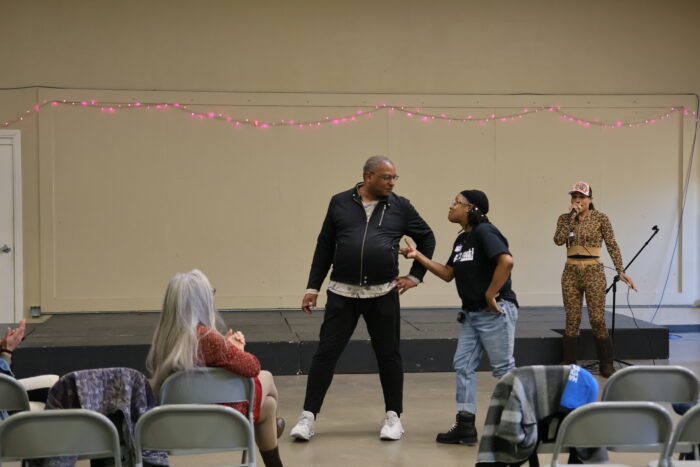
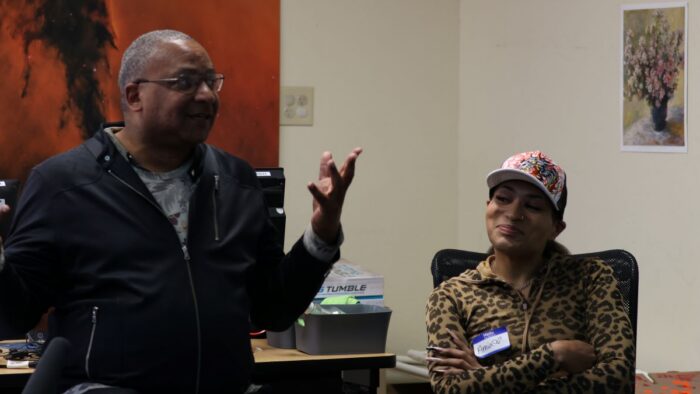
Garland Gravely (center-left) demonstrates a ballroom category with an attendee at Girls Rock weekend in Roanoke, while Amia Baltazar (right) commentates.Kennedy Nwabia
For LGBTQ youth in Appalachia, estrangement from their families of origin can be a common and heartbreaking experience.
So some LGBTQ people rely on “chosen family.” People who are not biologically related but who fill the roles of parents, siblings, aunts and uncles. In Roanoke, Virginia, the culture of ballroom offers the safety and stability of family, along with traditions that are handed down — traditions like vogueing.
On a Saturday morning in Roanoke, the local chapter of the nonprofit Girls Rock hosted a weekend of events. One of them was a workshop on vogueing.
It was led by 29-year-old Amia Baltazar Expression.
She demonstrated the five elements of vogue: hands, floor, performance, dance, catwalk and duck walk.
Vogueing is a stylized performance inspired by models and the fashion industry. It has deep ties to the Black and brown LGBTQ community. And it’s harder than it looks.
“If you take your hands and go into figure eight,” Baltazar said, making slow movements. “Now speed it up.”
Attendees tittered as she accelerated her hands until they were spinning together gracefully in a fluid loop.
Another move is the duck walk.
“That’s hard, too,” Baltazar said. “[If] your knees ain’t good, it ain’t working.”
And the catwalk.
“The cat walk is actually something that the Black trans women used to use as a joke to run away from men that were being rude and ignorant to them,” Baltazar said. “So he’d be like, ‘Hey, come here. Let me talk to you.’ And they’d be like, “No, no, no no!”
As she said this, she skittered away using a stylized walk while swinging her hips, sparking giggles from people watching.
Baltazar is a member of Roanoke’s House of Expression — one of many houses around the world that make up ballroom.
Ballroom houses are organizations within the LGBTQ community. They’re a place where members can find shelter and support. House members bear titles like father, mother, daughter.
And the father – and founder – of the House of Expression, is Father G, aka Garland Gravely.
“I started looking around, [and] I’m like, ‘There’s no ballroom culture in Roanoke or even southwest Virginia,’” Gravely said.
Now 57, Gravely grew up in Roanoke, raised by his mother and grandmother in the Baptist church. As long as he can remember, he knew he was different.
“I came out in the mid-1980s,” Gravely said. “I was like around 14, 15 years old when I came out, as far as admitting to myself that I was gay. The first place I went to was the Park on Salem Avenue.”
“I met a group of drag queens, and they were the first gay people that I met, that I interacted with when I first came out,” he said.
But Gravely still felt isolated.
“I just wanted to get out of Roanoke,” he said. “I was starting to get very, very depressed.”
Garland Gravely (left) speaks during Girls Rock weekend in Roanoke, VA, while Amia Baltazar (right) looks on.
Photo by Kennedy Nwabia
His oldest sister invited him to come live with her in Boston in 1987, when he was 18. He met other gay teenagers and discovered a community. But just as important, he found vogueing.
“The first time I saw the dance style voguing was actually in Boston, at this club called the Haymarket,” Gravely said. “I had never seen it before, coming from Roanoke, and I was like, ‘What are y’all doing?’”
What they were doing was expressing themselves. Ballroom dates back to the Harlem Renaissance, but it really took off in the 1970s and 1980s in Harlem when it was embraced by Black and brown trans women. The balls were a place for LGBTQ people of color to perform and be as fabulous as they wanted to be.
“When you go to a ball, you can be whatever you want to be, even though the outside world tells you you can’t be this because you’re Black and you’re gay,” Gravely said. “But in the ballroom community, you can live out your fantasy.”
Gravely began traveling to balls in New York City. They featured elaborate costumes and competitions, and they gave him an outlet to pursue his interest in fashion.
And they gave him something else.
“One of the things I love about ballroom culture is the family aspect of it, because a house is a chosen family,” Gravely said. “So you have a house mother and house father, brothers, sisters, uncles, aunts, because a lot of the kids, particularly the Black and brown communities, were kicked out of their homes for being LGBTQ. A lot of them were homeless on the streets. So a lot of these trans women adopted them as their children, and they became mothers to them. And it saved a lot of lives.”
Gravely eventually moved to South Beach, in Miami, where he got more into music and fashion. But after a couple of years, he felt a pull to come home. So he went back to Roanoke in 2004.
“When I moved back into my family home, I was able to come back with a different mindset, because I had changed living away for those for years,” he said.
Gravely was inspired by the TV show Pose to found his own house in Roanoke: the House of Expression. That was in 2019.
That same year, Amia Baltazar lost her home in Myrtle Beach, South Carolina, to a hurricane. Two years later, she moved to Roanoke.
“I was alone here in Roanoke,” Baltazar said. “I moved here in early 2021. I was in a 10-year relationship. I had custody of two siblings at the time, and they had just graduated. And everybody left.”
Baltazar eventually landed at the Park — the same, historic LGBTQ club that took in Gravely when he was a teenager. She was spotted by a member of the House of Expression, who told her about ballroom. She was still hesitant — until she attended one of the house’s balls.
“When I came to the ball that they were having and I met Garland [Gravely], it was just like an instant connection,” Baltazar said. “I haven’t really had much family growing up. I experienced the ridicule and the discrimination through family members. I know I needed that around me, and Garland gave me that. He made me feel safe. He made me feel like he was a father figure to me, and he’s always been there for me anytime I need him. He’s always there.”
When Gravely met Baltazar, it was an instant connection.
“I just immediately was like, ‘That’s my daughter,’” he said. “And she was like, ‘That’s my father.’ And so she’s mentoring me. I’m mentoring her, because at one point, she’s gonna become the house mother, and then she’ll bring her own kids in, and I’ll be a grandpapa.”
The House of Expression hosts its own events. And it’s linked up with other houses, like the House of Ninja, which dates back to 1982 and has chapters around the world.
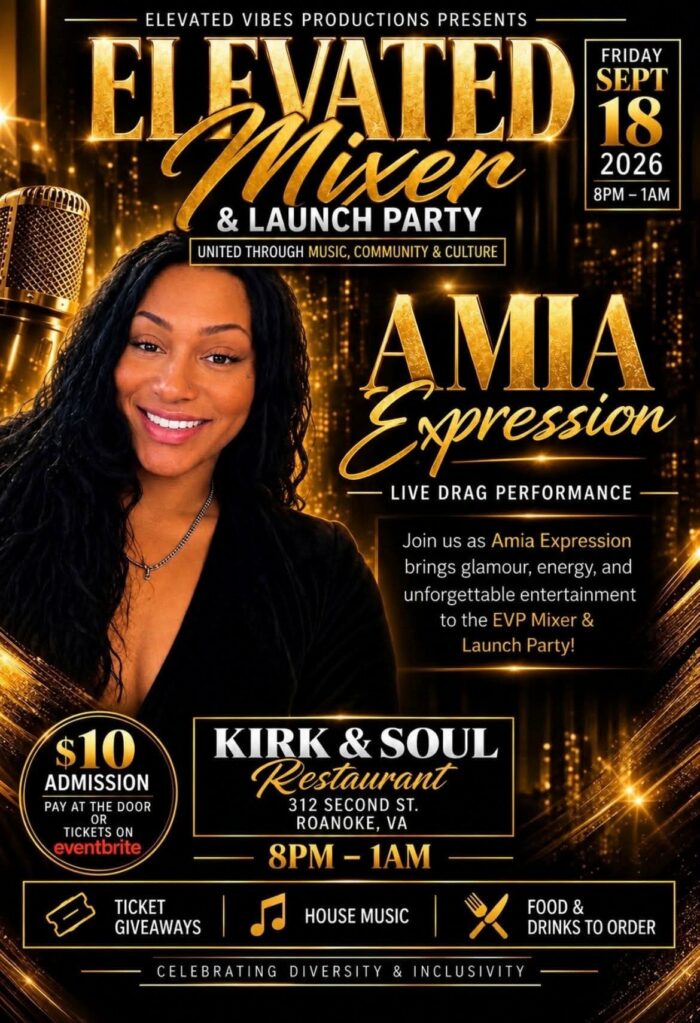
A flyer touting a Roanoke event headlined by Amia Baltazar Expression.
Courtesy of the House of Expression
“It’s community, family, love … and then we hit the floor,” Baltazar tells the workshop.
“And then we hit the floor,” echoes Gravely. “Then we go to the balls, we hit the floor, we support. I was taught a lesson several years ago, that even though we’re in different ballroom houses, we’re still family.”
This year, in June, eight members of the House of Expression traveled to Richmond, Virginia, for the Captivating House of West’s WTV ball. The House of West is another sprawling house with multiple chapters. And this ball was a big deal. It was promoted as the largest grand prize ball in ballroom culture history, with more than $60,000 in cash prizes for various categories.
The ball was held inside Richmond’s historic Main St. train station. People of every race, gender, body type and sexuality spun, walked, twirled, gave looks, dipped and more.
Baltazar was revved up.
“You’re going to see entertainment, honey,” she enthused. “You’re going to see looks! You’re going to see talent! You’re going to see see performance. You’re going to see sex sirens. You’re going to see an out-of-world experience!”
The competition in the various categories can be fierce.
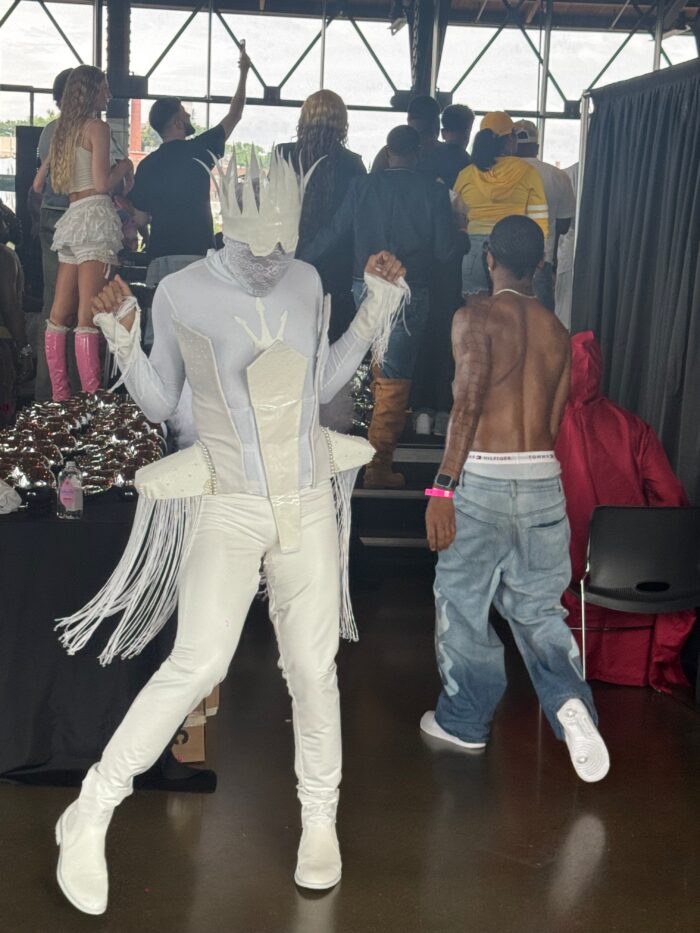
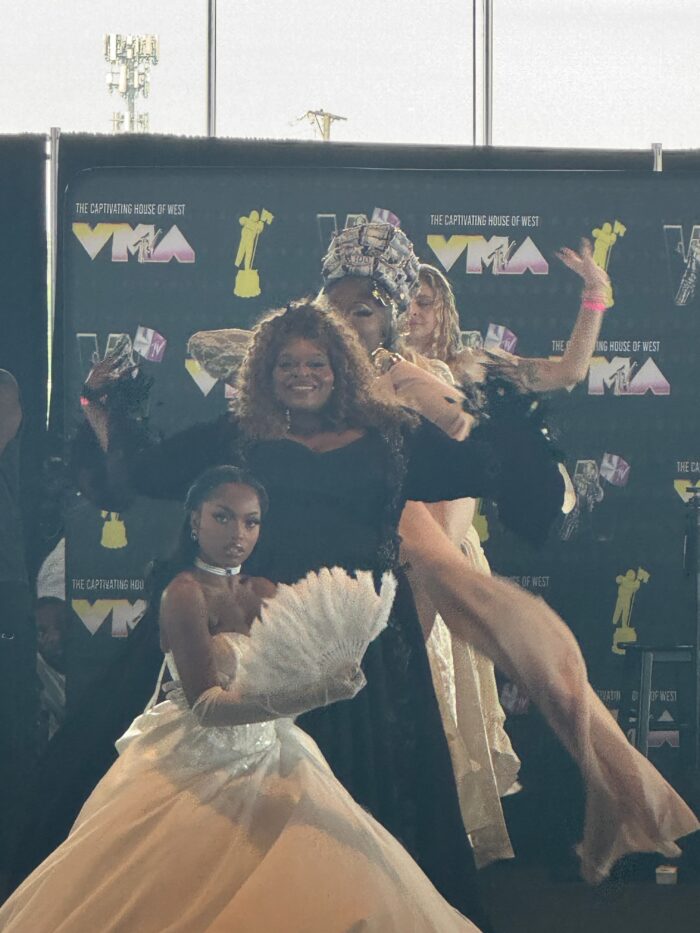
Scenes from the Captivating House of West’s WTV ball in Richmond, Virginia. Photo by Brad KutnerScenes from the Captivating House of West’s WTV ball in Richmond, Virginia. Photo by Brad Kutner
“There’s thousands and thousands and thousands of dollars involved in these major balls,” Baltazar said. “That’s why they come prepared, and they come for blood.”
Baltazar initially planned to compete. But the ball started late. There were 56 categories, and it didn’t make it to hers. Just as well — she wasn’t really feeling it anyway.
“In a ballroom community, in a house, if your effect is not 100% or what it needs to be, I will just take a chill and I will catch the next one,” she said.
Still to Gravely, the ball was a success. It was a time when his ballroom house was among peers. In an accepting, welcoming environment.
“We deal with so much outside of the real world, but here, you can just come and people who you want to be, without somebody policing your body and telling you who you should be,” he said.
For Gravely, Baltazar and the House of Expression, the ball was more than competition, music, spectacle.
It was a family reunion.
--
This story is part of the Inside Appalachia Folkways Reporting Project, a partnership with West Virginia Public Broadcasting’s Inside Appalachia.Subscribe to the podcast to hear more stories of Appalachian folklife, arts and culture.
Add WVPB as a preferred source on Google to see more from our team
Mountain Stage is changing locations for its final two live events of 2026. The Sunday, Nov. 15 show will now take place at the Charleston Theater at the Convention Center, and the Sunday, Dec. 6 show will be held at the Capitol Theater in Downtown Charleston.
During spooky season, popular attention turns toward ghosts and goblins – or if you live in Appalachia – cryptids. For the Appalachia + Mid-South Newsroom, Bill Lynch, producer of Inside Appalachia, brings us the story of the Flatwoods Monster.
This week, ballroom culture offers LBGTQ folks a chance to be as fabulous as they want to be. Also, national media reports on the deaths of notable people, but small, hometown papers add a more personal touch. And, alpha-gal syndrome takes red meat off the menu, but what about ostrich?
Local leaders continue to promote the state's aviation industry as the country continues to face a shortage of specialized workers including mechanics, technicians and air traffic controllers.