


Whimsical Phenomenon Promises To Attract Tourists To Huntington
A giant troll made of scraps and trash has been commissioned by Huntington-area economic developers as a way to increase tourism.
Continue Reading Take Me to More NewsAlert (09/29/2026): Our Parkersburg TV transmitter is still undergoing maintenance and remains temporarily inoperative. We apologize for the inconvenience.
All our programming is available via our TV livestreams on our website and WVPB Passport. Thank you for your patience!




To Educate, Inform, and Inspire by Telling West Virginia's Story
Mountain Readers 2026 has concluded! Please fill out our volunteer post-survey.
Nominate an exceptional West Virginia K-12 teacher today!

On Demand

On Demand

Stream original productions from WVPB

Watch locally produced documentaries & more.

On Demand

On Demand






West Virginia Morning

Inside Appalachia

West Virginia Week

Mountain Stage

Us & Them

The Legislature Today

The Legislature This Week

Send us your comments and questions.

Stream our board meetings.

Check out the latest WVPB news.

Sign up for our newsletter and get weekly updates.

Meet the WVPB staff.

WV Educational Broadcasting Commission, the WVPB Foundation, and the Friends of WVPB.

Come work with us!

Read our annual report and learn how we educate, inform and inspire with your support.

Sponsor impactful and engaging media and entertainment.

Use your IRA to make a gift to WVPB.

Become a member with your gift of $1,000 or more.

Make WVPB part of your legacy.

Manage your membership account.

Learn how you can Protect and Sustain West Virginia Public Broadcasting.
This story originally aired in the Sept. 27, 2026, episode of Inside Appalachia.
Vicki Skywark learned to knit because of sweaterlust.
“I fell in love in fourth grade with my friend’s hand-knitted sweaters,” she said.
Her friend’s mother, who was English, knitted them in a color to match every outfit the friend owned.
“I thought that was the coolest thing I had ever seen,” Skywark said.
Skywark’s mother signed her up for knitting classes that summer. Sixty years later, she had become an excellent knitter and a weaver who taught classes at the Blowing Rock Arts and History Museum.
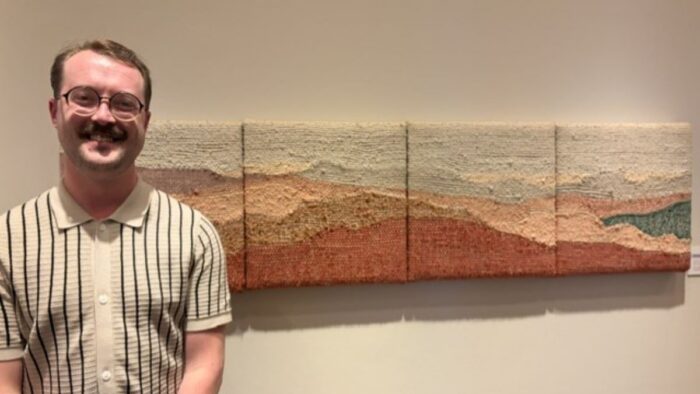
Blowing Rock Arts and History Museum, or BRAHM to its staff and regular patrons, showcased four tapestries that comprised their Barbara Grenell exhibit. Grenell was a weaver and National Endowment for the Arts award winner who moved to Burnsville in the 1960s and became a vibrant part of the region’s weaving landscape until her death in 2001.
“One thing I’ve found in Barbara Grenell’s work in particular is how excellent it is,” said Educational Outreach Coordinator Kayla Reische.
A weaver herself, Reische is president of the region’s Blue Ridge Fiber Guild. Skywark is also an officer of the fiber guild.
“It’s such a perfect example of high levels of math and planning and precision that you can find in weaving,” Reische said. “All my weaving friends — we all joke that we hate math and we’re not good at it, but, of course, we all find ourselves doing weaving.”
The planning and precision Reische loved in Grenell’s work was both model and inspiration in the weaving classes she and Skywark have been teaching. Crafts like weaving are no longer in the forefront of Appalachia’s subsistence culture, so keeping them alive through community classes is one of Reische’s passions. She is particularly enthusiastic about working with elders in memory care.
“Fiber arts in particular is good for cognitive health,” she said. “The sequencing, the patterns, the over under, the math they activate all parts of your brain. And you know what they say, lose it or use it; weaving is perfect for that.”
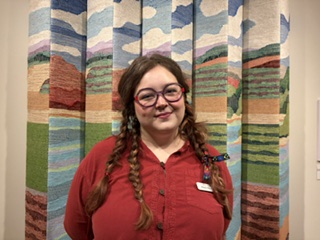
Weaving class members create simple, small pieces inspired by Grenell’s work — not that any of Grenell’s landscapes could be replicated; she had a unique style.
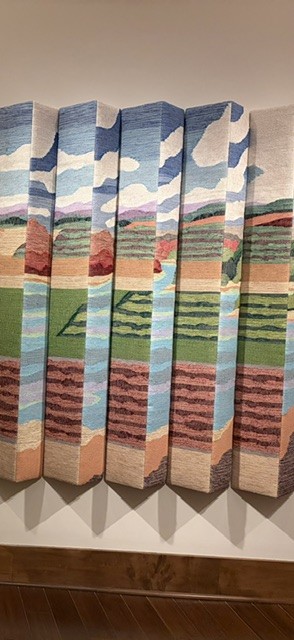
Grenell studied painting at the Philadelphia College of Art. Her painter’s eye informed her weaving hands, especially in her tapestry, combining two different landscapes. The large tapestry features accordion pleats with a different scene on the left and right sides. Viewed from the right, it shows a rich mountain sunset, with purples and pinks. Cross the room to the left and the scene evokes a farm where oranges and greens meld with yellows to suggest haystacks and hillsides.
This intricate practice sparked Reische’s awe at Grenell’s flawless execution, and it kindled a debate that was around long before Grenell came to North Carolina, and will endure after the exhibit closes: when an artist engages so beautifully and with such skill in what’s considered a handicraft, does it become an object to hang on the wall, or an upgraded towel? In other words, is it art or is it craft?
Blowing Rock Museum and History Museum Curator Gabe Wilson-Rhodes loves being asked this question.
“Any sort of value, judgment placed on that distinction is somewhat arbitrary,” Wilson-Rhodes said. “Things are the most interesting when they’re sticky, and there’s tension and there’s friction in the middle. So that stuff that’s especially blurry and sits right on top of the line, at least for me, that’s when I’m having the most fun.”
Both Reische and Wilson-Rhodes thought distinguishing between art and craft was an arbitrary marker in the eye of the beholder more than the mind of the artist. Both museum employees are weavers, and Wilson-Rhodes has a studio set up at his home. But he doesn’t think of himself as a fiber artist.
“I am very much a production weaver, a utilitarian weaver. I am not trying to create a work of art. I am trying to create a towel,” he said.
Grenell was not only doing precision calculations; she was working in a medium more often associated with handicraft than fine art. North Carolina has a history of industrial and household weaving, but both were geared toward making practical things. Grenell trained as a painter at the Philadelphia College of Art before gravitating toward fiber. So she brought a painter’s eye and a weaver’s hands to her projects.
“The woven tapestry form, where she is building the composition and the image through horizontal layers stacked upon each other, the weft going through her warp, in many ways, that mirrors the striations of the land, the actual geology of the mountains she was depicting,” Wilson-Rhodes said.
Downstairs in the exhibit hall, visitors enjoying the Grenell exhibit didn’t indulge in discussion of whether the painter-turned-weaver had left fine arts for handicraft. They just admired her work. One visitor said the colors were beautiful in the way they flowed. Another liked the way yarn had turned into something recognizable as a landscape.
Sam Reep, a museum docent, worked the exhibit regularly. He never got tired of looking at Grenell’s work.
“For me, it’s the color palette. I’m just so blown away by these lovely rose and purples.”
While many place Grenell firmly in the fine arts camp, Wilson-Rhodes said, moving from painting with pastels and oils to weaving with fiber made her a de facto advocate for the crafts movement. Grenell was up to this dual task.
She used her platform as a 1974 National Endowment for the Arts award winner to uplift all crafters and artists. She co-founded the Toe River Arts Council, taught at the Penland School for Craft in nearby Bakersville, and was a member of the Southern Highland Craft Guild out of Asheville. Through each of these organizations, she helped others get interested in working with fiber.
That legacy continues, Reische said. The museum offers employee-led weaving classes based on Grenell’s exhibit at regional eldercare centers for those experiencing cognition and memory loss. Work from some of the neophyte elderly weavers is on display in the smaller gallery above the Grenell exhibit.
Grenell’s precision and the beauty of her work, perfect in creating recognizable landscapes, have made her a role model for future generations of weavers.
--
This story is part of the Inside Appalachia Folkways Reporting Project, a partnership with West Virginia Public Broadcasting’s Inside Appalachia. Subscribe to the podcast to hear more stories of Appalachian folklife, arts and culture.
Add WVPB as a preferred source on Google to see more from our team

A giant troll made of scraps and trash has been commissioned by Huntington-area economic developers as a way to increase tourism.
Continue Reading Take Me to More NewsMiddle Tennessee’s Dickson County is known for being the filming location for Ernest Goes to Camp, which grossed upwards of $20 million in the late 1980s. For the Appalachia + Mid-South Newsroom, WPLN’s Jewly Hight looked into the area’s earlier lore about mysterious creatures of the night.
Continue Reading Take Me to More NewsThis week, ballads tell stories about all kinds of real-life events, but after Hurricane Helene, one group of ballad singers felt some topics were still too raw. Also, the author of a book on ancient Ohio credits a former grad student with introducing him to the region’s mysterious earthworks. And, the legacy of Affrilachian poet Norman Jordan includes a summer camp for teens to study their heritage.
Continue Reading Take Me to More NewsSouth Charleston has been recognized as an American World War II Heritage City, the National Park Service announced Friday.
Continue Reading Take Me to More News