Alert (09/29/2026): Our Parkersburg TV transmitter is still undergoing maintenance and remains temporarily inoperative. We apologize for the inconvenience.
All our programming is available via our TV livestreams on our website and WVPB Passport. Thank you for your patience!
This week, Barbara Kingsolver’s new novel takes on issues of class and classical music. Also, kudzu warriors band together to fend off invasive plants and take back the land. And, it’s pawpaw season, but a new bug could be harming the trees.
Bluegrass And Old-Time Hopefuls Find A Tune In Spoons
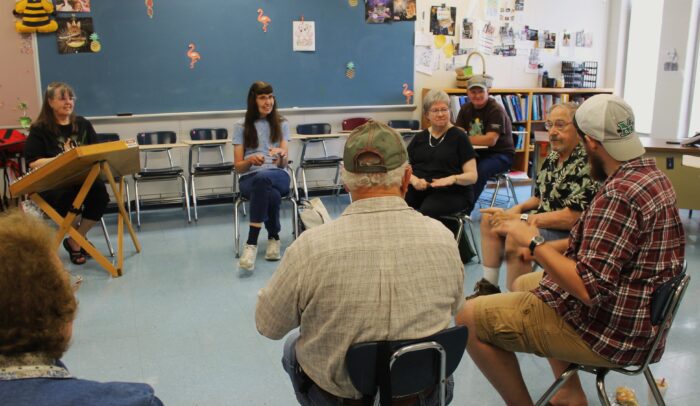
Students gather in Fairmont, West Virginia to attend a free spoons workshop hosted by Pattyfest. The class is led by percussionist Jeff Fedan.Lauren Griffin/West Virginia Public Broadcasting
Listen
Share this Article
This story originally aired in the Nov. 26, 2023 episode of Inside Appalachia.
In a classroom in Fairmont, West Virginia, a diverse group of students has gathered to learn how to play an unlikely instrument: the spoons.
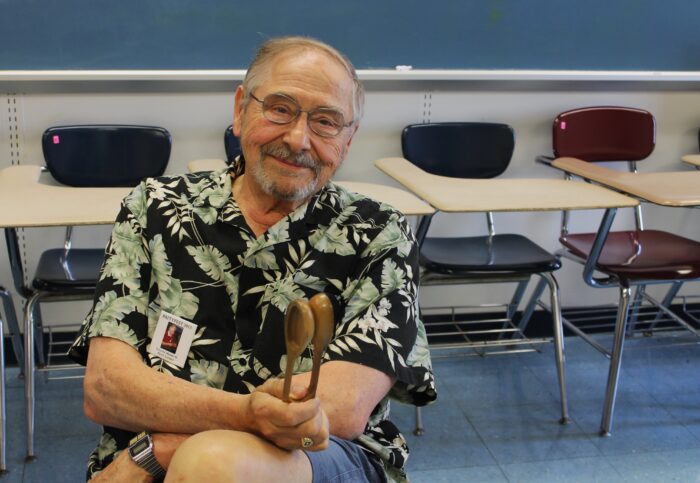
Looking relaxed in a Hawaiian shirt at the center of the circle is their teacher Jeff Fedan. The seniors, kids and young adults who showed up for Fedan’s lesson are playing along to a dulcimer-version of Golden Slippers with spoons of different shapes and styles. As they clack along, Fedan encourages them to try out new rhythmic patterns.
Jeff Fedan has been teaching aspiring spoons players how to play for years. He is also one of the co-founders and organizers of the yearly Pattyfest.
Credit: Lauren Griffin/West Virginia Public Broadcasting
As a recent retiree, Fedan now has more time to dedicate to his musical passion. He’s primarily a drummer, but he also plays the dulcimer.
When Fedan moved to West Virginia decades ago, he started attending music festivals. As a percussionist, he was intrigued when he came across the spoons at a festival once. He picked up the skill and has been teaching other folks how to play for about 10 years. Over that time, he’s noticed increasing interest in the spoons.
Fedan is teaching this free spoons workshops at Pattyfest. It’s a yearly festival held in honor of Patty Loomen. Loomen was a mountain dulcimer player who taught Fedan, along with many others.
Throughout Appalachia, old-time and bluegrass jams are a beloved pastime. For those who want to join, the spoons are an accessible way to dip your toe in. For Fedan, spoons are both affordable and approachable.
“Not everybody can afford an instrument like a guitar, which is several hundred dollars. But if they are inspired by the sound of spoons, for just a few bucks, you can get something that you can use to participate in a jam session,” says Fedan.
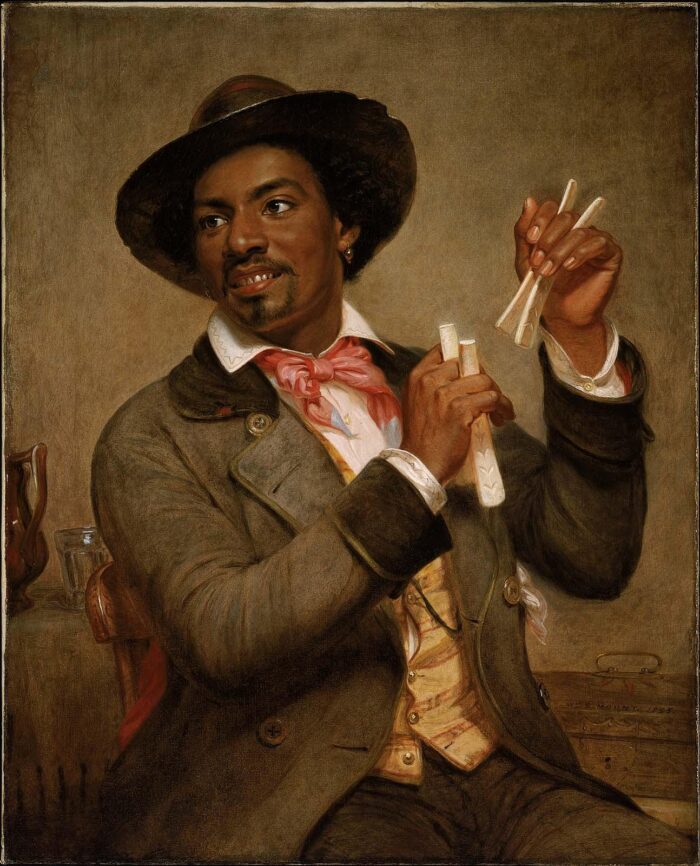
Spoons have been played for centuries in Europe, Asia and the Americas. In ancient history, people used bones to play. You can still find bones players today, but more often people use a wooden set.
The spoons became popular in American folk music, particularly in African American jug bands. You might find the spoons accompanied by a washboard or a jug. Simple, household items that can easily be picked up to carry a tune.
The Bone Player, William Sidney Mount (American, 1807–1868)1856
Credit: Bequest of Martha C. Karolik for the M. and M. Karolik Collection of American Paintings, 1815–1865
Aspiring spoons players have a couple different options. You could play with metal spoons. Or you could opt for a pair of carved wooden ones.
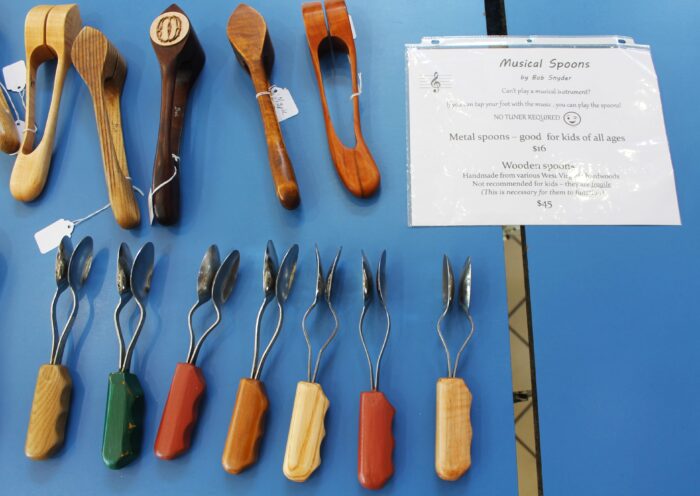
Like their players, each set of spoons has its own personality. Bob Snyder, an old-time musician from Clarksburg, West Virginia, is also a woodworker. After seeing spoons around at festivals, he tried making them himself, creating his own design in the process. He makes his spoons from sassafras, walnut, oak and other hardwoods.
Bob Snyder sells all kinds of different spoons at the festivals he attends. There are metal ones with wooden handles and carved wooden sets of different woods and styles.
Credit: Lauren Griffin/West Virginia Public Broadcasting
“Even two of the same woods, they’re gonna sound different because of the grain in them. I like the walnuts. Everybody’s different,” says Snyder.
Snyder starts out with a square block of wood. He carves out his shapes and glues the two halves together. The final step of his process is lots and lots of sanding.
“I want them to last for people and be comfortable. If it’s uncomfortable, they’re not gonna play it,” says Snyder.
Wooden spoons mimic the shape of kitchen spoons. Cups of different sizes are carved out of the wood. The two halves can then be glued together, creating one singular instrument, rather than two metal spoons that have to be held together in a particular way.
Wooden spoons might be more comfortable, but some players still prefer metal spoons. Emily Kaniecki in Wheeling, West Virginia, is one.
Kaniecki grew up in a family of bluegrass musicians but never picked up an instrument herself. She knew she had rhythm though. So one day, she looked up how to play the spoons online and taught herself how to play.
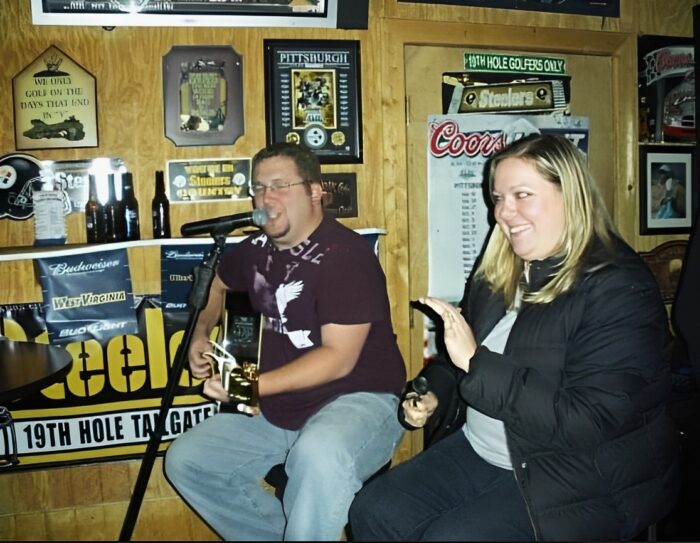
Kaniecki’s twin brother played in an old-time group, the Marsh Wheeling String Band. After teaching herself how to play, she joined the band on stage at Oglebayfest, an annual fall festival.
Emily Kaniecki (right) performing with her friend Tim Ullom at the 19th Hole in Wheeling, West Virginia.
Credit: Emily Kaniecki
“It was always kind of a joke at first. People just thought it was funny. But after a while, I wanted it to be more of a serious thing,” says Kaniecki.
Playing the spoons isn’t always easy. Your body is part of the instrument.
“I’ve taken my jeans off and my whole entire thigh is covered in bruises from just hitting,” says Kaniecki.
Kaniecki has honed her skills and can turn a clamor into a tune. She explains that playing the spoons is not just about the sound you make, but also about the performance. When she gets on stage, she becomes the star of the show.
Kaniecki delights her audience with spoons tricks like the drag. A drag is a technique where you sweep the spoons across your fingers. Instead of hitting the spoons on your leg, you can also play off your elbow or even your head.
Along with her performance at Oglebayfest, Kaniecki has brought out her spoons at open mic nights, on stage at festivals, even at her own wedding. These days, her work as a nurse and a mother keeps her busy. But she says she’ll never retire from the spoons.
“I love it. It’s so easy if you can just have rhythm, practice. It’d be a really cool instrument to play that doesn’t really require formal musical training. And also, it’s different. It’s not something you see everyday,” says Kaniecki.
So, next time you’re putting away your silverware, give it a try. Play along with the rhythm to a song, find a local bluegrass jam, or take a free workshop next year at Pattyfest.
------
This story is part of the Inside Appalachia Folkways Reporting Project, a partnership with West Virginia Public Broadcasting’s Inside Appalachia and the Folklife Program of the West Virginia Humanities Council.
The Folkways Reporting Project is made possible in part with support from Margaret A. Cargill Philanthropies to the West Virginia Public Broadcasting Foundation. Subscribe to the podcast to hear more stories of Appalachian folklife, arts and culture.
Add WVPB as a preferred source on Google to see more from our team
On this West Virginia Week, a mine operation in Kanawha County gets a WARN Notice, three Wyoming County Schools will remain closed until next week, and we learn the origins of the Flatwoods Monster.
This week, Barbara Kingsolver’s new novel takes on issues of class and classical music. Also, kudzu warriors band together to fend off invasive plants and take back the land. And, it’s pawpaw season, but a new bug could be harming the trees.