This week, too often, people with mental health challenges or substance use disorder wind up in jail. But crisis response teams offer another way. Also, changes to the Endangered Species Act could benefit big business. They could also kill animals like the eastern hellbender. And, in troubled times, a West Virginia writer says to find peace in nature.
Berkeley County Resident’s Gadget Geocaches Put Local Tourism On The Map
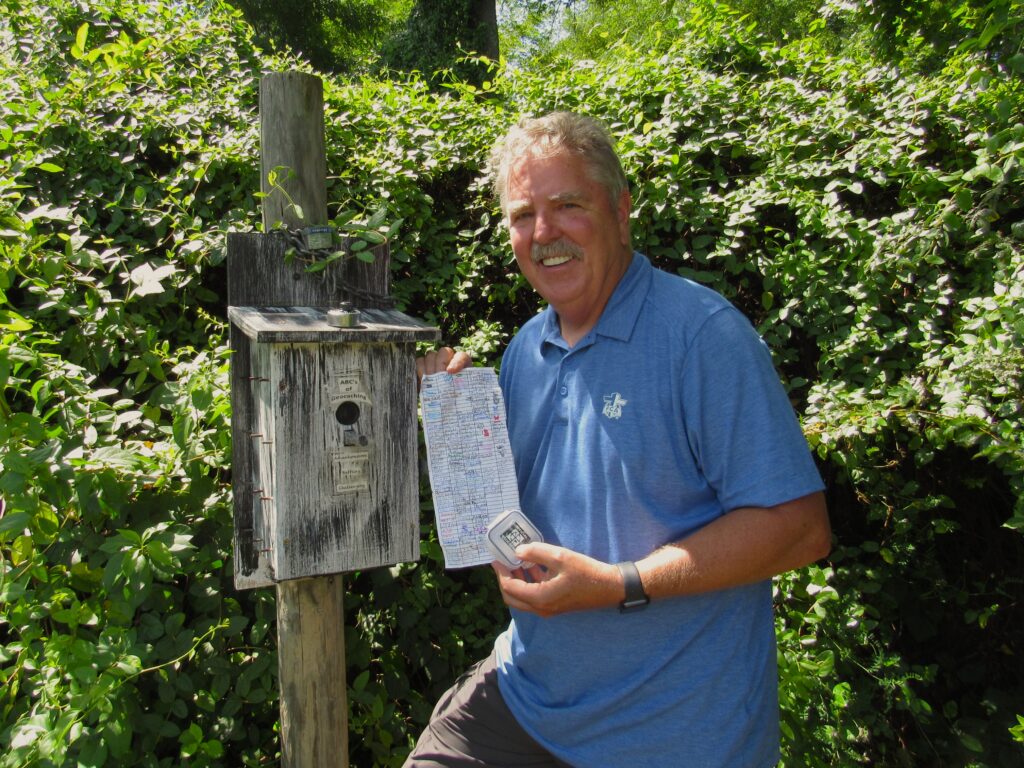
Known online as WVTim, Berkeley County resident Tim Eggleston has hidden dozens of gadget geocaches and received international acclaim.Jack Walker/West Virginia Public Broadcasting
Listen
Share this Article
Across Berkeley County, dozens of mysterious containers masquerade as simple birdhouses or wooden boxes that do not warrant a second glance. But for fanatics of the cultural phenomenon known as geocaching, these containers — and the challenge of getting inside them — is a lot more interesting.
Geocaching is an outdoor activity in which players use their phones or GPS devices to navigate toward hidden containers, similar to a treasure hunt. Players receive clues and log their finds online through the Geocaching website.
While geocaching typically ends once you find a container, years ago Berkeley County resident Tim Eggleston made the game a bit trickier by pioneering what is today known as the “gadget cache.” And his one-of-a-kind creations have been a boon for tourism in West Virginia’s Eastern Panhandle.
Users of the Geocaching app can navigate to geocaches with their phones, tracking their distance and cardinal direction.
Photo Credit: Jack Walker/West Virginia Public Broadcasting
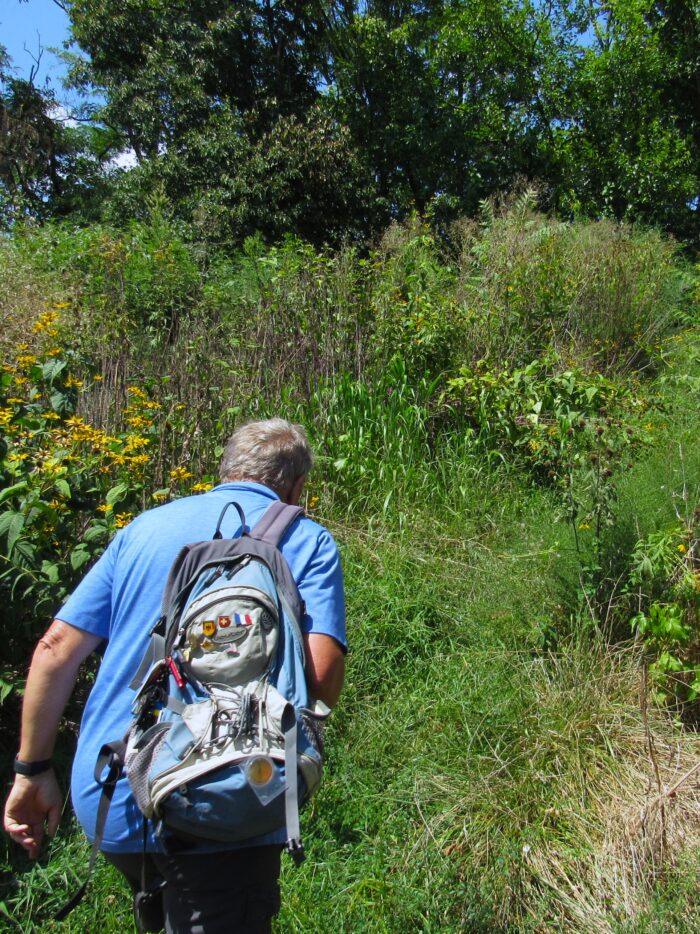
Tim Eggleston follows a footpath toward one of his geocaches, hidden at a Berkeley County rest stop just south of the Maryland border.
Photo Credit: Jack Walker/West Virginia Public Broadcasting
A Digital Treasure Hunt
Visit a town park, welcome center or mall parking lot and you may pass a geocache without knowing it. The treasure boxes are hidden in 190 different countries, with players leaving coordinates and clues to their location.
Prizes inside the containers are often scant, especially when they are not frequently maintained. But for Eggleston, who goes by the username “WVTim” online, the fund goes beyond any single reward. Instead, he sees geocaching as an activity with appeal across areas of interest.
“If you like biking, you can bike to geocaches. If you like history, you can go find spots that have historical significance, and most likely, there’s a geocache there,” Eggleston said. “That’s the beauty of geocaching. Whether you’re young or you’re old, it’s kind of got something for everyone. And everybody approaches the game differently.”
Eggleston was introduced to the game by a church friend in 2008 and quickly became hooked. But eventually he grew tired of finding the same types of geocaches over and over again.
“A lot of people have found 10,000 pieces of Tupperware under trees,” he said. “But, after a while, they became so normal that I [went], ‘I don’t think this is for me.’ And I came up with the idea to put a geocache in a bird house.”
Eggleston quickly realized the personalized approach that made the game most fun for him revolved around hiding geocaches for other players in creative ways. And his hides are far from ordinary.
Pictured here, one of Tim Eggleston’s geocaches requires users to play a specific tune on a xylophone. Doing so provides them the code to get into the birdhouse container.
Photo Credit: GadgetCaches/YouTube
The Advent Of The Gadget Cache
Eggleston’s containers are large and often hidden in plain sight. The catch is, getting inside is not as simple as snapping open a lid.
He pioneered what is now known as the “gadget cache,” which refers to geocaches that incorporate a puzzle or some type of mechanical challenge to get inside.
Geocaches can come in all different shapes and sizes, with the lone rule that they must contain some type of logbook where players who found the container can write their name. The creative liberty surrounding what qualifies has led Eggleston to hide more than 300 geocaches in his years playing the game.
Currently, “all my gadget caches that bring people to Berkeley County are all bird houses,” Eggleston said. “So I can put them right in plain view and nobody even thinks anything about it.”
One container at a highway rest stop just south of the Maryland border requires players to pull rings tethered to a birdhouse in a particular manner to release a tube out the bottom. At the local visitor center, players who dial their radios to a specific channel can hear a looping recording of Eggleston’s voice, sharing the coordinates to a container in Martinsburg.
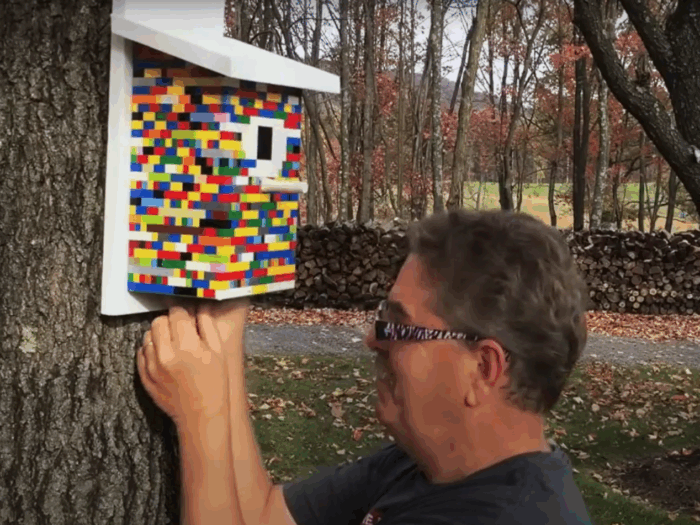
Another hide has a rainbow-colored xylophone hidden inside, requiring users to play a specific tune to unlock a secret code. Eggleston even has hidden a birdhouse made of Lego pieces, requiring players to observe their pattern to identify a sequence to unlock the box.
Tricks like these can be confusing and even frustrating for some players, Eggleston said. But for many others, they add an element of intrigue that has drawn international acclaim.
Eggleston knows firsthand that people travel from around the world to find his dozens of hides across Berkeley County. Many of them shoot him messages for travel tips; one family from the Netherlands even asked to crash at his home.
“They came and we have now developed a great relationship,” he said. “We’ve grown through our friendship [with] people that we’ve met through geocaching; people from other countries. It’s opened up a whole new world for us.”
Another “gadget cache” created by Tim Eggleston is made of legos, and requires players to observe color patterns in their placement to unlock a secret code.
Photo Credit: GadgetCaches/YouTube
Cornering A Tourist Niche
When players really like a geocache, they can give it a favorite point online. Thanks to Eggleston, Berkeley County has more favorite points than any other county in the United States. His geocaches alone have been found tens of thousands of times.
Eggleston says he is inspired to hide geocaches because he wants more people to see Berkeley County, supporting local tourism and business in the process.
Many of his hides are deliberately placed near local businesses and landmarks. Sometimes, Eggleston coordinates his release with local tourism officials to better spotlight places of interest to visitors.
“We have people come in from Ireland, England, Australia, Germany — especially Germany — Denmark, from all over the place, as well as from across the country,” said Mark Jordan, executive director of the Martinsburg-Berkeley County Convention and Visitors Bureau. “They come to Berkeley County specifically to geocache Tim’s trails.”
Jordan said his bureau sometimes works with Eggleston to coordinate the release of several geocaches at once, taking visitors along preset trails or landmark tours. The bureau often creates rewards for players who complete entire trails like these, typically in the form of a limited-edition, trackable coin.
Distributing coins like these is one way Jordan sees firsthand how many people visit Berkeley County just to geocache. But he said that still does not include the thousands of other players who have traveled to the county without paying the bureau a visit.
For some out-of-state travelers, having a network of one-of-a-kind geocaches is the difference between spending another night in Washington, D.C. and making the trek to West Virginia, Jordan said.
“It’s such a great thing,” he added. “It’s great to showcase Berkeley County. It’s great to showcase Martinsburg. It’s great to showcase West Virginia.”
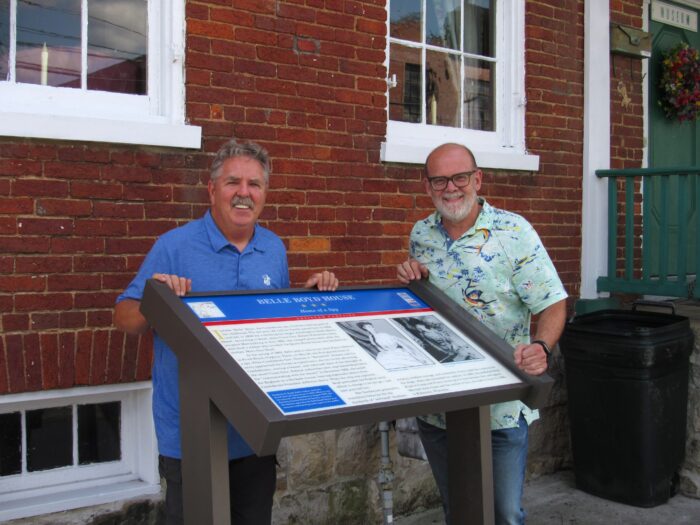
From left, Tim Eggleston and Mark Jordan stand next to a historical information sign outside the Martinsburg-Berkeley County Convention and Visitors Bureau.
Photo Credit: Jack Walker/West Virginia Public Broadcasting
A Worldwide Phenomenon
Meanwhile, Eggleston and Jordan say community leaders across the state and even the country have reached out, hoping to replicate Berkeley County’s magnetism among geocachers.
“It’s caught on quite a bit. We have other counties in the state asking Tim how to do it,” Jordan said. “Of course, he’s from Berkeley County and he won’t help them. But he offers great advice.”
Eggleston said he gets invites to events nationwide to show off his creations and teach others how to make similar containers. While he said he is steadfast in his allegiance to supporting Berkeley County, he also takes pride in helping others learn.
That is partly why he launched a YouTube page to show how he builds the trick containers. To his surprise, it has raked in more than 1.7 million views.
“I’m just an old guy. I’m not a YouTuber. I’m not an influencer,” he said. “I’m just about making the game better and showing other people how I do it.”
And while replicas may pop up around the world, Eggleston’s hides are still widely known as the real deal — especially because he is still hiding new gadget caches, each time with an added twist players won’t see coming.
To learn more about geocaching in Berkeley County and WVTim’s hides, visit the Martinsburg-Berkeley County Convention and Visitors Bureau website.
If you feel under the weather, how do you know when it’s time to see a doctor? Also, a growing movement to make Appalachia the “truffle capital of the world,” is being led by a small-town farmer in southern Kentucky.
On this West Virginia Week, health care in the state may see transformation, Gov. Patrick Morrisey wants to bring out of state foster kids home, and we explore the origins of a popular American hymn.
This week, too often, people with mental health challenges or substance use disorder wind up in jail. But crisis response teams offer another way. Also, changes to the Endangered Species Act could benefit big business. They could also kill animals like the eastern hellbender. And, in troubled times, a West Virginia writer says to find peace in nature.
Written by a former slave ship captain, “Amazing Grace” has traveled far beyond its origins. In this encore episode, Us & Them traces how the hymn has become a powerful folk song and civil rights anthem — speaking to pain, forgiveness and the possibility of change.