This week, a Japanese Shinto garden took root in southwestern Virginia because of family connections spanning geography and generations. Also, in Whitesburg, Kentucky, a new mosaic uses recovered objects to honor the town’s people after the flood of 2022. And, the young adult novel Verity Vox and the Curse of Foxfire mixes historical fact with spooky Appalachian folklore.
An Ohio Photographer Spent 15 Years With One Family. She Says Her Project Never Ended
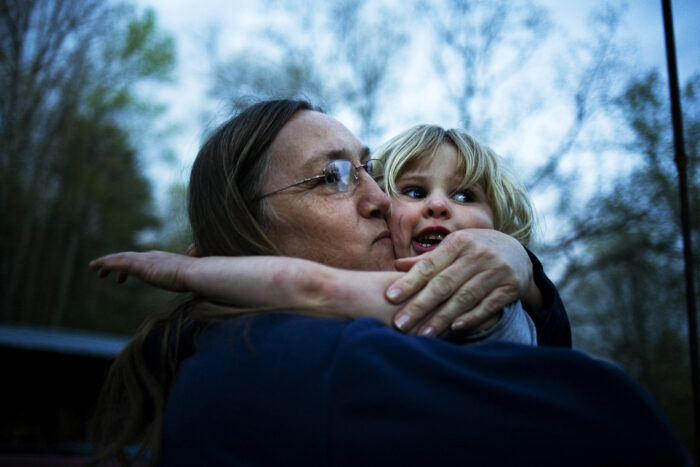
Paige clings to her grandmother, Lorrie, outside their home in Carbondale, Ohio, on April 28, 2011. Lorrie and her husband, Lee, raised their daughter’s four children — Sonya, Paige, Seth, and Noah — after their mother, Amber, was unable to care for them because of abuse and neglect. Carbondale, named for the once-abundant coal resources in the surrounding hills and valleys, is far from cell service and economic opportunity. At the time, Lorrie and Lee were already struggling to make ends meet and managing chronic health issues, having already raised four children of their own.Courtesy of Maddie McGarvey
Late last year, The New York Times published a guest essay titled, “An Act of Witness in Appalachia.” It describes photographer Maddie McGarvey’s relationship with Paige Casto and her family. McGarvey was a sophomore studying photojournalism at Ohio University 15 years ago when she decided to document grandparents raising their grandchildren. A social worker in Athens, Ohio connected her with the Casto family, and she’s been photographing them ever since.
Now, McGarvey is a freelance photographer for The New York Times covering the Rust Belt and Appalachia.
Inside Appalachia Associate Producer Abby Neff spoke with McGarvey about her relationship with Paige Casto and how it’s changed since their first meeting.
The transcript below has been lightly edited for clarity.
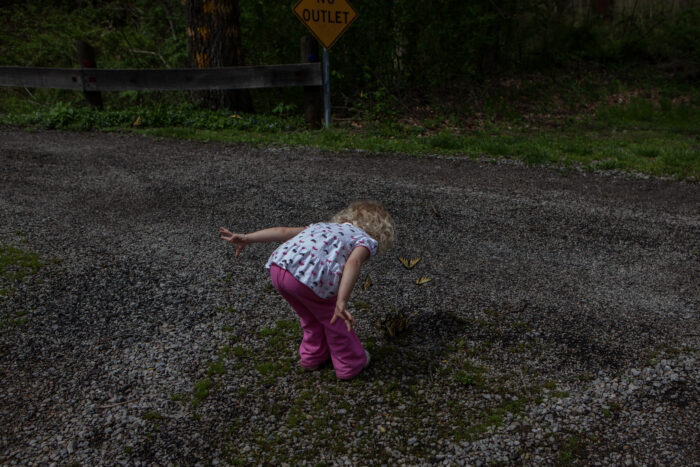
Paige leans over to look at butterflies outside her grandmother’s home in Carbondale, Ohio, on April 27, 2011. She and her three siblings were raised by their grandparents after their parents were unable to care for them due to neglect and abuse.
Photo Credit:Courtesy of Maddie McGarvey
Neff: I’m looking at a photo right now of Paige looking down at swallowtail butterflies. The caption reads, “Paige chasing butterflies outside her grandmother’s home.” I just wanted to ask the context behind this photo and kind of what brought it to life for you, and why it’s featured in this story.
McGarvey: So, this photo is actually probably the first or second time I ever met Paige. She was probably three or four years old here and really just so full of wonder. They lived in a holler. No cell phone service, but with a lot of natural beauty around them. There’d be little creeks and hills with flowers. We’d go and pick flowers and walk around barefoot. And at this moment, Paige just kind of leaned over and looked at a bunch of butterflies that were just around — I don’t even know what they were swarming around. But she was just, she … had just such childlike wonder. And she was, like, three or four years old … it’s kind of representative of the start of our relationship together and me kind of capturing her and how she was viewing the world throughout these different ages.
Neff: Can you tell me about your initial meeting with Paige and her family?
McGarvey: Yeah. So, I originally started this project when I was a sophomore at Ohio University, and I noticed that there was an increasing trend of grandparents raising their grandchildren. This was around 2009, so a lot of these families were affected by the opioid crisis. There was just a lot of instability, mental illness, you know, all of those kinds of issues going on. And I met with a social worker who put on a piece of paper, “Lorrie Casto, I’m raising my three grandkids” and a phone number. And I remember being 19 years old and not really knowing what I was doing in any regard, but being very, very nervous to make this phone call. But Lorrie said, you know, “Come on over. Sure, you can document our lives.” And it just sort of started this sort of beautiful relationship that lasts the next 15 years. So when I first went over to the trailer that they lived in, I just I noticed these three blonde kids just running throughout the yard, and, you know, Paige was three or four then, and just instantly curious about me, and I was curious about her, and that kind of was the start of our relationship.
Maddie McGarvey with the Casto children.
Photo Credit:Courtesy of Maddie McGarvey
Neff: The anecdotes you share about the Castos in The New York Times story are vulnerable and raw. On the night Paige’s brothers are sent to foster care, she calls you. What was that moment like in your relationship with Paige?
McGarvey: Yeah, so I guess since I’ve known Paige since she was three years old, and this happened last year when she was nearly 18, it did just — you know, it feels like I’ve known them my entire life. It wasn’t strange at all that she reached out to me, and I’m glad that I could be a person stable in her life to do so. But you know, it was — it’s sad to see her struggling so much and to see her family separated. It’s not necessarily anyone’s fault. It’s so many factors that go into these kids ending up in foster care, but it doesn’t make it any easier for a sister who’s losing her baby brothers that she’s had around her entire life. So yeah, it’s really tough, and it’s hard to watch that, but it’s also been kind of inspiring to see how she navigates this as she’s growing up and becoming a young a young adult.
Neff: How did this project challenge the “stranger with a camera” trope that seems to endure in Appalachia?
McGarvey: That’s a really good question. I think what makes you not a “stranger with a camera” is spending a lot of time with these people, and I think it’s really important that people don’t just parachute into areas like Appalachia or anywhere and expect to understand the entire complicated history of a place without spending time and effort. And I think that’s important, and I take that seriously. And that’s why, I think, I just committed to doing this project for going on 15 years. And I have no plans to stop as long as they’ll have me. But you know, I think you always start as a stranger, and hopefully, through these connections and trust and time, it builds into something a lot more substantial and beautiful.
Neff: How are Paige and her siblings doing now?
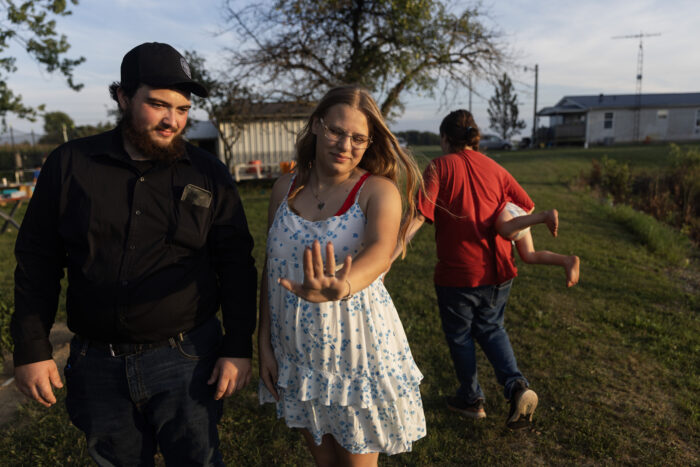
Paige Casto and Vallie Guseman, both 18, stand outside Paige’s aunt’s home in Kenton, Ohio, where they were living, after getting engaged on August 17, 2025. Vallie grew up living next door to Paige in Carbondale, Ohio, where they first met as children. The couple plan to marry in the spring, and Paige says she hopes to start a family as soon as she can.
Photo Credit:Courtesy of Maddie McGarvey
McGarvey: They’re doing okay. You know, Paige is going to be married in the spring. She moved to a different part of Ohio, living with her fiancé. He got a job at a factory. You know, she’s figuring things out. I think she’s eager to start her own family, even though she’s quite young. I think she just desperately wants to kind of give the love to a child that maybe she didn’t always feel when she was growing up. And I’ll be there to continue documenting her as long as she’ll have me. I just — I’m very thankful for the trust and for a family, you know, giving this stranger a chance and kind of developing into something a lot more beautiful that I never would have known would have happened after just being a 19-year-old at OU making a phone call all those years ago. It’s kind of a testament to the power of photography and just the kind of relationships it can help you find in this world, just through curiosity and try and understand your neighbors better.
Neff: A lot of your work in The New York Times and other freelance projects you’ve done focused mainly on the Rust Belt in Appalachia. What do you want people to take away from the photos that you share and you shoot, especially in a region that has a lot of media misrepresentation?
McGarvey: Yeah. I mean I think Ohio, the Rust Belt, Appalachia — these are all places that people have potentially preconceived notions [about] but really hold a lot of nuance. And I’m really lucky to be able to travel this entire region and meet people from all walks of life, all backgrounds, different opinions, different jobs, just every kind of walk of life to try to show what’s happening here with some nuance … I think a lot of times when I’m shooting for national publications, they assume I’m coming in from New York or [Washington] D.C. and I think telling them, “No, I live here in Ohio, and I know these issues, and I care about this place, and I’m not trying to just perpetuate stereotypes. And I’m looking for the nuance and I’m looking for the layers in this place.” I think that goes a long way with trust. And I do feel passionately about covering your own backyard and the things that are making up your community and the issues that your neighbors care about. I just — that’s something that really matters to me. So, I feel lucky that I get to live here in Ohio and be curious about something on my own and be able to explore it through photography and hopefully share it with a larger audience and get them to understand it on a different level too.
Neff: Maddie, thank you so much for speaking with me today. I really appreciate it.
McGarvey: Thank you, Abby. I really appreciate your interest.
Add WVPB as a preferred source on Google to see more from our team
This week, a Japanese Shinto garden took root in southwestern Virginia because of family connections spanning geography and generations. Also, in Whitesburg, Kentucky, a new mosaic uses recovered objects to honor the town’s people after the flood of 2022. And, the young adult novel Verity Vox and the Curse of Foxfire mixes historical fact with spooky Appalachian folklore.
West Virginia is seeing a dramatic decline in overdose deaths, but addiction’s consequences can be complex. On a new episode of Us & Them, Trey Kay explores what addiction can leave behind for children and families through the film “What We Hide” and a conversation with addiction and mental health professionals.
West Virginia has been at the center of America's opioid epidemic and overdose death toll. While recent reports show the state’s overdose deaths have fallen by nearly 38%, addiction remains the most common reason for West Virginia children to be taken from their families. In the next episode of Us & Them, host Trey Kay attends a WVU training symposium, including a screening of the recent film "What We Hide," and hears from professionals who work with people affected by addiction.
Drew McClanahan of the West Virginia Department of Education noted that despite being a small percentage of the overall student population, students facing extreme adversity outside the classroom were overrepresented in the data.