Alert (March 11, 2026): Our TV translator in Flatwoods is experiencing technical issues. Our engineers are troubleshooting the problem. Thank you for your patience.
The hillbilly stereotype is frequently used to shame mountain people, but there are gentler versions, like Snuffy Smith, the long-running comic strip character. Snuffy Smith originally started out as a supporting character in his comic strip, which first launched in 1919 when Billy DeBeck created Barney Google. Artist Fred Lasswell was brought in during the ‘30s to create Snuffy Smith and his friends. And now the strip is written and drawn by John Rose, who lives in Virginia’s Shenandoah Valley.
Senate Health Committee Advances Bill To Ban Gender Affirming Care
Sen. Chris Rose, R-Monongalia, is chairman of the Senate Energy, Industry and Mining Committee.Will Price/Legislative Photography
Share this Article
Gender dysphoria is a feeling of distress that can happen when a person’s gender identity differs from the sex assigned at birth. Some, but not all, transgender people have gender dysphoria at some point in their lives.
In 2023 the Legislature banned gender-affirming care for minors with narrow exceptions for specific hormone therapies.
Under that law, minors who are experiencing suicidal ideations in relation to gender dysphoria can go through multiple hoops to get hormone therapies as treatment.
Now, a more conservative Senate is moving to do away with those exemptions. A bill sponsored by Sen. Chris Rose, R-Monongalia, would ban hormone therapy for new and existing patients under the age of 18.
The Senate Health Committee heard testimony from medical professionals, and from advocates of the bill who video-called in from out of state.
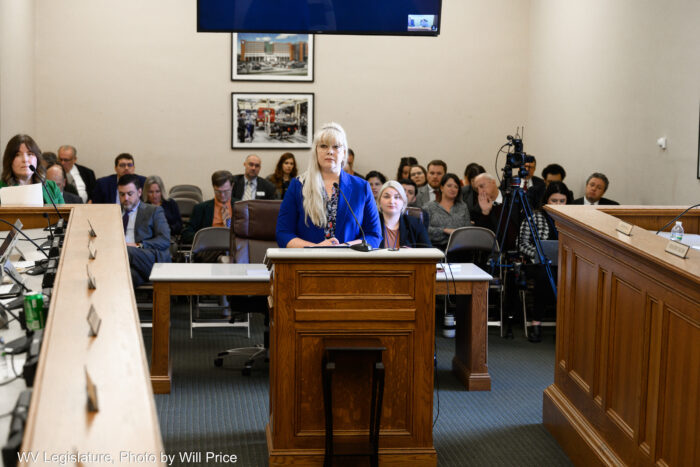
Chantel Weisenmuller warned legislators that Senate Bill 299 could be dangerous for trans minors in the state.
Photo by Will Price/WV Legislative Photography
Chantel Weisenmuller, president of the West Virginia Psychological Association, told lawmakers that stopping gender affirming care for teenagers is risky and detrimental to their health.
“As a psychologist, that is a very frightening prospect for me,” Weisenmuller said. “Because from clinical lived experience, whenever folks suddenly lose access to this necessary, evidence-based, best practice medical treatment, we see a marked, significant, intense escalation in depression, anxiety and suicide, suicidality.”
An amendment was offered by Sen. Joey Garcia, D-Marion, that would allow existing patients to continue receiving hormone therapy.
“We’ve heard from West Virginia Practitioners and the West Virginia Association For Psychology representative about the potential harms, including increased harms for someone that’s currently undergoing medical treatment under the exception, that’s in law, especially if it’s done immediately,” Garcia said.
The amendment was rejected. Rose, the lead sponsor of the bill, said no minors in the state should be receiving hormone therapy.
“The reason this bill is necessary in the first place is there’s never a medically necessary reason to transition a child,” Rose said. “There’s never a medically necessary reason to chemically castrate or sterilize a child. For a mental illness, you get mental health. There is therapy for that, but never is it justifiable to permanently alter their body with something that’s irreversible.”
Rose asked Weisenmuller if conversion therapy could be used to treat gender dysphoria instead.
Conversion therapy is a widely discredited practice of attempting to change a person’s sexual orientation or gender identity. A number of states and municipalities have banned it.
Weisenmuller said conversion therapy is not recommended by the American Psychological Association or the American Psychiatric Association.
“We have over 100 years worth of data showing that suicide rates actually increase precipitously after exposure to what folks may think about as conversion therapy,” Weisenmuller said. “Conversion therapy kills people. So no, that is not something that any licensed provider in the state would offer to a child or to their family.”
Simon Maya Price from Boston Massachusetts appeared before the committee virtually. He says for a brief time during his adolescence, he believed he was female. Now, a freelance speaker he advocates for bills like West Virginia Senate Bill 299.
“The more desisters and de-transitioners I talk to, the more I realize just how close I was to being permanently disfigured, disabled and becoming a lifelong medical patient,” Price said.
Price said his doctors recommended he undergo gender affirming medical treatments. However, he said his father refused the treatment, something for which he said he is now grateful.
“The law in West Virginia says that if you get the sign-off from two doctors, you can receive puberty blockers and cross-sex hormones,” Price said. “In my case, I had four who would have done that.”
The bill passed the Senate Health Committee, without any amendments. The bill now heads to the Judiciary Committee.
Add WVPB as a preferred source on Google to see more from our team
The West Virginia Legislature closed its 60-day session at midnight on March 14. Gov. Patrick Morrisey had 15 days, not counting Sundays, to sign, veto or allow the 306 bills the body passed to become law. That deadline passed Wednesday night.
While not directly involved in the case, the PCSB’s amicus brief – also known as a “friend of the court” brief – would be focused on religious liberty to assist the court in making its decision.