


Harrison County Voters To Consider New, Unique Levy Aimed At Historical Preservation
The levy would provide at least $100,000 for the next four years to 13 historic preservation organizations across the county.
Continue Reading Take Me to More News


To Educate, Inform, and Inspire by Telling West Virginia's Story
Mountain Readers 2026 has concluded! Please fill out our volunteer post-survey.
Nominate an exceptional West Virginia K-12 teacher today!

On Demand

On Demand
Stream original productions from WVPB

Watch locally produced documentaries & more.

On Demand

On Demand






West Virginia Morning

Inside Appalachia

West Virginia Week

Mountain Stage

Us & Them

The Legislature Today

The Legislature This Week

Send us your comments and questions.

Stream our board meetings.

Check out the latest WVPB news.

Sign up for our newsletter and get weekly updates.

Meet the WVPB staff.

WV Educational Broadcasting Commission, the WVPB Foundation, and the Friends of WVPB.

Come work with us!

Read our annual report and learn how we educate, inform and inspire with your support.

Sponsor impactful and engaging media and entertainment.

Use your IRA to make a gift to WVPB.

Become a member with your gift of $1,000 or more.

Make WVPB part of your legacy.

Manage your membership account.

Learn how you can Protect and Sustain West Virginia Public Broadcasting.
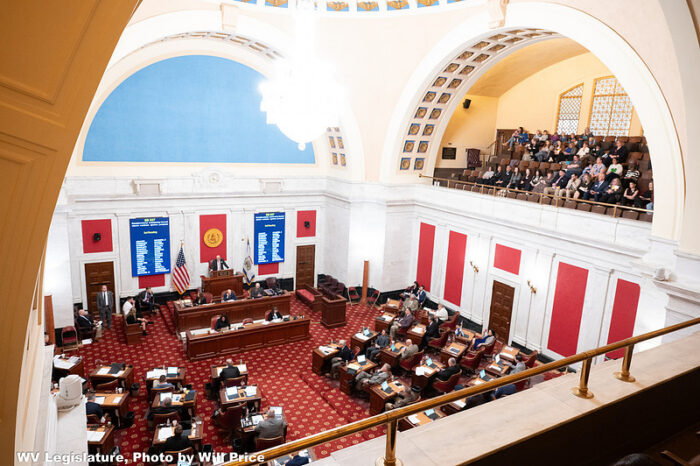
The West Virginia Legislature closed its 60-day session at midnight on March 14. Gov. Patrick Morrisey had 15 days, not counting Sundays, to sign, veto or allow the 306 bills the body passed to become law. That deadline passed Wednesday night.
The governor delivered 12 bills to Secretary of State Kris Warner that he decided to veto. They are evenly divided between bills that originated in the House of Delegates and the Senate.
The governor’s objections to each bill vary and can be read in the letters to Warner at the links below.
They are: SB 558, SB 649, SB 672, SB 697, SB 705, SB 744, HB 4002, HB 4393, HB 4626, HB 4730, HB 4893, HB 5074.
The bills vetoed include topics from mandating the state pay for drug trials for the drug ibogaine to one removing the Division of Highway’s ability to control who can access a road.
House Bill 4626 would have mandated the drug trials for ibogaine. The governor’s comment was that he encouraged medical innovation for a medication that has the potential to treat substance use disorders and post-traumatic stress, but “we should do so without requiring the state to award grants of undefined and unfunded amounts.”
House Bill 4002 would create the West Virginia Collaboratory at Marshall University to “facilitate the dissemination of the policy and research expertise of state institutions of higher education within West Virginia.” The governor’s objection to this bill is that it would give the Senate President and the Speaker of the House the ability to appoint members to the office. He said in his letter that is in “violation of the constitutional prohibition that ‘no such officer shall be appointed…by the Legislature.”
He said in the letter that the bill “unconstitutionally deviates that well-established separation of powers principle.”
Morrisey vetoed Senate Bill 558, which would increase penalties for people passing school buses picking up children. He noted the problem with the bill was likely a drafting error where the penalties for the first and third offense were spelled out, but the second offense was incomplete. It did not spell out a maximum penalty, and it doesn’t specify whether it is a misdemeanor or a felony. That leaves open the possibility someone could be sentenced to life in prison on a second offense, a much harsher penalty than on third offense.
The governor was concerned that Senate Bill 649 would conflict with the state’s rural health transformation program in its creation of a new Medicaid coverage policy regarding home blood pressure monitoring. His letter noted that this policy might reduce the funds available to the state or even make it ineligible for future awards.
Senate Bill 697 was drafted because of frustrations from the timber industry with the Division of Highways when it came to access points to property. Morrisey said the bill was much broader than the timber industry, however, and would “severely curtain WVDOH from performing routine maintenance, protecting the travelling public, and preventing damage to our roads.” He noted that the budget bill he recently signed included an extra $125 billion to modernize and repair roads.
The governor signed the 2026-2027 budget into law on March 12, but made a dozen line item vetoes there as well.
The West Virginia Constitution does allow the state Legislature to overrule a veto from the governor. However, both chambers adjourned “sine die” – meaning without a set date to return – at midnight on March 14. Only the governor can reconvene a special session to formally address legislation before the next regular session in January 2027.
Add WVPB as a preferred source on Google to see more from our team

Twenty days from the election, Republican Congressman Riley Moore and Ace Parsi, the Democratic challenger in the second congressional district of West Virginia, met for a debate.
Continue Reading Take Me to More NewsData centers compete with regular customers for energy, but the Federal Energy Regulatory Commission has rejected a proposal that would have shielded them.
Continue Reading Take Me to More NewsThe changing colors of the leaves and the dropping temperatures of fall bring with them calls to get vaccinated against the flu. But in recent years, that call to action has expanded. We talk with Dr. Brian Huggins, Monongalia County health officer and medical director, about when to get vaccinated.
Continue Reading Take Me to More NewsGas prices are at record highs nationwide for autumn. West Virginia Democrats are again asking Gov. Patrick Morrisey to help cut the price.
Continue Reading Take Me to More News