Elk Creek, Virginia, is a small, unincorporated community located in Grayson County, about a half hour from the North Carolina border. Many people in Elk Creek have deep ties to their land, and for one family taking care of their land and honoring their ancestors meant creating a traditional Japanese Shinto Garden. From Elk Creek, Folkways Reporter Wendy Welch brings us the story.
The unincorporated town of Comfort, West Virginia, is made up of two gas stations and an elementary school. All three sit along a winding, two lane road that on any given day is peppered with trucks carry loads of coal. Coal they picked up at the Kanawha Eagle mining complex a few hundred feet down the road, but the last several years have been tough for the industry and now fewer and fewer of those trucks roll through.
The Miner
Credit Ashton Marra / West Virginia Public Broadcasting
/
West Virginia Public Broadcasting
Patriot Coal electrician and Boone County resident Derek Chase.
Derek Chase, 31, has worked in the industry for nearly a decade. Previously a Massey Energy then Alpha Natural Resources employee, Chase currently works as an electrician for Patriot Coal at their Kanawha Eagle mining complex.
Patriot filed for bankruptcy this year and in August issued notices to some 1,000 employees in southern West Virginia that they could be laid off.
Those notices came on the same day that Alpha, the second largest mining company in the county, filed for bankruptcy itself.
But Chase’s story isn’t unique in Boone County, where he lives and works. The county has lost nearly 2,700 mining jobs since 2011, the highest number of coal job losses for any county in the nation.
The Budget
The decline hasn’t just been bad news for miners like Chase. Coal is one way local governments in West Virginia pay for things like water lines, senior centers and trash collection.
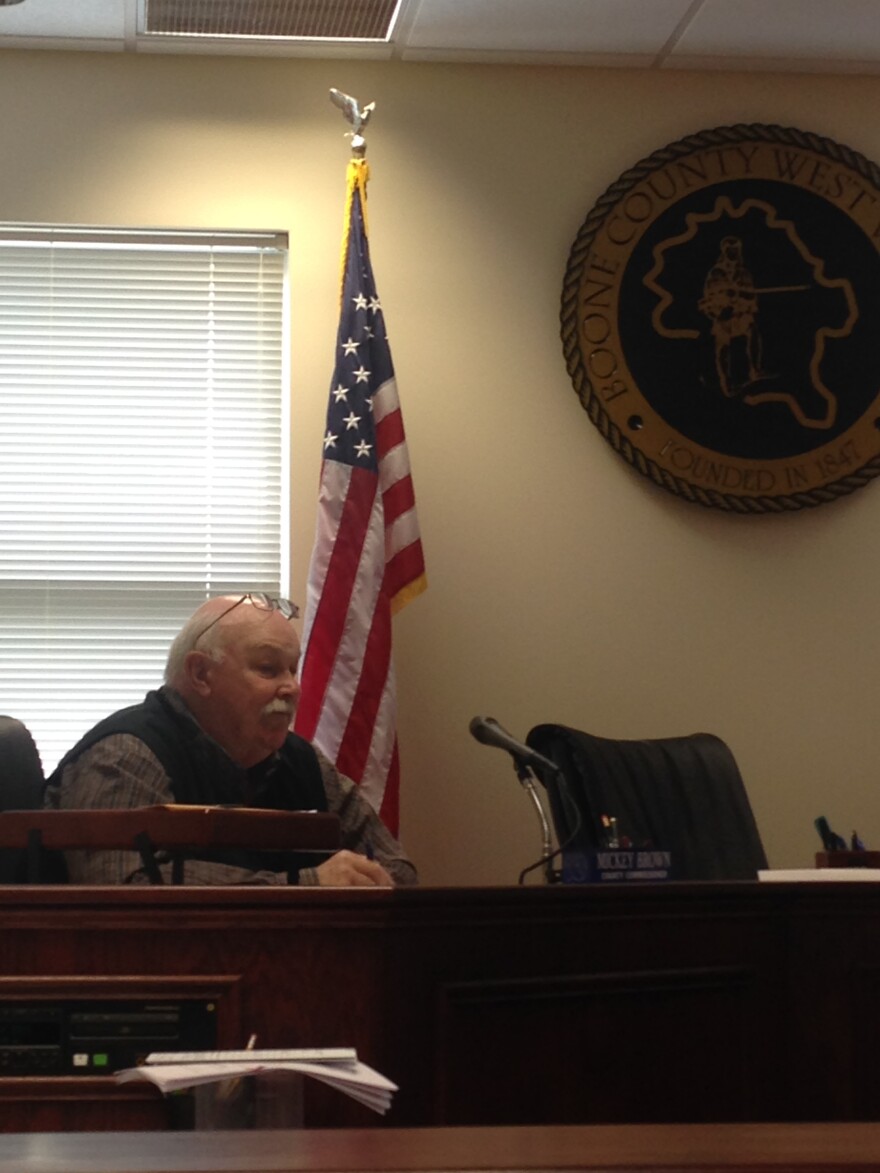
“All your coal counties are really hurting in southern West Virginia,” Boone County Commissioner Mickey Brown said. “We’re all the same.”
Credit Ashton Marra / West Virginia Public Broadcasting
/
West Virginia Public Broadcasting
Boone County Commissioner Mickey Brown during a commission meeting in Madison.
Brown has served as a member of the county commission for 15 years and watched as his county’s budget grew in the early part of the decade because of an influx of tax dollars from the industry, both property taxes on mining facilities and equipment and severance taxes, or the 5 percent extraction tax companies pay on the value of the resource they mine.
As the price of coal declined over the past several years, Brown said so did the taxes Boone County collected. In 2012, he said his county budget was some $27 million. Today, it stands at about $14.6 million.
“Now, we’ve made cuts all along to where we’ve been watching what we’ve been spending,” he said.
And those cuts came to county services.
Before, when somebody would come in with a request, it could be an extravagant request and we could do it, but now we kind of made a policy that we aren't going to do anymore grants.- Boone Co. Commissioner Mickey Brown
The Community Impact
Boone County prioritizes projects that will bring public drinking water to its rural communities. Instead of paying for it themselves with severance tax dollars, today the county relies on federal and private grants to fund water line expansions. Those grants can be costly and time consuming for small governments to apply for and keep track of.
The amount of money the commission can grant to special projects is decreasing as well. Brown said a few years ago, the Boone County Board of Education came to the commission for help replacing the bleachers at all three county a high schools, a project that cost $500,000.
If that project came before the commission today, Brown said there is no way they could help.
“Before when somebody would come in with a request, it could be an extravagant request and we could do it,” he said, “but now we kind of made a policy that we aren’t going to do anymore grants. A thousand dollars a year maximum.”
The State
The state is starting to feel the pinch too. Deputy Revenue Secretary Mark Muchow said in 2012, coal-mining tax revenues made up about 9 percent of the state’s budget. In the fiscal year 2016, the budget year that began July 1, that amount is expected to be about 5.4 percent, a $148 million dollar decrease.
Muchow blames many factors for the decline in the industry: pressure from federal regulators, the abundance of cheaper, cleaner natural gas from fracking, a decrease in foreign demand, and deeper coal seams that are more expensive to mine.
Moving On
The decline in coal has made it hard for Chase to provide for his wife and three young children. His wife works as a nurse and Chase said she could provide for the family on her own if she worked as a traveling nurse, but he doesn’t want her to do that.
So Chase began looking for work, long before his lay off notice came. He found a job with CSX outside Albany, New York, some 650 miles from his home in Boone County.
“[You’ve] got to work somewhere and there’s not going to be any place to work here,” he said.
As of a few weeks ago, CSX had put Chase’s training on hold because of financial troubles elsewhere in the company, partially because of a decline in rail shipments of coal.
Add WVPB as a preferred source on Google to see more from our team
PSC staff completed their report by saying that should the applicant NextEra decline a minimum 60-day delay, they recommend the application be dismissed for lack of completeness.
Social Security began 91 years ago when President Franklin Roosevelt signed it into law. Since then, it has provided a social safety net to Americans, allowing many of them to retire with dignity, according to John Hishta, senior vice president of campaigns with AARP. But many experts say that without some action, social security benefits will have to be reduced by 20% in 2032. News Director Eric Douglas sat down with Hishta to understand the situation.
It’s thunderstorm season, but not all of them are the same. For the Appalachia + Mid-South Newsroom, Bill Burton and meteorologist Tawana Andrew break down what we know – and what we don't – about the climate and weather in the region. This week, they examine different types of thunderstorms.