This week, we’re revisiting a show featuring storytellers out loud in front of audiences. Folks like five-time champion of the West Virginia Liars’ Contest, Bil Lepp. Also, musicians Anna & Elizabeth, whose storytelling used something known as a crankie. And, we’ll head to the International Storytelling Center in Jonesborough, Tennessee.
The Center for Disease Control reports that one in 68 children in the U.S. will have autism. That number jumps to 1 in 42 if we’re just talking about boys. And the risk increases if you already a have a child with autism. In West Virginia, new research is underway to try to get at how the autistic mind ticks.
Credit West Virginia University
/
West Virginia University
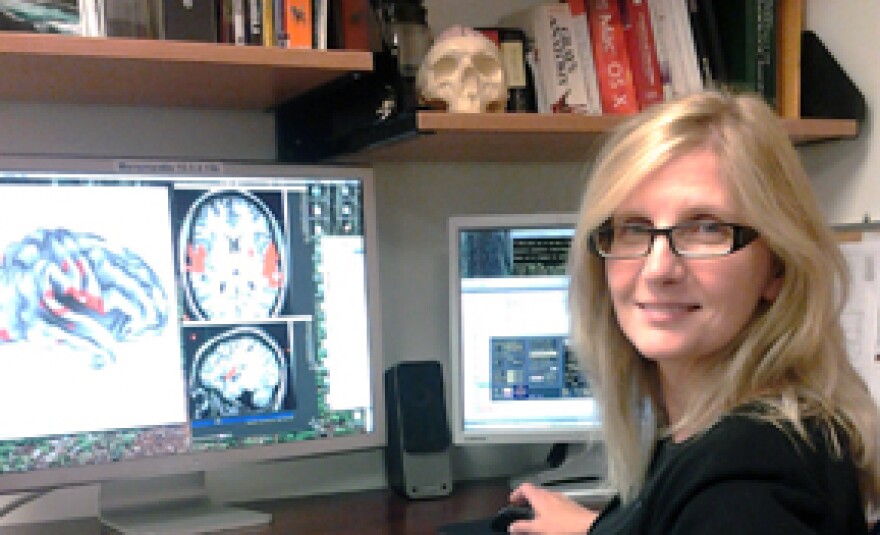
Paula Webster at the Center for Neuroscience at WVU.
Paula Webster is a neuroscience graduate who works in the Department of Neurobiology and Anatomy at the Center for Neuroscience at West Virginia University.
While a psychology major at Wheeling Jesuit University, Webster discovered her three-year-old son was on the Autism Spectrum. She became a therapist who practiced applied behavioral analysis (ABA). But Webster wants to know more than how to intervene after diagnosis.
This is the first biomedical research into autism at the university. The study hopes to incorporate subjects in a wide range of ages—children through adults.
Webster works with Assistant Professor at WVU James Lewis, a neuroscientist. They taking and studying images of the brains of people with and without autism performing certain tasks.
The research isn’t just focused on what parts of the brain kids and adults with autism use, but also how they process information. It’s clear, said Webster, that there are many with autism who compensate to accomplish tasks. She hopes that by imaging high-functioning individuals with autism she may be able to start to characterize some of the methods of compensation they’re using.
Webster speculates it may be those mechanisms that allow them to be high-functioning.
“I think we can get at trying to characterize some of those compensatory mechanisms a little bit better,” Webster said, “and correlate those with sub-scores of autism scores to try to get some sub-types of autism.”
Webster hopes the research will go towards influencing the various therapies that exist as well as possibly providing a way to diagnose autism earlier, which in and of itself would be a powerful tool to help abate the condition.
Add WVPB as a preferred source on Google to see more from our team
This week’s Inside Appalachia features storytellers from around the region, including author, television host and five-time West Virginia Liars Contest winner Bil Lepp. Here he is back in 2019, telling a story during a Mountain Stage performance at the West Virginia Culture Center.
The state Department of Agriculture has issued new restrictions on animals coming into West Virginia, in an effort to keep a dangerous insect out of the state.
The Policy Center for Maternal Mental Health’s 2026 report card awarded West Virginia’s a B-Minus grade, but that's an improvement from just three years ago.
The late singer-songwriter Daniel Johnston grew up in West Virginia and came onto the indie music scene in the 1980s. Last year, Johnston was inducted into the West Virginia Music Hall of Fame and he’s featured in the next episode of Us & Them. In this award-winning show, host Trey Kay learns about Johnston’s legacy which was partly shaped by his challenges with mental illness.