This week, a new report finds the number of black lung cases is at its highest since the 1970s. The human cost is high. Also, the author of a new book says reintroducing nearly extinct animals back into the wild can boost damaged ecosystems, but they can't repair them. And, roadside attractions pay tribute to our enduring fascination with weird.
Podcast Seeks Greater Understanding Between Appalachia and Arab World
Listen
Share this Article
People on the outside looking in often misunderstand Appalachia’s cultural ways and traditions. Those same attitudes are often leveled at people from the Middle East.
The new student podcast Sandstone, by Clara Haizlett, seeks to introduce people from both cultures, with the aim of developing greater understanding between them.
Haizlett grew up on a small homestead farm in Bethany, West Virginia, in the Northern Panhandle and was homeschooled. She said her parents gave her opportunities to explore cultures and languages different than her own, and she spent the years after high school studying Spanish while traveling in Latin America.
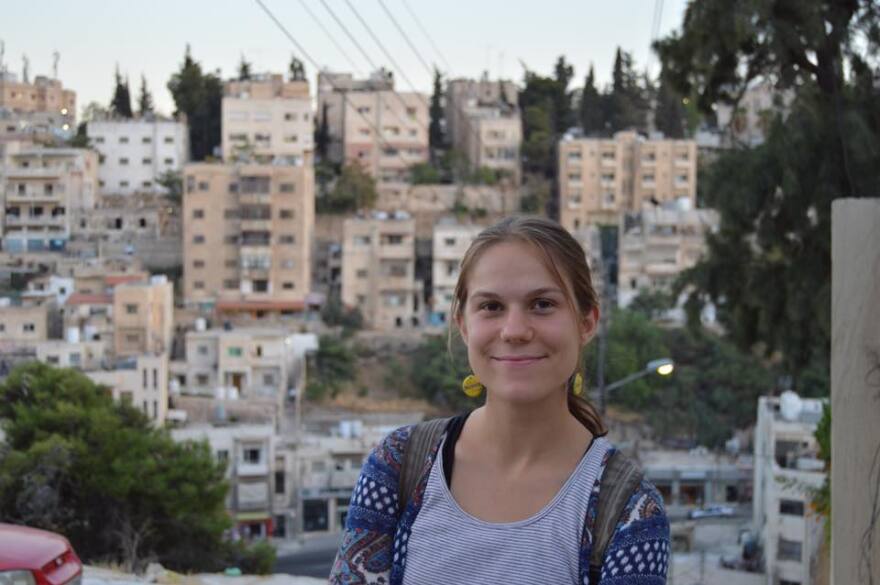
Clara Haizlett studying abroad in the Middle East.
“I grew up being encouraged to learn and experience the world through an inquisitive lens. I really was inspired to continue language learning and especially, was attracted to the Arab world,” she said.
Like many people, the terrorist attacks on Sept. 11, 2001, informed Clara’s attitude toward the Arab world. She addresses that in the podcast.
“When men in turbans showed up on my TV screen in the early 2000s, I was horrified. I would shut my eyes, but I could still hear the AK-47s and the Allahu Akbars,” she said in the first episode.
Despite that, when the opportunity came to study abroad in Morocco, Bahrain and Jordan, she jumped at the chance.
Those experiences opened her eyes to different cultures, but she saw similarities to the way she was raised as well. She decided to create a podcast to describe her own travels while giving a voice to the people she met along the way.
Haizlett decided to name her podcast Sandstone because the rock type is common in both places. Sandstone is basic, but it can also be transformed into something greater than itself. Much like her own transformation, she says.
For her, the podcast is about creating a greater understanding between the people she grew up with and the people she has come to call friends.
“I just would like to encourage greater curiosity and empathy towards people that we might not normally empathize with, especially as we interact with refugee populations. And watch the news and being able to greater understand where they’re coming from and yeah, who they are,” she said.
Haizlett explained that she hopes her friends in Appalachia and the Middle East will learn about each other through the podcast. She doesn’t expect it to change the world, but she hopes it might open some listeners’ minds.
“It’s geared primarily toward fellow West Virginians, but also people from the region who maybe don’t know a lot about the Middle East. And maybe don’t really care too much about the Middle East but through storytelling I hope to inspire kind of a deeper understanding of that culture and world,” she said.
For many people in Appalachia, the differences in cultures revolve around differences in faith. The Middle East is primarily, but not exclusively, Muslim. Appalachia is primarily, but not exclusively, Christian.
She interviewed a man from Alabama who is now an imam in a mosque in Morgantown, West Virginia. His name is Kip.
“Right after 911, there was definitely this fear of Muslims as violent people, and the Muslims in America have done a lot to show that that’s not the case. But what worries me is that that hasn’t made people like Muslims any more. Well, look, maybe you disagree with, you know, maybe you think the Amish people are weird, and maybe you are but you let them do their thing. You don’t tell them they have to drive cars or whatever I do give you let them stick to themselves and live their way of life the way they want to as long as they don’t, you know, bother anybody else,” Kip said in the third episode of Sandstone.
She also talked to an evangelical Christian with experience in the Middle East. His name is Pastor Joseph Cumming.
“There are texts in the Koran that can be interpreted to support peace and love through neighbor, self-giving sacrificial love for others, and there are texts in the Koran which can be interpreted which can be interpreted to support war and violence. if we’re honest, the same is true of the Bible. Of course, I believe the Bible teaches peace, but I can find you abundant examples of evangelical Christian leaders quoting Jesus saying ‘I come not to bring peace but a sword’ in order to endorse war in the name of Jesus,” Cumming said.
Haizlett will graduate from West Virginia University in December. She plans four more episodes in the Sandstone podcast but has also applied for a grant to continue her studies in Jordan. If she receives that grant, she plans a second season Sandstone as a live, immersive event during her travels.
Sandstone is available through Apple Podcasts and wherever you find your podcasts.
Add WVPB as a preferred source on Google to see more from our team
On this West Virginia Week, plans for a new transmission line may be in trouble, a former state delegate is indicted, and the state has a new secretary of tourism.
This week, a new report finds the number of black lung cases is at its highest since the 1970s. The human cost is high. Also, the author of a new book says reintroducing nearly extinct animals back into the wild can boost damaged ecosystems, but they can't repair them. And, roadside attractions pay tribute to our enduring fascination with weird.
On this West Virginia Morning, a new book, “The Beasts of the East: The Fall and Rise of America’s Eastern Wilderness,” looks at the process to reintroduce large game to parts of Appalachia.
Social Security began 91 years ago when President Franklin Roosevelt signed it into law. Since then, it has provided a social safety net to Americans, allowing many of them to retire with dignity, according to John Hishta, senior vice president of campaigns with AARP. But many experts say that without some action, social security benefits will have to be reduced by 20% in 2032. News Director Eric Douglas sat down with Hishta to understand the situation.