More than 3,000 pumpkins decorate the Pumpkin House in Kenova, an event that has turned into a community carnival but started out with five simple carved pumpkins.
Workhorses And The Intimacy Of Spoons, Inside Appalachia
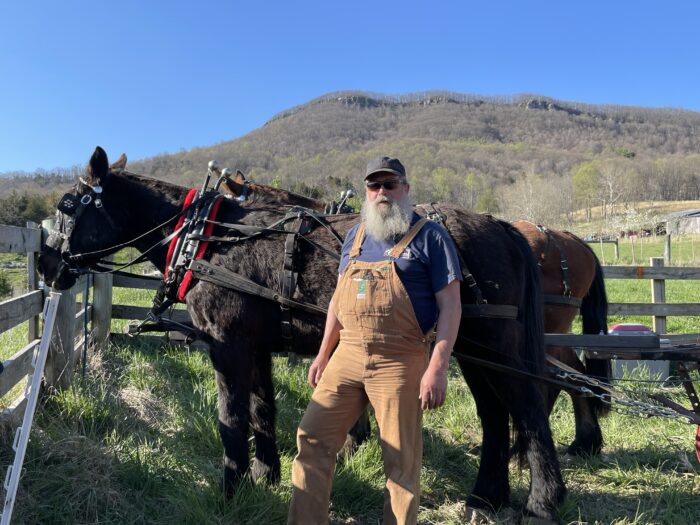
Now farming on the western end of Tazewell County, Virginia, at the foot of historic Paint Lick Mountain, Charlie Lawson uses Betty and Millie to prepare the ground for spring plantingConnie Bailey Kitts/West Virginia Public Broadcasting
Listen
Share this Article
A few people still farm the way folks did before tractors. We visit with farmers who still rely on real workhorses to get their work done.
Also, Kentucky artist Lacy Hale’s “No Hate in My Holler” screenprint may never go out of style. Appalachians are still telling her how much they identify with its message.
And a Virginia poet reflects on the importance of spoons and what’s helped his writing.
A family photo of Danny Wingate using a team of horses to plow his sister’s garden in Comers Rock, Virginia. Shortly after being interviewed for this story, Wingate passed away.
Workhorses On The Farm
Before the tractor, farmers in Appalachia relied on workhorses to plow fields and pull their wagons. In southwestern Virginia, the practice has mostly disappeared, often along with the farms themselves. But a few farmers never let go of farming with a horse.
Folkways reporter Connie Bailey Kitts had the story.
No Hate In My Holler
In Pound, Virginia, a mural depicts an old woman smoking a pipe and holding a baby wrapped in a big bright quilt. The mural honors midwife Nancy Mullins Shores and is part of a growing body of work by artist Lacy Hale. Her work also includes the viral image “No Hate in My Holler.” In 2022, Mason Adams spoke with Hale about her work, but also caught up with her recently.
Writer Jim Minick explores meanings in silverware, among other things in “The Intimacy of Spoons.”
Jim Minick And The Intimacy Of Spoons
Jim Minick made a career as a writing professor, teaching at colleges and universities in Georgia, South Carolina and southwestern Virginia, but he’s also the author or editor of eight books. His latest is a volume of poetry/collection of poems titled The Intimacy of Spoons.
Producer Bill Lynch spoke with Minick about Appalachian book festivals and writing about silverware.
------
Our theme music is by Matt Jackfert. Other music this week was provided by Ed Snodderly, James Michael Stevens, Morgan Wade, John Blissard, Tim Bing, Sierra Ferrell and Kaia Kater.
Bill Lynch is our producer. Zander Aloi is our associate producer. Our executive producer is Eric Douglas. Kelley Libby is our editor. Our audio mixer is Patrick Stephens. We had help this week from folkways editor Chris Julin. You can find us on Instagram and Twitter @InAppalachia.
You can send us an email: InsideAppalachia@wvpublic.org.
On this West Virginia Week, urban cryptids get us into the Halloween spirit, a researcher revives forgotten musicians and a conversation with a journalist covering data center development.
This week, data centers are rapidly expanding into rural parts of Appalachia, and folks say they are having trouble finding information about these projects. Also, artificial intelligence is disrupting human art, including fiber arts like crochet. And folks are pushing back, like they always have — with song.
Inside Appalachia this week explores data centers and artificial intelligence (AI). As part of this special episode, host Mason Adams spoke with Dan Parks, a journalist who writes a Substack called Country Roads News. He's been covering data center development in Tucker County. We listen to an excerpt.
Southern West Virginia has rich but often overlooked musical traditions. Chris Haddox is a WVU professor of sustainable design, but he's also spent years uncovering more information on those overlooked musicians. We spoke with him to learn more about his effort to shine a light on the musical talents of local miners, now with the help of a grant from the Mellon Foundation.